
Trusty: ‘Greater Transparency and Accountability’ Needed in FCC Funding Programs
The commissioner outlined her priorities for the agency at a Free State Foundation event Thursday.

Jake Neenan
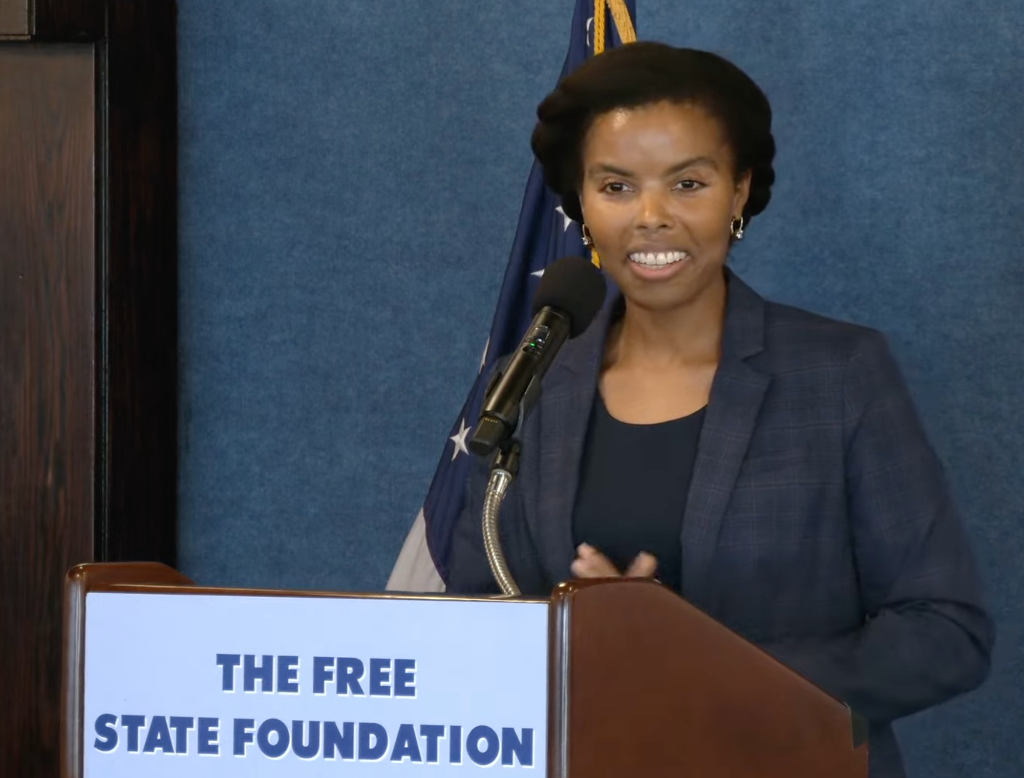
WASHINGTON, Sept. 18, 2025 – Olivia Trusty, the Republican Federal Communications Commissioner who took office in June, said Thursday the agency needed “greater transparency and accountability” in its funding programs.
She outlined her priorities for the agency at a Free State Foundation event at the National Press Club in Washington. Her three focus areas were universal connectivity, public safety and national security, and U.S. leadership in next-generation technologies, she said.
Universal connectivity
Broadband connectivity is “a workforce issue, and it’s a public safety issue, which is why it’s critical that we bring greater transparency and accountability to our funding mechanisms. Dollars must flow where they are needed most, not where they are easiest to administer,” she said. “It’s also why using all the available tools to reduce regulatory barriers that hinder broadband deployment is so important.”
The FCC administers the roughly $8 billion-per-year Universal Service Fund. The USF supports four programs that subsidize the construction and maintenance of rural broadband networks, as well as internet discounts for low-income households, rural healthcare centers, and schools and libraries.
Lawmakers are working on legislation to modernize the program, funded by fees on interstate and international voice revenue since 1997. Commenters gave them input earlier this week. FCC Chairman Brendan Carr has been supportive of adding some big tech companiy revenue to the contribtuion pool, so have ISPs.
Trusty didn’t detail which parts of the FCC’s funding programs needed reform.
Public safety
“Think about how reliant we’ve become on real-time alerts, from natural disasters to AMBER alerts, and other emergencies. Our systems must not only be fast, but trusted,” Trusty said.
The agency has an open docket on next-generation 911 systems, which locate callers more precisely, and on national emergency alert systems like the ones Trusty listed.
The FCC is also administering its Rip and Replace program, which reimburses smaller providers for ridding their networks of Chinese gear deemed security threats by lawmakers. Plagued by underfunding, it got a $3 million injection of cash late last year. Participants are supposed to file status updates to the agency Sept. 30.
“Engaging in greater collaboration with our intelligence and homeland security partners, and developing stronger tools to defend our networks from threats, will enhance our ability to respond when foreign actors seek to undermine our networks,” Trusty said.
Next-generation technologies
Trusty said the U.S. leading in 5G and 6G, Wi-Fi, satellite broadband, and AI would be important, both economically and to minimize the influence of adversarial nations who “view communications infrastructure as geopolitical leverage.”
“If we want America to lead in 6G, AI, and space-based networks, we must make spectrum available for commercial use, support research and development, incentivize private capital, and ensure American values are incorporated into international standards,” she said. “Other nations, particularly China, are racing to shape global standards and dominate emerging communications infrastructure.”
The FCC is looking into making swathes of new spectrum available to satellite operators, and removing power limits that companies say are hampering satellite broadband. The agency is also generally eager to get more spectrum in the hands of wireless carriers.
Carr pushed EchoStar, which he said wasn’t putting its spectrum holdings to good use, to sell $40 billion worth of licenses to AT&T and SpaceX in recent weeks. The re-auction of AWS-3 licenses is set to get underway before mid-2026.
Last week Arielle Roth, the head of the National Telecommunications and Information Administration, which handles federal spectrum, said the FCC should avoid disrupting the 6 GHz band widely used for Wi-Fi and push back “on Chinese attempts to redefine” the band at the World Radiocommunication Conference in 2027. China has allocated the band for licensed 5G and 6G use.





Member discussion