Up to 50 Million Jobs Could Be Vulnerable to AI
Bipartisan commission rejects universal basic income as policy response.

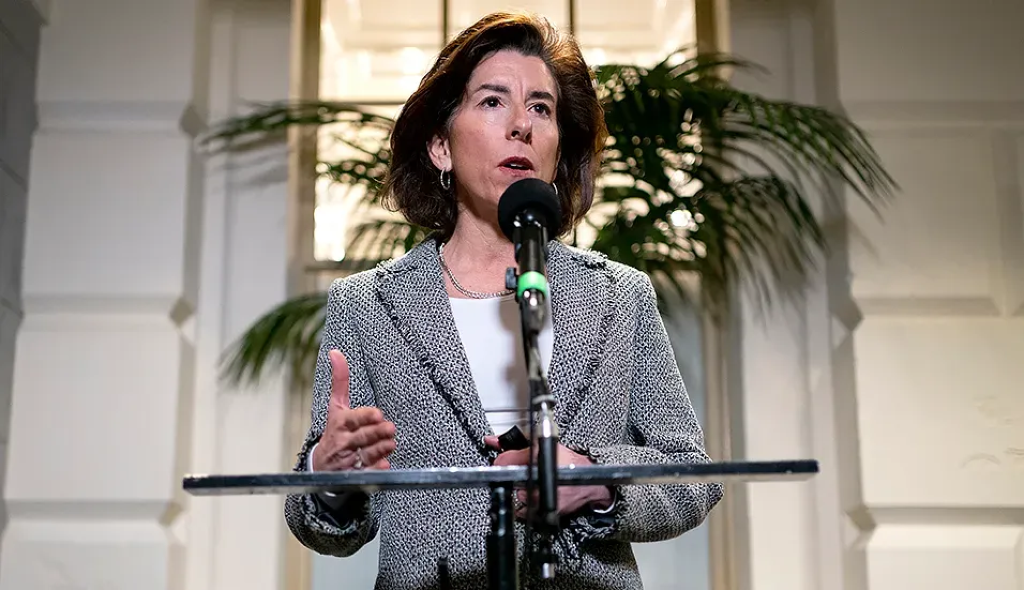
WASHINGTON, June 11, 2026 – Former Commerce Secretary Gina Raimondo rejected universal basic income as the desired response to artificial intelligence-driven workforce disruption.
Speaking at a Thursday event, Raimondo said the goal is for Americans to “flourish and prosper with work, by the way, not with a universal basic income, but dignified work.”

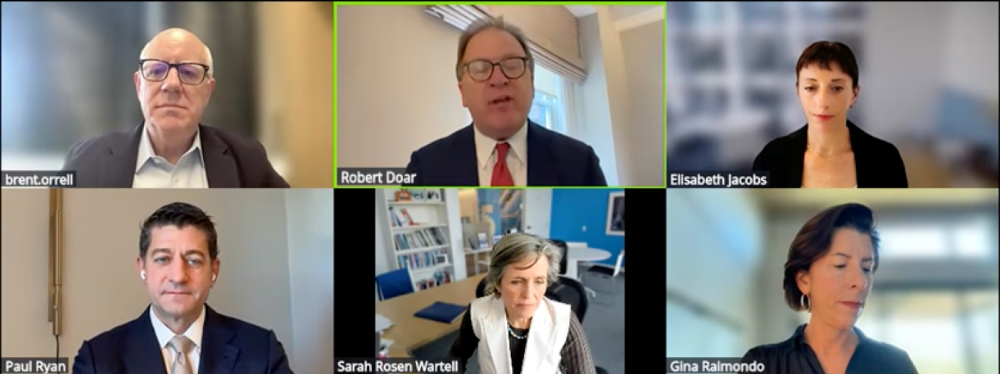
The event hosted by the American Enterprise Institute and the Urban Institute marked the launch of the Commission on AI and the Future of the American Workforce, a joint initiative of the two think tanks.
The bipartisan commission, co-chaired by Raimondo and former House Speaker Paul Ryan, will bring together leaders from business, labor, academia and government to develop policy recommendations aimed at helping workers and employers navigate the economic disruption expected from the rapid adoption of AI.
Organizers said the commission will focus on preserving employment and workforce participation as policymakers grapple with the potential labor market effects, noting that some estimates suggest as many as 50 million U.S. jobs could be vulnerable to artificial intelligence.
“The revolution of AI is here, and Washington, D.C. needs to quickly wrap its head around the specific policy challenges that is going to present this country for the American workers and for job creators,” Ryan said.
He also rejected that idea of a universal basic income.
“The entire focus of the commission is on employment, it’s on keeping people attached to the labor market and the labor force,” Ryan said. “We’re trying to come up with alternatives, so that UBI is not necessary and isn’t needed to be considered.”
“We must never allow technology to replace or overtake the value of the individual worker,” Ryan said.
Raimondo drew on her family’s experience during the China trade shock, noting her father lost his manufacturing job after 28 years, to argue that past policy failures were not about misunderstanding economics, but about failing to build a “bridge” to the next chapter of work.
“You can’t be blasé,” Raimondo said. “Ten to 15 million people will be without work. It will massively disrupt our country and our politics.”
“We are already seeing historic inequality – gains to capital, not to labor. I don't think this country can handle epic unemployment,” she said.
“If all we do is let AI create America's first trillionaires and not bring the rest of the country along, we have not succeeded,” Raimondo said.
Speakers said the economic impact of artificial intelligence remains uncertain. Whether the AI economy will see sustained and inclusive growth, further inequality with productivity gains benefitting only a few, or fall flat and leave the economy reeling, will be the impetus for quick and decisive action by policymakers.
“We have to get very serious right now in a bipartisan way to come up with new ideas,” Raimondo said.