
Virginia County Near D.C. Terminates Contract with All Points Broadband
APB CEO says Culpeper County pulled the plug on crews in the trenches.

Jericho Casper
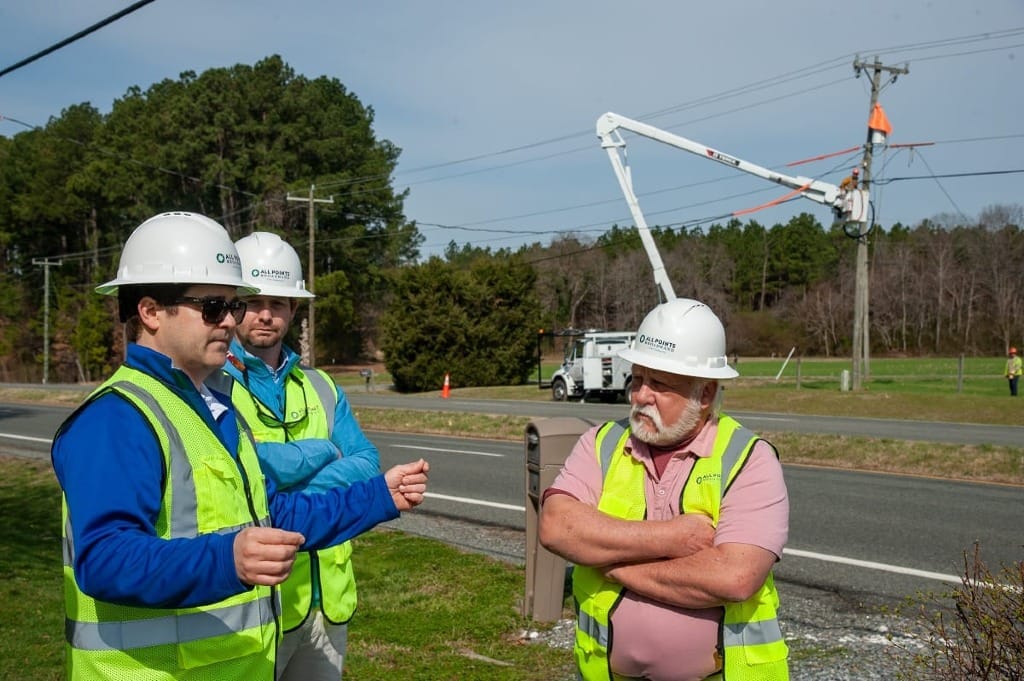
WASHINGTON, May 9, 2025 – Less than three years after All Points Broadband was contracted to build 536 miles of fiber to connect over 4,300 homes in Culpeper County, Virginia, the county issued a stop-work order “due to nonperformance,” halting the effort just as crews prepared to begin connecting individual homes.
“In Culpeper, we had a fully funded project that would be complete by the end of this year,” APB CEO Jimmy Carr told Broadband Breakfast in an interview Thursday. “We had 11 construction crews in market and we were preparing to bring more.”
The stop-work order came in early March, just as APB was entering the final stage of construction and days after Carr said the company requested formal confirmation from the county to release newly approved state funds.
“It's unfortunate, the county has chosen to forfeit more than $13 million in state funding and [more than $18 million] of private investment,” Carr said. “We feel for the residents of Culpeper, who are going to wait longer to receive fiber broadband than they otherwise would have to.”
An unraveling project
The project unraveled in stages, Carr said. First, a utility tripled the price to lease essential middle-mile fiber; then, APB was told to replace more than 80 percent of utility poles it needed to use; and finally, despite additional state funding to move the project underground, the county declined to accept the money, and shut the project down.
The first blow landed just days after Virginia announced the allocation for the project through the state’s flagship broadband expansion program, the Virginia Telecommunication Initiative, administered by the Department of Housing and Community Development (DHCD).
“When the grant application was submitted, our design was based on leasing middle-mile fiber from two electric utilities,” he said. “But one of them more than tripled the price per mile on a net present value basis. That was more than the project could bear, and so it required a pretty substantial redesign of the routing.”
Then came make-ready disputes. Carr said one pole owner insisted the company and the state replace 81 percent of the utility poles they applied to use, at an average cost of $75,000 per mile.
After months of negotiations – and a Virginia law modifying cost allocation rules for electric cooperative pole attachments – APB got the pole replacement demand reduced to 29 percent. But even then, Carr said, the project was looking at make-ready costs of $25,000 per mile, far above sustainable levels.
Moving deployment underground
“We made the decision that we needed to transition the project to a primarily underground deployment to get away from the cost and the delays associated with make-ready work in Virginia,” Carr said.
In Virginia, there’s been a tenfold increase in make-ready activity across the state compared to the previous year, putting enormous pressure on deployment timelines. The issue became so pervasive that in 2023, state officials created a $30 million grant fund to help providers transition aerial projects to underground fiber builds.
APB took advantage of that fund. “Last summer, we briefed the county publicly about our plan to transition the project from aerial to underground,” Carr said. In October and November, Culpeper County submitted applications on behalf of APB to the competitive grant program. By year’s end, 100 percent of those applications were approved.
That approval brought $7.4 million in additional state support for the project, with APB committing another $2.5 million in matching capital to secure the award.
“At that point, the state and the private sector were covering 84 percent of the total project cost,” Carr said. “The county’s share was just 16 percent.”
But despite the new funding, Carr said the county declined to formally accept the money.
“Before we mobilized even more construction crews, we asked the county for written confirmation that it would accept the additional funding,” Carr said.
A stop work order that stopped all work
But the confirmation never came. Instead, the next day, the company received a directive from the county attorney to stop all work on the project.
At the time, 11 construction crews were already working in Culpeper, with 65 miles of fiber installed and 80 miles of VDOT permits approved, Carr said.
APB had spent more than $10 million on design, permitting, and construction – and had $7.7 million in construction materials staged and ready, according to APB. The company also said it had secured $7.6 million in bonded permits, with another $15 million in permits submitted and pending approval.
“In projects like these, you always come across unexpected roadblocks and curveballs,” he said. “But every county that has selected All Points and worked with us to modify the original plan, when necessary, has seen a successful project come to completion.”
“We are building broadband [in] places that nobody else has tried to serve, ever,” Carr said. “If it were easy, it would have been done already.”
District supervisor called APB a ‘non-performing vendor’
County officials, for their part, have cited APB’s’ failure to meet construction benchmarks as the reason for terminating the agreement. In a public statement, they said the grant funding had expired “due to nonperformance,” and that continuing without “adequate progress on the ground” would risk further delays.
Salem District Supervisor Tom Underwood, a vocal critic of the project, was more blunt. In a social media post, he called APB an “awful non-performing vendor,” and said, “whenever you are in a truly toxic relationship with a company that does not believe performing is critical, get out.” Underwood previously described the project as “an abject failure.”
The project was supposed to be completed by Feb. 28, 2024, but the county requested the state extend the grant funding and timeline, creating a new completion date of Feb. 28 this year.
“During March and April, the county worked willingly with DHCD to attempt to find a method to preserve the state grant funds, but unfortunately these efforts have been unsuccessful,” county officials said via a press release.
Carr said APB has begun refunding customer deposits and reallocating construction crews to other projects across the state. As for the 65 miles of fiber already installed in Culpeper, he said the company was keeping its options open on how best to best preserve that investment.
Carr declined to comment on whether either party planned to pursue legal action.
Beyond Culpeper, APB has completed major broadband projects across Virginia, including a five-county regional build in the Northern Neck that wrapped earlier this year, as well as deployments in King William and Middlesex counties. Carr said the company currently has construction underway in four additional counties, with 53 third-party crews active across its Virginia footprint.






Member discussion