
WISP Speeds Rising, But So are Starlink’s, Ookla Says
The company predicted increased competition between the two for rural broadband subs.


WASHINGTON, Nov. 17, 2025 – Speeds are increasing among the larger wireless broadband providers, a new report from Ookla found. The research company noted SpaceX’s satellite service is also improving and could serve as a source of competitive pressure in the rural broadband market.
Ookla used its speed test data to analyze median download and upload speeds from eight of the largest WISPs from the first quarter of 2021 through the second quarter of 2025. Over that time, each of the companies saw improved speeds, especially download.
Starry, which uses proprietary hardware and licensed millimeter wave spectrum, came in the highest by a large margin with a median download speed of 202 megabits per second (Mbps), followed by Resound at 99 Mbps and Nextlink at 68 Mbps.
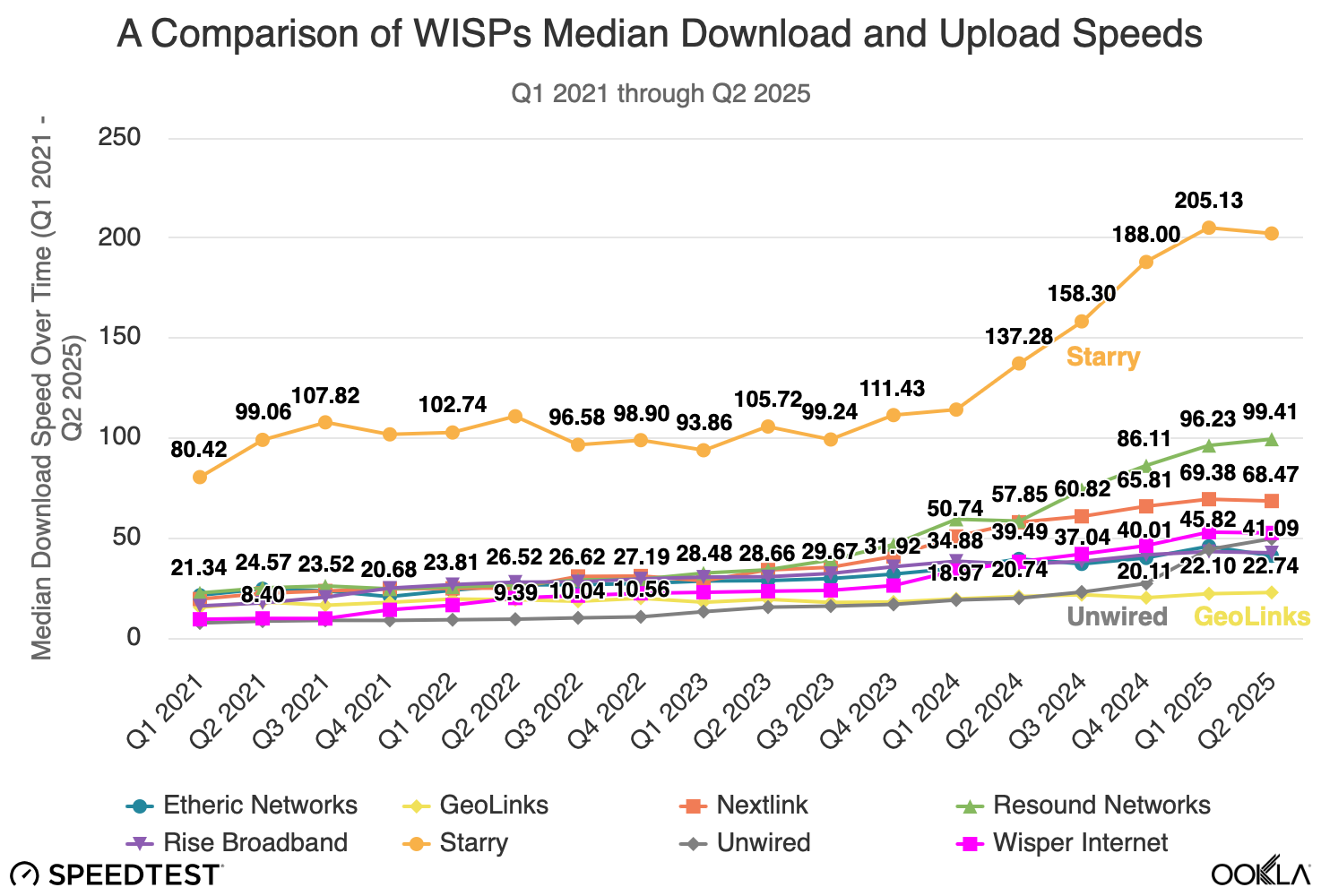
“It’s important to note that all of these companies vary greatly in terms of their spectrum holdings, their business models, their coverage areas, and their vendor equipment, which drives a large variance in performance outcomes,” wrote Sue Marek, Ookla’s editorial director and the author of the report. “Nevertheless, it’s notable that all eight of the WISPs we monitored improved their median download speeds during that time period.”
The analyzed WISPs include Starry, Resound Networks, Whisper Internet, Nextlink, Unwired, GeoLinks, Etheric, and Rise Broadband. In addition to fiber in some cases – fiber customers were excluded from Ookla’s analysis – they use different combinations of licensed and unlicensed spectrum, as well as some Citizens Broadband Radio Service airwaves, which use a tiered licensing system.
“While using unlicensed spectrum means that a WISP can launch services quickly without having to purchase costly spectrum licenses, it also means that congestion and interference can result in the WISP having to carefully manage demand for their services,” Marek wrote.
SpaceX’s low-earth orbit satellite broadband service has also been upping its speeds, according to a previous Ookla report, with median download speeds of 104 Mbps in the first quarter of 2025.
WISPs are likely to face increased competition from LEOs
With the Federal Communications Commission looking to help SpaceX increase its broadband performance via the agency’s satellite spectrum rules, and the nascent Amazon Leo (formerly Project Kuiper) service planning a launch later this year, WISPs are likely to face increased competition for rural broadband subscribers, according to Marek.
“To continue to play in the broadband space, WISPs need to try to secure more spectrum – licensed or unlicensed – to avoid network congestion and interference and also invest in network upgrades so their services remain competitive,” she wrote.
She noted SpaceX’s introductory service is still much more expensive than most WISPs’ at $80. The company did introduce a more competitive $40 plan last week that could help court customers put off by the historically higher prices – and higher upfront equpiment costs.
In the 49 states that have reported bidding results, WISPs were tentatively awarded 11 percent of the 3.6 million locations in line for Broadband Equity, Access, and Deployment program funding so far. Satellite services from SpaceX and Amazon are in line for another 20 percent.
As the Ookla findings show, both technologies can still struggle to meet BEAD’s minimum speed benchmark of 100 * 20 Mbps – a median download speed of 100 Mbps means half the speed tests conducted on the providers network came in below that.
Citizens Broadband Radio Service in the picture
In an effort to protect spectrum used by wireless ISPs, WISPA, which represents small and wireless broadband providers, has indeed been making a push to protect CBRS at the FCC. Some CBRS users and proponents were nervous the FCC would consider auctioning some of the airwaves to meet Congress’s goal of selling off 300 megahertz of nonfederal spectrum.
WISPA reiterated to the FCC in late September, just before the government shutdown, that it should avoid clearing even part of the general access (GAA) part of the band, the free-to-use tier that must accept interference from priority license holders and coastal Navy radars.
The agency “should consider other spectrum bands that will be less disruptive to widely deployed operations in rural communities and the consumers who rely on GAA for broadband connectivity,” the group wrote.
CBRS proponents have also marshalled support from GOP lawmakers in both chambers of Congress on the issue.
Starry is in the process of being acquired by Verizon, which is looking to boost its own fixed wireless offering for multi-dwelling units like apartment buildings, Starry’s specialty. The company’s millimeter wave spectrum, which it bought for $48 million in 2019, can offer high speeds but struggles to punch through obstacles like trees.








Member discussion