
WISPA to FCC: Don’t Sell General Access CBRS Spectrum
The group noted most CBRS devices are associated with at least one general access license.

WASHINGTON, Oct. 7, 2025 – The Federal Communications Commission should not consider auctioning a shared spectrum band as it looks to meet benchmarks set by Congress this summer, a trade group for wireless ISPs told the agency.
The sweeping budget legislation passed July 4 directs the FCC to sell off 800 megahertz to the private sector, 300 of which will come from outside the federal government.
“That should not come from CBRS,” wrote Louis Peraertz, WISPA’s VP of policy, bolding the words for emphasis. “It may seem attractive to cleave the upper 50 megahertz of spectrum, which is only used for General Authorized Access (“GAA”), from CBRS, but that also would be extremely destructive to existing users.”
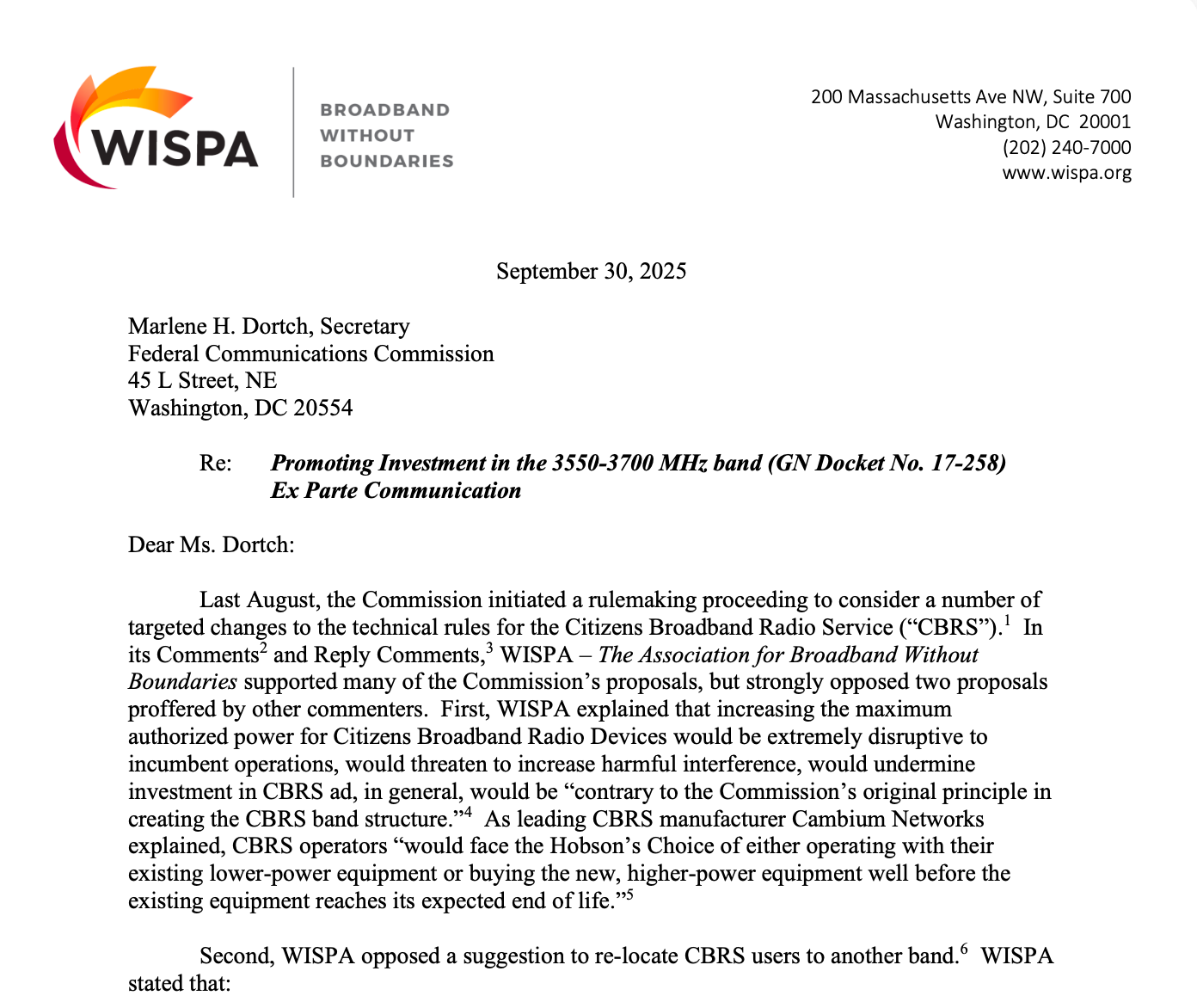
The law does not protect the Citizens Broadband Radio Service or the 6 GHz band from being sold, despite some drafts including the measures, causing users to fear some of the airwaves could be sold off.
The Sept. 30 letter filed by WISPA is focused on CBRS, which uses a tiered licensing system in the 3550-3700 MHz band. It comes after Trump administration officials have publicly sought to dispel concerns about the other band at issue, 6 GHz, which is unlicensed and used for Wi-Fi.
“A number of us in this administration were very intimately involved in designating that band,” Robin Colwell, deputy director at the White House National Economic Council, said of 6 Ghz last week at the 2025 SCTE TechExpo. “We fought to get it, and I don't understand why anybody would think we're trying to go back on that now.”
The head of Commerce’s National Telecommunications and Information Administration, which manages federal spectrum, has also urged the FCC not to disturb 6 GHz. The band was opened by the FCC in 2020 under the first Trump administration. The CBRS framework was established in 2017, and priority licenses were auctioned in 2020.
GAA users can access CBRS spectrum for free, and must accept interference from priority licensees and coastal Navy radars. He cited an NTIA report from last year that found more than 70 percent of all CBRS devices were GAA-only, and most using priority licenses also had a GAA license – nearly 95 percent of equipment in the band had at least one GAA license as of June 2024.
“As the Commission and NTIA begin the process of identifying 800 megahertz of spectrum for higher-power licensed use, they should consider other spectrum bands that will be less disruptive to widely deployed operations in rural communities and the consumers who rely on GAA for broadband connectivity,” Peraertz wrote.
Peraertz noted that about 11 percent of all tentatively awarded BEAD locations are in line for fixed wireless, including more than half of the eligible homes and businesses in Montana and Nebraska and more than 40 percent in Iowa and New Mexico.
“Notably, these are large rural states where the coverage and capacity benefits of CBRS can enable efficient deployment,” he wrote.
WISPA, like the cable industry and other users have done, also took the time to reiterate that raising maximum power levels in CBRS would also be “extremely disruptive,” by causing unworkable interference and forcing providers to replace equipment. The FCC took comment on the idea last year.
A group of ten Republican Senators also wrote to the FCC last month supporting both CBRS and 6 GHz.
The wireless carriers generally prefer the exclusive licenses their networks are built on, and the industry’s main trade group decried the FCC’s 2020 decision to make all 1,200 megahertz of the 6 GHz band unlicensed. AT&T and the Defense Department have proposed selling off part of CBRS and moving current users elsewhere.
Experts have noted it would be a complicated endeavor, as both bands are currently in use, and the FCC itself hasn’t indicated it has an appetite to upend either band.
The law does require 100 megahertz to be auctioned from the upper C-band, which the FCC was already interested in selling off. The carriers have said as much as 220 megahertz could come from the band, now occupied by video distribution companies that will have to repack.








Member discussion