
A Broadband Breakfast Spotlight on AI Infrastructure at CES2026
Artificial intelligence has dominated CES2026. Broadband Breakfast panelists probed the infrastructure and energy implications

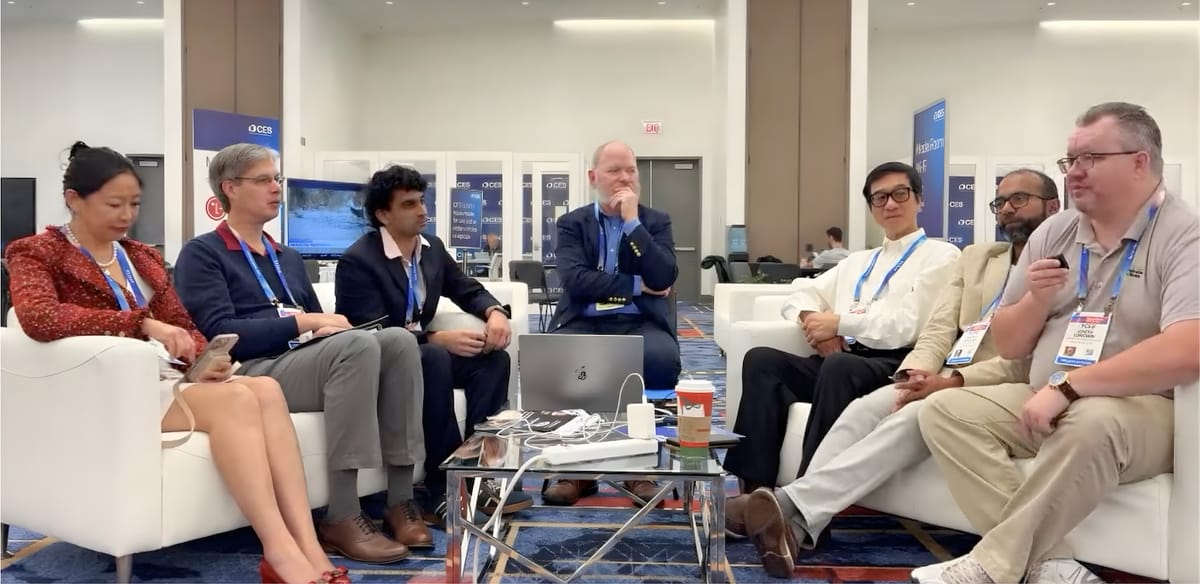
LAS VEGAS, Jan. 7, 2026 — Artificial intelligence is not just about software, but about digital infrastructure.
Highlights Reel:
That was the core message that a diverse set of experts from telecom, data centers, energy, finance, chip-manufacturing and journalism shared on Broadband Breakfast Live Online’s Wednesday webcast live from the Consumer Electronics Show here.
Jasmine Shih, a veteran venture capital investor with experience at Nvidia and Applied Materials, emphasized that "AI is not only just being processed. Its performance per watt is a primary goal."
 Broadband Breakfast
"CES 2026 made one thing unmistakably clear. We're no longer talking about AI and software. We're actually talking about AI and infrastructure," Shih said.
Other panelists discussed how new chip technologies promise dramatic improvements in energy efficiency even as AI deployment accelerates. Joseph Longway, owner of Longway Broadband Services, said chip-maker Nvidia's latest chips are going to reduce energy usage by 10x.
"The new chips that are coming out are going to reduce all that stuff by 10x, they're saying," Longway said.
Yet there were some notes of disagreement about the extent and consequences – including potential societal disruptions – from AI’s rapid advancement.
Full Video
For example, Aaron Rose, CEO of Lyman Communications, voiced concerns about growing economic disparities. "Just not everyone is living in tech," Rose said. "We saw when we had to do work from home and remote learning, a lot of people, even in Silicon Valley, do not have the technology, and we're seeing these jobs being disrupted."
Rose pointed to warnings from The Economist about capital expenditures "drastically increasing, and the return on investment doesn't look as promising."
Shafaq Abdullah, founder of AI Earth Fund, stressed the need for balanced development. "We are at a moment of this industrial revolution," Abdullah said. "Now we are potentially overbuilding the AI infrastructure without actually understanding [the importance of optimizing] energy needs."
The panel highlighted data center challenges, with Longway noting that even clients seeking a modest amount of megawatts of power face capacity constraints with energy.
Porter Wong, founder of the non-profit group Clean Leap, discussed his organization's work with nearly 3,000 startup applicants in the sustainability space. "Our national electric grid is not built for that," Wong said regarding AI's power demands.
On robotics, panelists noted rapid advancement in physical AI applications. "The physical AI is really going to bring the AI evolution to the front seat," Shih said. For example, Wong also mentioned seeing robots "everywhere in China, right, in a hotel, in a shopping mall."
Shih and most of the other panelists maintained optimism about technology's trajectory: "Everything they have done is help humans to be living better lives, better distributed resources. We will overcome it because AI is not human. The future belongs to humanity."






Member discussion