Accessibility, Consumer Groups Warn Against Scaling Back Broadband Transparency Labels
AARP cautioned the FCC against relying on ISPs’ characterizations of consumer behavior

Jericho Casper
WASHINGTON, Jan. 20, 2026 – A proposal to scale back federal disclosure requirements for Internet plans has drawn sharp criticism from accessibility organizations, consumer groups, and advocates for older adults.
Congress in 2022 directed the Federal Communications Commission to create standardized broadband “nutrition labels,” displaying prices, speeds, fees, and other key details.
Under new leadership, the FCC in October asked whether it should eliminate six disclosure requirements and how else it might “streamline the label requirements.”
Accessibility advocates warned Friday that the FCC’s rulemaking, which would close the agency’s inquiry into the matter indefinitely, risks “freezing requirements at a baseline” that fails to meet the needs of people who are disabled, vision or hearing impaired, or have limited English proficiency. The objections came as broadband providers urged the FCC to pare back the labels.
Among the provisions the FCC has proposed cutting were requirements that providers read labels aloud over the phone, offer them in multiple languages, and display them within customer online portals. The FCC’s rulemaking would also drop requirements that ISPs maintain machine-readable data on labels and archive labels for two years.
Broadband providers urged on the FCC's rollbacks
Broadband providers and industry trade groups, including NTCA, NCTA, WISPA, CTIA and USTelecom, urged the FCC to move forward with the majority of its proposed rollbacks, arguing that several of the existing disclosure requirements were costly, redundant, or unhelpful to most consumers.
However, AARP, representing 125 million Americans over the age of 50, cautioned the FCC against relying on ISPs’ characterizations of consumer behavior and urged the agency to weigh comments submitted on behalf of consumers. Responding directly to industry claims, AARP said providers failed to demonstrate or quantify any undue burden associated with complying with the existing broadband labeling rules.
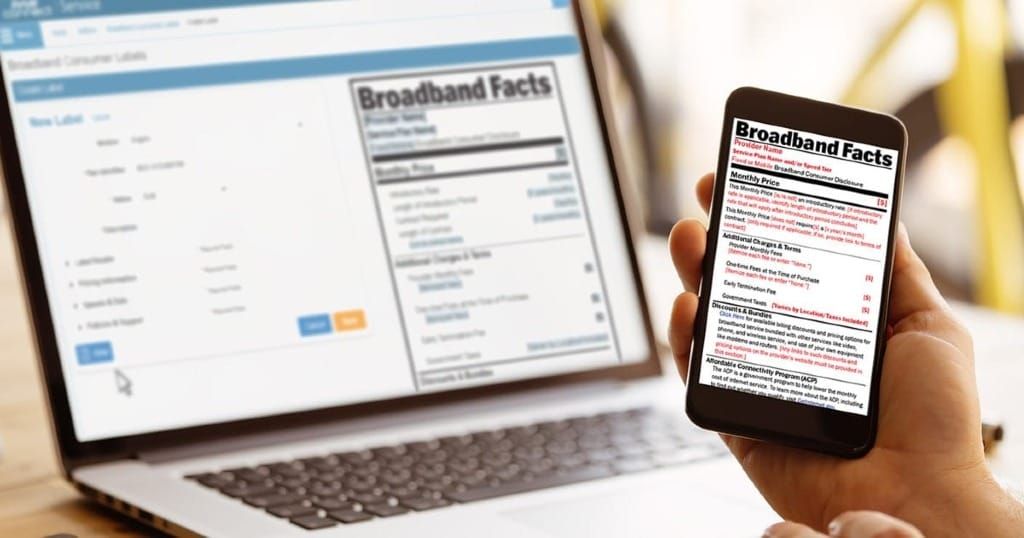
Adding to the record, accessibility groups, including Deaf Equality, told the FCC in comments that customer portals were essential for consumers who manage their broadband services using screen readers, captions, or voice interfaces. “Removing this requirement would eliminate a consistent access point for consumers who rely on digital accessibility tools,” the groups said.
Advocates for minority groups, including Asian Americans Advancing Justice, emphasized the importance of “retaining the essential multilingual requirement and continuing to provide over the phone and online account portal access to broadband labels,” in comments.
The Utility Reform Network weighed in, emphasizing that machine-readable label data was essential for research on broadband affordability and public oversight.
TURN said the FCC’s “reliance on vague industry comments that machine readability increases technical complexity and cost – without evidence of widespread use or benefit to consumers – is unfounded.”
The Schools, Health & Libraries Broadband Coalition and the Consortium for School Networking argued broadband labels are especially important for participants in the E-rate and Rural Health Care programs.
Industry argues 2022 rulemaking exceeds congressional intent
However, industry groups argued that several of the existing label requirements were unnecessary, duplicative, or exceeded Congress’s intent.
Wireless industry group CTIA told the FCC that reading a complete label aloud over the phone was “not useful to most consumers and should not be required,” but supported the policy that labels be displayed in any language in which a provider markets its service.
Trade groups including USTelecom and NCTA argued that the 2022 broadband label rules went beyond what Congress directed and called on the FCC to decline adopting any remaining proposals from the earlier rulemaking.
WISPA similarly urged the FCC to simplify, rather than expand, label requirements, and said any new obligations should be optional or flexible.
After an initial delay caused by the government shutdown, the FCC extended the comment deadline by 14 days after New America’s Open Technology Institute, Public Knowledge, the Benton Institute for Broadband & Society, and TURN filed a motion arguing additional time was needed to adequately assess the FCC’s proposed changes.
Stakeholders’ replies on the matter will be due Feb. 16.
Member discussion