
Affordable Connectivity Program Reached More Than Twice the Families of Lifeline
At Georgetown panel, researchers credit public-private partnerships for ACP's 43% take rate vs. Lifeline's 20%.

WASHINGTON, Sept. 15, 2025 – Why is it that households eligible for an income-based federal program don’t take advantage of it?
Only 20 percent of eligible households use Lifeline and fewer than one in five enroll in the Low Income Home Energy Assistance Program, yet the Affordable Connectivity Program drove take-rates of about 43 percent, more than twice as high.
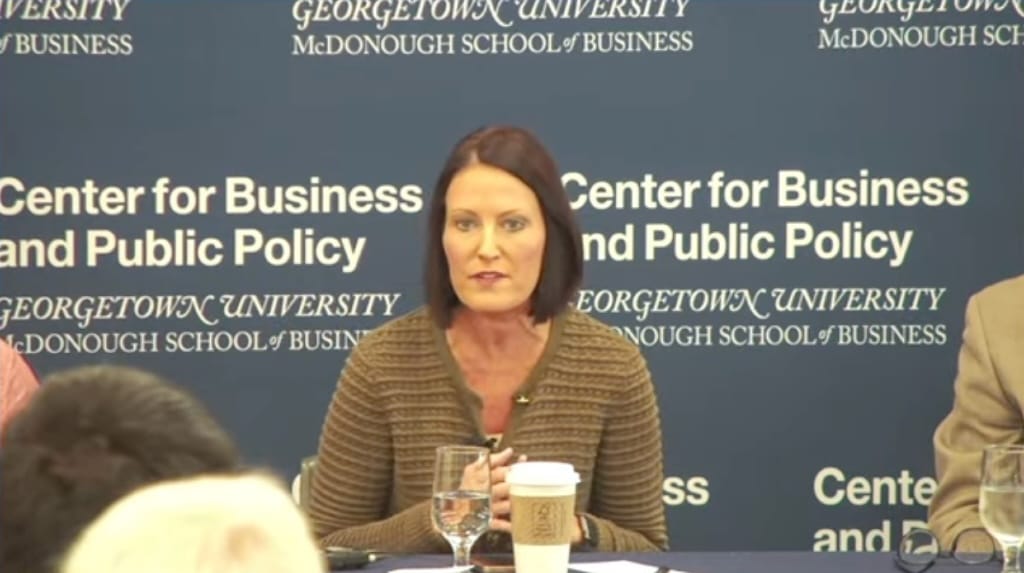
At a Georgetown University event Monday on Capitol Hill, a panel of economists and public policy experts said the contrast underscores how program design choices can make or break adoption of federal subsidies.

A report by Georgetown professors John Mayo and Jeffrey Macher, along with economist Timothy DeStefano – two of whom were on Monday’s panel – helped frame the discussion. Titled “Beyond Participation,” the analysis found that ACP’s higher take-rates were closely tied to strong partnerships between private providers, local governments, and trusted third-party outreach actors.
“From the start, the FCC required participating internet service providers to actively engage with local government and non-governmental organizations to try and promote the policy,” DeStefano said. “In addition to that engagement, we know that the FCC also worked [those] organizations to have outreach programs to drive uptake.”
“Finally, the FCC also designed a program called the FCC outreach grant program, which provided financial support to local organizations on the ground that could then use that financial money to help promote the policy to potential eligible households,” DeStefano detailed.
Large ISPs and county governments boosted ACP sign-ups
The researchers found that large internet providers and county governments boosted ACP sign-ups significantly, while smaller providers had a lesser effect. Counties with stronger local government staffing also saw higher participation.
President of Heartland Forward Angie Cooper credited ACP’s unusually high participation to those same requirements for local engagement.
She noted that the FCC directed dollars to community-based groups that already had the trust of residents. Those “digital navigators,” Cooper said, were often the difference between households hearing about ACP and actually signing up, because they reached people in familiar places like schools, churches and neighborhood centers.
Her group was one of many that drove enrollment in the $14.2 billion ACP, and the program’s predecessor the $3.2 billion Emergency Broadband Benefit, during the pandemic.
Cooper recalled hosting a webinar with more than 100 people at the program’s rollout and pushing the FCC to rethink its reliance on online sign-ups. “I said, ‘oh, no,’ we're trying to get in touch with people that don't have access to the internet,” she told the audience.
Her organization responded with billboards, radio ads, and flyers through schools and community groups. “Because of that engagement, we in the heartland were able to help 100,000 folks get signed up for the program,” she said.
Heartland Forward partnered with Latino advocacy groups
Later, Heartland Forward partnered with the Latino advocacy group, the League of United Latin American Citizens, to address information gaps. “Through that initiative, we were able to help 380,000 people get information, and about 230,000 of those we know, actually then signed up for the program,” Cooper said.
Scott Wallsten, president of the Technology Policy Institute and a former economic director of the National Broadband Plan, said “targeted efforts like ACP tend to be more effective at getting people online than broader subsidies such as Lifeline.”
But he also argued the program’s design created distortions. Many of those who enrolled were already connected, he said, and the $30 monthly subsidy pushed cheaper entry-level internet plans out of the market.
He pointed to past FCC experiments showing that even at a price of zero, many eligible households did not enroll. That same study showed some were willing to pay more just to avoid taking digital literacy classes.
Adoption, he argued, hinges on more than affordability alone: it depends on trust, program design, and respect for how people value their time.
Wallsten said future programs will need more evidence to succeed. “We do need more work to understand the price elasticity of demand,” he told the audience. “We need to continue to experiment, and be open to results.”
DeStefano emphasized that persistent barriers remain across all means-tested programs.
“These include information costs… transaction costs… and finally, we know that many households see applying for benefits as a stigma to their household,” he said, “which can also act as an impediment to signing up for it.”




Member discussion