
Amazon Leo Launch Delayed Again as FCC Deployment Deadline Looms
FCC chairman advises the company to address the more than 1,000 satellite shortfall amid launch setbacks.

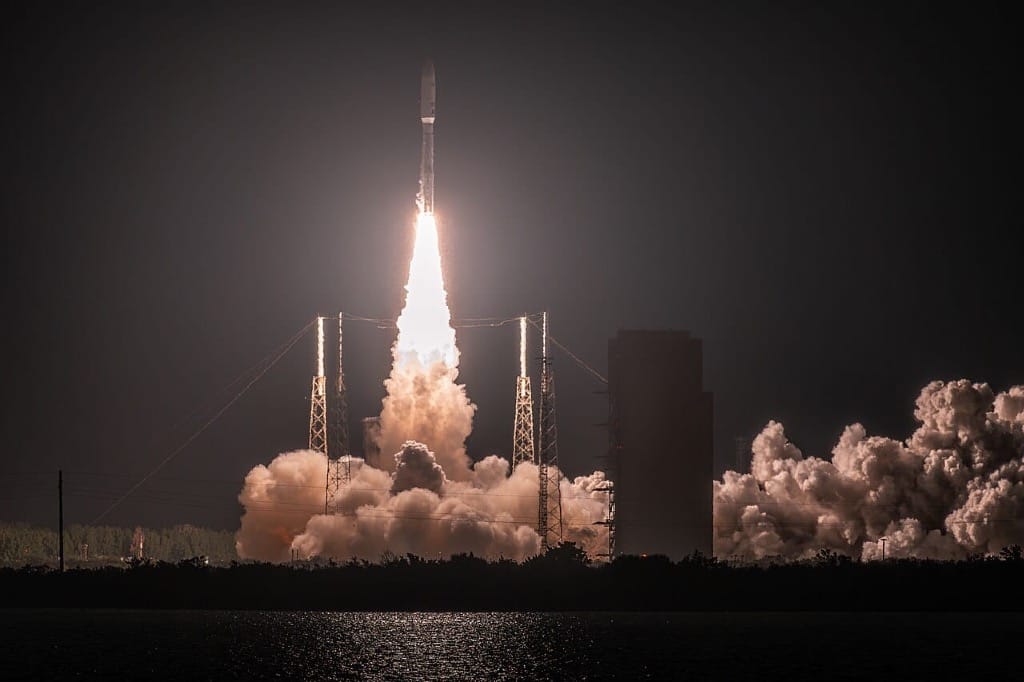
WASHINGTON, March 30, 2026 – Amazon Leo, formerly Project Kuiper, has delayed its fifth launch in partnership with the United Launch Alliance, citing inclement weather.
The mission, designated LA-05 (Leo Atlas 5), was set to lift off from Cape Canaveral Space Force Station on Sunday, but now joins a list of scheduled setbacks that threaten the company’s ability to meet federal deployment deadlines.
“Due to predicted inclement weather, the fifth launch of the United Launch Alliance (ULA) Atlas V 551 rocket carrying the next batch of production satellites for Amazon Leo, Leo 5, has been delayed,” ULA announced.

“The launch vehicle and spacecraft are healthy. A new launch date will be provided upon finalization of range approvals and deconfliction with the NASA Artemis II launch,” the release stated.
The Amazon Leo program, a low-Earth orbit satellite network designed to enhance global internet access, now has 212 satellites in orbit.
While the company has additional missions scheduled for April, including LA-06 (Leo Atlas 6) with 29 satellites and LE-02 (Leo Europe 2) with 32 satellites, the cumulative deployments still fall drastically short of the Federal Communications Commission’s requirements.
The FCC has granted Amazon satellite milestone extensions around 20 times previously, and the company filed another request for extension in February.
The initial program milestone mandated that Amazon deploy 1,618 satellites by July 30, 2026. Even with the current proposed missions, the company would still fall short of that target by 1,316 satellites.
According to previous company statements, the delays are related to launch vehicle availability from third-party providers, including ULA, Blue Origin, and ArianeGroup, and necessary prototype ‘reengineering’.
Earlier this month, Amazon Leo filed a denial request with the FCC opposing SpaceX’s proposal to launch a constellation of one million satellites for a data center network. Amazon argued the plan would harm global competition and lacked technical feasibility.
The move drew comments from FCC Chairman Brendan Carr.
In a post on X on March 11, Carr advised the company to focus on its own compliance, stating, “Amazon should focus on the fact that it will fall roughly 1,000 satellites short of meeting its upcoming deployment milestone, rather than spending their time and resources filing petitions against companies that are putting thousands of satellites in orbit.”
With the July 30 deadline approaching and the latest launch delayed indefinitely, Amazon Leo faces an increasingly narrow path to meeting its deployment obligations.








.jpg)
Member discussion