
At Mobile World Congress, Attendees Flag AI, Tech Sovereignty, and Geopolitics
A global telecom cold war as 70 percent of AI computing infrastructure sits in the U.S., but Chinese equipment vendors are ascendant elsewhere

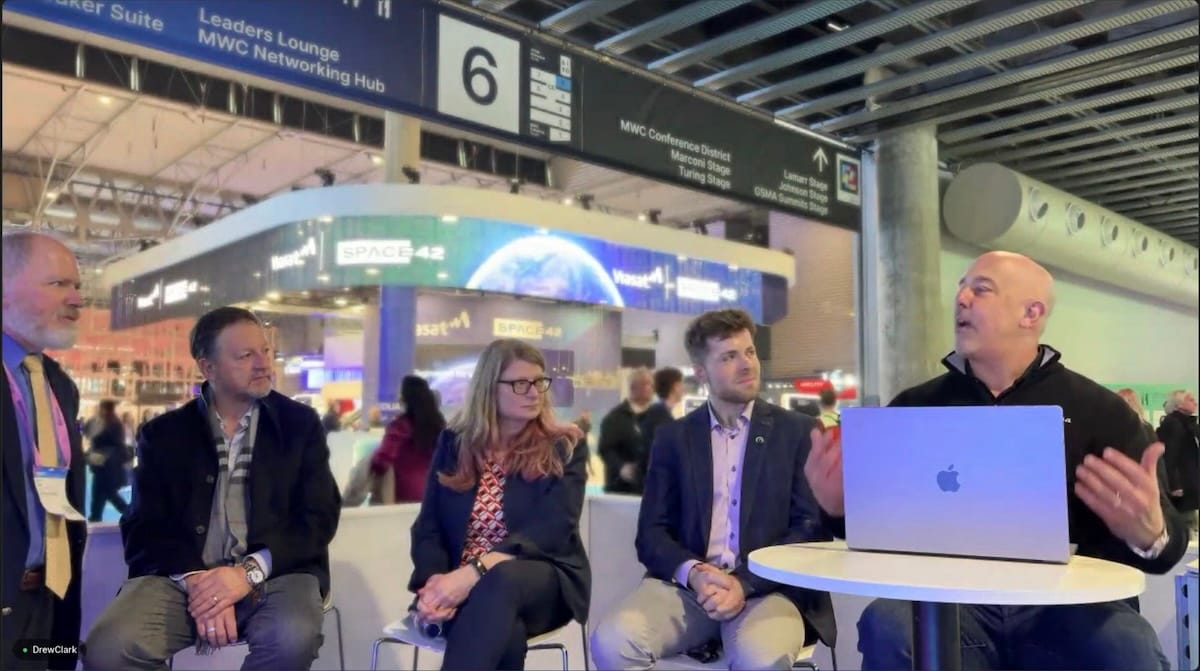
BARCELONA, Mar 5, 2026 — Telecommunications industry leaders gathering at Mobile World Congress here this week highlighted many of the themes emerging from the largest global communications event, including AI, digital sovereignty, the elusive "killer app" for 5G, plus an emerging global cold war over telecom equipment.
Drew Clark, CEO of Broadband Breakfast, moderated a live panel Wednesday from the conference floor in Barcelona, where he was joined by executives from Mimosa Networks, Ookla, InkBridge Networks, and Dentons law firm.
Jim Nevelle, senior vice president and general manager of equipment provider Mimosa Networks, said the overwhelming message from the conference floor was one of unmet demand.
 Broadband Breakfast
"It's turning into a, not just a desire, it is a demand that people have this," Nevelle said of global internet connectivity. "It doesn't matter what corner of the planet you're on. Everyone now has that need, that desire."
Nevelle, a MWC veteran of more than a decade, said carriers are increasingly looking beyond efficiency gains toward new revenue streams. "Optimization has occurred. Now people are looking for how do I expand my business? How do I grow?" he said.
 Broadband Breakfast
Luke Kehoe, industry analyst at Ookla, said the most striking development at this year's conference was European telecom operators pivoting aggressively toward digital sovereignty.
"European telcos are really leaning into government demand for sovereign European built solutions where there's control of all of the different dependencies in networks," Kehoe said.
Kehoe also noted that satellite connectivity dominated announcements, with major European carriers including Telefonica striking partnerships with SpaceX's Starlink. On the question of 5G's trajectory, he offered a pointed observation: "6G needs AI, but AI doesn't need 6G."
Jana Sedive, vice president of customer experience at InkBridge Networks, pushed back on the conference's AI hype, arguing that the technology is most valuably deployed at the operational rather than consumer-facing level.
"You want AI to be the turbocharger, not the engine," Sedive said. "You can't use AI to mask for engineering."
Sedive also flagged a geopolitical surprise that emerged during the conference: Some network operators are reportedly considering moving toward Chinese equipment vendors previously identified as supply chain risks, reasoning that at least those vendors are predictable, she said.
"It's a very interesting risk calculation," Sedive said. "I was very surprised to hear it."
"There were some people talking about using some vendors who have been identified as a supply chain risk in many countries, including Canada and the U.S., and people are talking about derisking by going to those vendors because at least they're not erratic," Sedive said. "It's a very interesting risk calculation, and I was very surprised to hear it."
A telecom cold war
The remarks underscored a stark disparity in how the global telecom market operates outside North America, where Chinese vendors banned from U.S. networks remain highly visible players, even as roughly 70 percent of global AI computing infrastructure sits in the United States compared to just 5 percent in Europe.
Todd Daubert, a partner at Dentons Global Technology Media and Telecommunications with more than two decades of MWC attendance, raised alarms about the governance vacuum surrounding agentic AI systems.
"You can have a whole series of agents that are talking to each other, and nine out of them can be governed properly and solid and really done. And then you can have one that isn't. And that one can bring down everything," Daubert said.
He argued that governments should set boundaries rather than prescribe solutions. "Regulation needs to be done in a way that creates a stable platform to enable the benefits of technology," he said.


Member discussion