Bartlett Cleland: The Market Is Already Solving Dead Zones; BEAD Shouldn't Fund Them
Now that the big three carriers are jointly building satellite direct-to-device coverage, BEAD should stop chasing rural mobile and stick to connecting unserved homes.


The recent announcement that AT&T, T-Mobile, and Verizon will jointly advance satellite direct-to-device (D2D) technology should settle an ongoing debate over the $42.5 billion Broadband Equity, Access and Deployment (BEAD) program. Whether taxpayer dollars should be diverted to subsidize mobile coverage in rural areas now has a clear answer. No.
Some advocates have pushed to stretch the program beyond its core mission of connecting unserved homes and businesses to include mobile coverage and wireless infrastructure. Their arguments were always weak, and now market realities have fully dismantled them.
The nation's three largest carriers are actively deploying satellite direct-to-device technology that could make traditional “dead zones” largely obsolete. When terrestrial coverage drops, smartphones will increasingly connect directly to satellites, extending service into areas once considered unreachable. What policymakers had previously treated as a persistent market failure is quickly becoming a target of private-sector innovation. That is innovation inspired by need just as free market advocates love.
That shift matters because public subsidies are most defensible where markets cannot, or will not, deliver. Here, carriers face strong incentives from competition, merger commitments, and consumer expectations to expand coverage. T-Mobile remains bound by its commitment to reach 99% of America with 5G coverage. Verizon and AT&T face similar pressures, and they are investing accordingly.
This too is exactly what a healthy, functioning market should look like. Companies invest in innovation, compete for customers, and deliver solutions. Government's role is to set the rules of the road and maintain competition, not to subsidize outcomes the private sector is already racing to achieve.
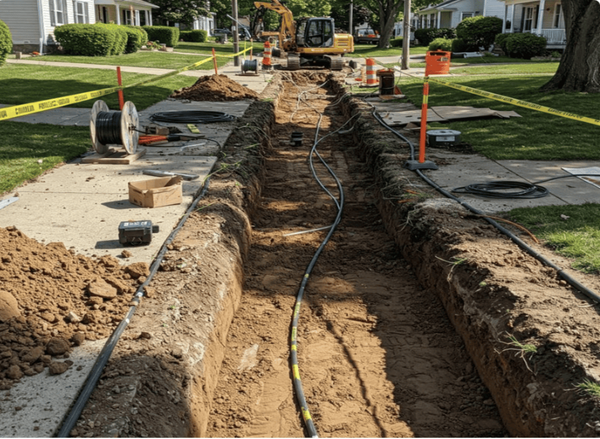
Beyond duplicating private investment, redirecting BEAD funds toward mobile infrastructure would undermine the program's core strength: precision. BEAD, unlike other programs, was designed to identify specific unserved locations and direct funding to connect them with reliable, high-speed broadband. Expanding its scope invites the kind of overbuilding and waste that have plagued past federal broadband efforts.
Consider the Universal Service Fund (USF). The Fund began with a narrow purpose, subsidizing telephone service, and grew into a sprawling subsidy regime financed by a tax on every American's phone bill. Federal connectivity programs have a habit of expanding well beyond their original intent, to the point where they become essentially unrecognizable from their original purpose. BEAD should not follow that path.
Meanwhile, BEAD's core mission still remains unfinished. Millions of Americans, particularly in rural and tribal areas, are still waiting for the reliable, high-speed broadband that BEAD was created to deliver. That is the problem Congress set out to solve, and every dollar diverted to mobile coverage is a dollar not spent connecting those households.
Public policy works best when it complements market forces rather than trying to override them. BEAD should stay focused on what it was built to do and leave dead zones to the companies already working to erase them.
Bartlett Cleland serves as Executive Director for the Innovation Economy Alliance. Bartlett’s decades of work on technology and innovation in public policy have been informed by his broad array of work and education outside of traditional public policy channels. Whether relying on his business background of MBA, work at a human resources consulting firm or as a CEO, he seeks to make every policy debate relevant to what happens to real people and to real business. He has spent decades working for public policy think tanks, technology trade associations, social welfare organizations and on Capitol Hill. This Expert Opinion is exclusive to Broadband Breakfast.
Broadband Breakfast accepts commentary from informed observers of the broadband scene. Please send pieces to commentary@breakfast.media. The views expressed in Expert Opinion pieces do not necessarily reflect the views of Broadband Breakfast and Breakfast Media LLC.