California Rep. Calls for Guardrails as Preemption Fight Shapes AI Talks
Ted Lieu, D-Calif., said state rules not ideal, but unavoidable until Congress sets baseline protections.

Akul Saxena
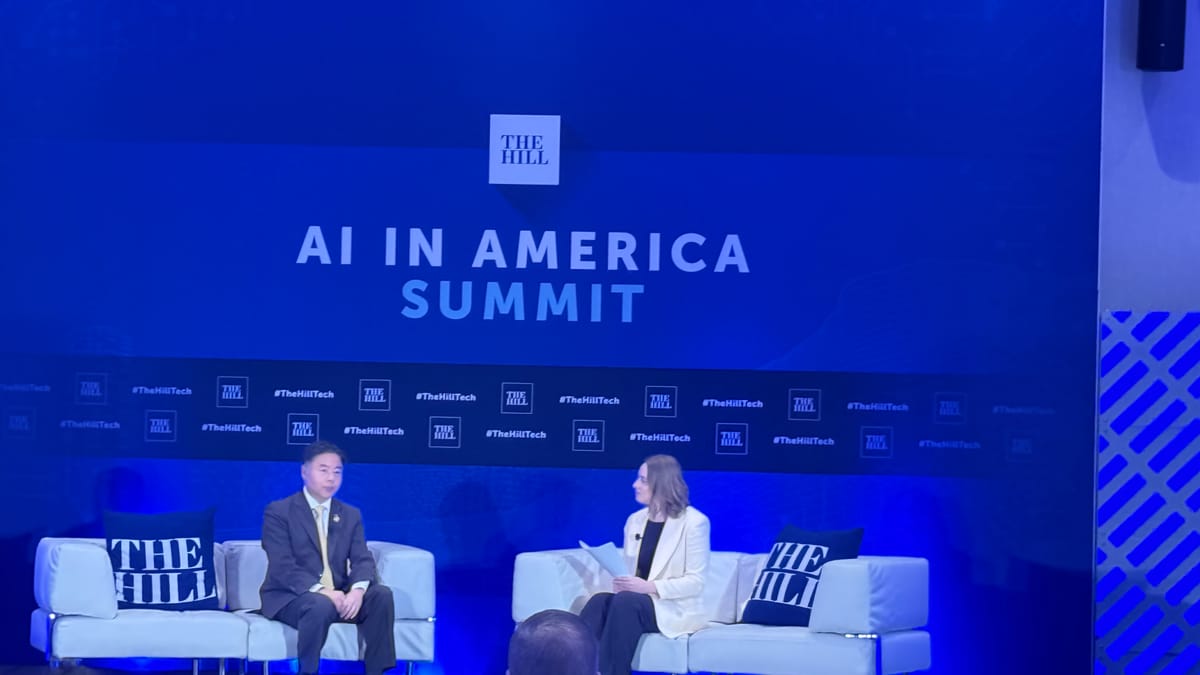
WASHINGTON, Dec. 3, 2025 – Rep. Ted Lieu, D-Calif., said Wednesday he isn’t opposed to federal preemption efforts on state AI regulation – but urged a “reasonable standard” before preempting state artificial intelligence laws.
“It can’t simply be replaced with nothing,” Lieu said at a summit on AI by The Hill.
Lieu highlighted more than 17 states advancing child safety, synthetic media, and transparency laws. Such a state-by-state patchwork is “not ideal” and is inefficient, he said, but without a national framework, states are justified in stepping in.
He derided the Trump administration for its efforts to twice attempt to impose a 10-year federal freeze on state AI laws: First in the budget reconciliation measure in the summer, and more recently in failing to secure its inclusion in National Defense Authorization Act, the annual defense measure.
Lieu, co-chair of the House Bipartisan Task Force on Artificial Intelligence , noted that the first approach failed in the Senate by a 99–1 margin.
The second attempt to insert the same moratorium into the defense bill through a leadership letter also appeared unsuccessful, saying the provision “was not going to get in.”
Working to develop a comprehensive AI bill
Lieu said he was developing a comprehensive AI bill by combining proposals with bipartisan support, including testing-disclosure requirements to make clear when automated systems - not human actors - are generating outputs or information. He said transparency represented one of the clearest areas of cross-party consensus.
He warned that access to frontier-scale AI models, the most advanced general-purpose models, remains limited to a few private companies.
Lieu said neither the Department of Defense nor academic researchers should be able to use the most advanced systems unless developers voluntarily grant access, calling the arrangement a long-term risk for national security and scientific progress.
He backed the National Artificial Intelligence Research Resource, a federal initiative designed to provide computing capacity and data resources to government and universities.
Lieu also cited early signs of workforce disruption tied to AI deployment. He referenced the most recent release of the Automatic Data Processing National Employment Report, a monthly measure of private-sector job activity, which showed 32,000 losses in November when analysts had expected gains. He said companies are learning they “can complete work with fewer employees,” warning that shrinking job openings may mark the first stage of automation-driven displacement.
Lieu said analysts were already linking part of the shortfall to artificial intelligence, noting that some firms may be postponing hiring or discovering they “can do tasks with nine people instead of ten,” a shift he described as an early indication of changing labor demand.
Lieu said there he remained hopeful about AI’s long-term benefits, citing breakthroughs in scientific research such as rapid protein-folding advances that once required years of work.
Member discussion