Carriers Finalize Direct-to-Device Spectrum JV
Announced in May, the deal was seen as a ‘shot across the bow’ at SpaceX


WASHINGTON, Oct. 1, 2025 – Nearly five months after announcing plans to pool their spectrum resources for direct-to-device satellite use, the big three mobile carriers have finalized their joint venture.
The JV will be led by Paul Roth, a longtime AT&T executive, while the companies search for a permanent CEO, they said in a release Thursday.

When they outlined plans for the JV in May, the carriers said they were combining their rural spectrum resources and creating a platform for satellite operators to use those airwaves for direct-to-device mobile service outside the reach of their terrestrial networks.
Industry analysts saw the JV at the time as a “shot across the bow” at SpaceX, which is by far the furthest ahead with its direct-to-device plans. The partnership would both make it easier for another satellite company to compete with SpaceX, they said, and reduce the odds of one carrier breaking rank and giving the satellite operator a deal to sell service on their network.
“Through combined investment by the three JV partners, provider options will expand, and, as a first step, direct-to-device (D2D) access will improve,” the companies said in a release. “This will enhance competition as consumer choices grow in satellite service. Emerging communications technologies can be more easily and quickly developed and launched to enhance customer experience.”
T-Mobile already has a deal to offer direct-to-device with SpaceX, and AT&T and Verizon have a similar arrangement with AST SpaceMobile. The companies said Thursday individual deals like those wouldn’t be affected or prohibited by the JV.
The carriers also said Thursday that the JV would work with smaller rural carriers to “enable them to bring new products to market for their customers” and help them “deploy innovative new services for customers more quickly.”
When the JV was announced in May, the Rural Wireless Association was apprehensive. The group said the partnership would lead to big carriers pulling out of roaming deals with smaller providers, effectively running them out of business and leaving their customers with only direct-to-device service offered through the JV.
RWA did not immediately respond to a request for comment Thursday.
SpaceX’s current direct-to-device service with T-Mobile is powered by about 650 satellites. The company has asked the Federal Communications Commission to launch 15,000 units to power its next-generation direct-to-device service, which would use SpaceX’s own spectrum it’s acquiring from EchoStar.
Amazon has asked the FCC for permission to launch 5,100 satellites to support a direct-to-device service, which would also use exclusive spectrum the company is acquiring through its purchase of Globalstar.
In addition to AST’s plans to offer service through carrier partnerships, the company is asking for FCC permission to use Ligado’s exclusive direct-to-device spectrum for a future constellation. AST is behind schedule on its current constellation but is hoping to start service later this year.
SpaceX’s mobile ambitions
SpaceX executives said on the company’s earnings call in August that the company is planning to compete directly with the major carriers.
They described placing tiny radios on mounts already holding dishes for SpaceX’s Starlink home broadband service. Analysts were skeptical of the idea.
“Consensus has increasingly concluded that w/o terrestrial spectrum, physics constrain SpaceX's ability to deliver seamless, nationwide mobility,” Wolfe Research analyst Peter Supino wrote in a Tuesday investor note. “We don't think Starlink Mobile is ‘dead’ but will require acquisitions in coming FCC spectrum auctions to change skeptics' minds… and potentially open the MVNO door.”
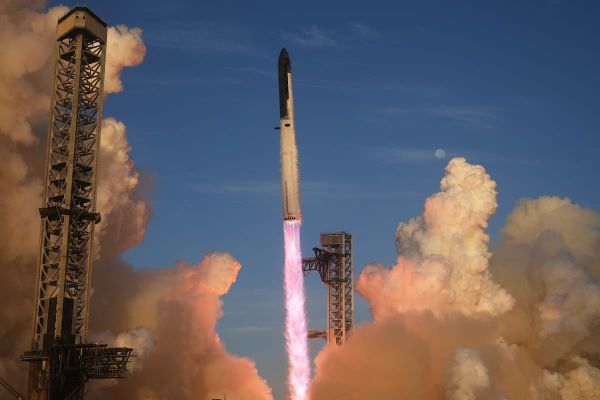
This week, SpaceX completed the fourteenth test flight of its massive Starship rocket, which deployed new, larger Starlink satellites into orbit. The company is aiming to make Starship fully reusable, which would make launches significantly faster and cheaper.
The Wall Street Journal reported last month that SpaceX had stopped accepting launch orders on its current Falcon 9 rocket after 2028.