
FCC Chair Offers Few Specifics on Universal Service Reforms
NTCA’s Bloomfield worries Carr’s push for USF ‘efficiency’ could hurt rural providers

Jericho Casper
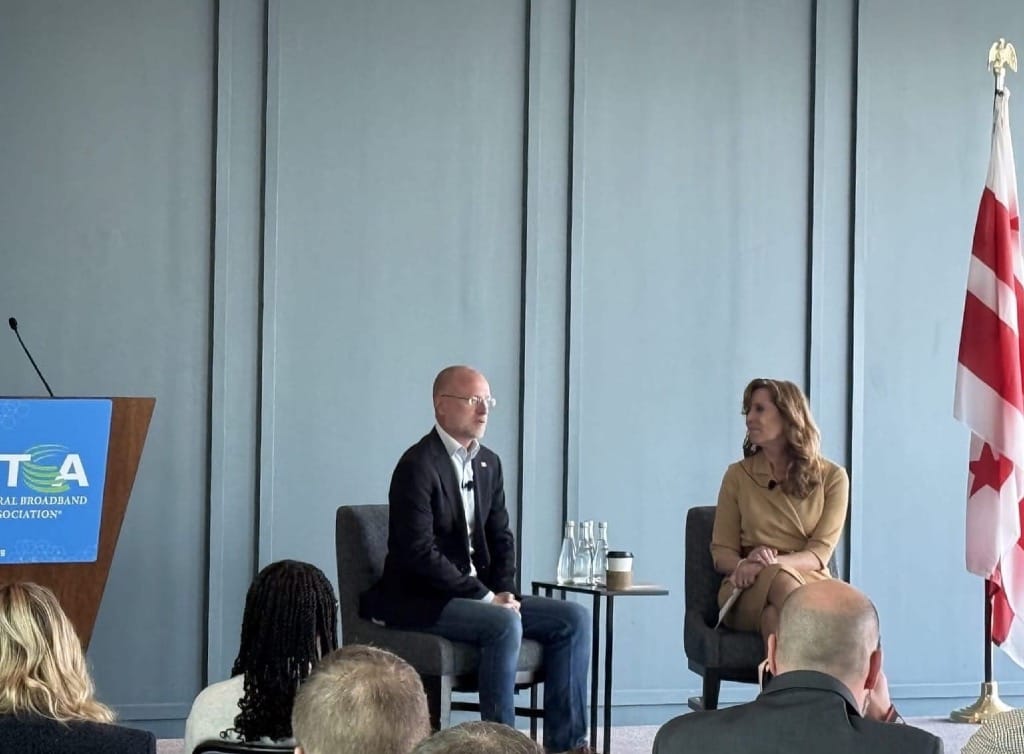
WASHINGTON, Nov. 18, 2025 – Federal Communications Commission Chairman Brendan Carr declined Tuesday to outline specific reforms being considered for the Universal Service Fund, only broadly calling for “efficiencies” to be driven out of what he deemed a legacy program.
NTCA CEO Shirley Bloomfield pressed Carr three separate times for specifics, including where Carr stands on reforming who contributes to the $8.5 billion fund. Speaking to a roomful of rural broadband officials, Carr said the FCC has “limited authority” to expand who pays in.
“I think we have to acknowledge there is limited authority for the FCC to go beyond the existing base,” Carr said when asked whether he still supported expanding contributions to large technology platforms. He spoke at a policy summit hosted by NTCA – The Rural Broadband Association at the Royal Sonesta in Washington.
Carr said there were “still a lot of inefficiencies” in USF's model. “I think there’s a lot of efficiencies that we can drive out,” he said. Ultimately, he said he would defer to Congress to lead discussions on how to reform the program.
Speaking to reporters afterward, Bloomfield said Carr’s emphasis on “efficiency” raised concerns for NTCA’s members. She said the term had often been used in the past to justify standardizing models toward one technology or one price point, ignoring the realities of rural builds.
“A flat model doesn't work,” she said. “I worry that in the spirit of efficiency, the results are not going to accurately detail what really needs to be done.”
Bloomfield also said she worried that Carr “gloms on a little bit to the highest-cost,” warning that efficiency should not become shorthand for steering rural locations toward the easiest or cheapest technology option.
“I wanted Chairman Carr to be extremely clear on where he wanted to go,” Bloomfield said. “His focus on efficiency, I get it, but what does that look like?”
Bloomfield underscored that NTCA members maintain fiber to 86 percent of customers. Without dependable USF support, she said, providers would be forced to raise rates to levels that would be prohibitive for rural families.
Calls mount for dominant internet platforms to pay into USF
Carr previously floated the idea of assessing large technology companies for USF contributions in a 2021 op-ed, entitled Ending Big Tech’s Free Ride on the Internet, but has not advanced a concrete proposal since.
Today, the burden of funding USF largely falls on consumers, who see the fee added to their monthly phone bills. The fund’s contribution factor has climbed from roughly 5 percent in 2005 to a record 39.3 percent in the third quarter of 2025.
Joining Bloomfield at the press conference, Ph.D. researcher Roslyn Layton said the economics of the USF cannot be fixed without requiring the nation’s most dominant internet companies to share in the cost of the networks that carry their traffic.
The roughly $8.5 billion Universal Service Fund drives $200 billion a year on USF connections alone to the biggest internet brands: Alphabet, Meta, Amazon, Apple, Microsoft, Netflix, and TikTok. “Thats based on publicly available data,” Layton said.
Layton argued in many cases providers would not need to upgrade their networks if it wasn’t for network traffic brought about by the largest eight edge providers. She said those brands generate two-thirds of network traffic, including 80 percent at peak times, and compromise 90 percent of network costs.
“These companies aren’t paying to help this data be delivered, but they're expecting the networks can be built and deliver their content,” she said.
“A third of Americans will get online in some way over the course of the year through USF connections - whether at home, at school, or at a library,” she detailed. “This little bit of money is making a huge difference for 130 million people,” she said, calling it “staggering.”
Both Bloomfield and Layton pointed to the Lowering Broadband Costs for Consumers Act as a promising model. The bill would require edge providers and broadband providers with more than $5 billion in annual U.S. revenue, and responsible for more than 3 percent of national data traffic, to contribute to USF.
They also pushed back on proposals to fund USF through congressional appropriations, an idea raised by Sen. Ted Cruz, R-Texas.
“Two-thirds of taxes are paid by households,” Layton said. “Consumer users bear 100 percent of the cost, for the most part. So if you put it on appropriations, your household will still be bearing a disproportionate part of the cost.”



Member discussion