FCC Interested in 1.6 GHz Auction in 2028, NTIA Official Says
The Office of Management and Budget released a memo aimed at speeding government spectrum reviews


WASHINGTON, Sept. 11, 2026 – The Federal Communications Commission is “very interested” in holding a spectrum auction in the 1.675-1.695 GigaHertz (GHz) band by the end of 2028, a senior Trump administration official said Wednesday.
The National Telecommunications and Information Administration, which manages government spectrum like 1.6 GHz, has been reviewing the band as a candidate for mobile and direct-to-device use.

Tricia Paoletta, NTIA’s number two official, said the agency was studying the band for both mobile and direct-to-device satellite service because of the increasing interest from satellite companies.
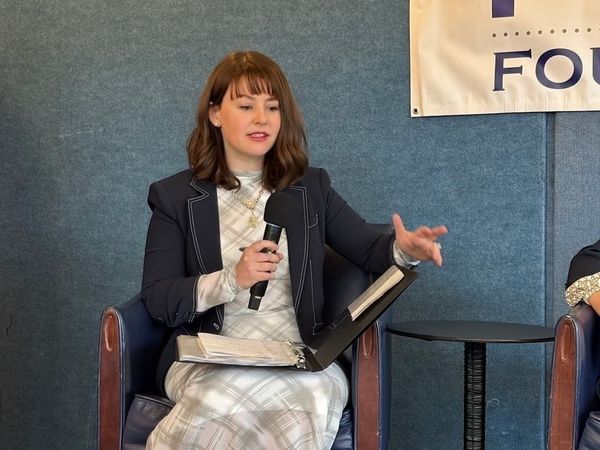
“We told the FCC, ‘Go ahead, and we’ll include studies for direct-to-device,’ because they’re very interested in moving and trying to get an auction in that band by the end of the president’s term,” she said, speaking at a Hudson Institute event in Washington Wednesday.
NTIA has already identified for auction 5 megahertz of the band, used by the National Oceanic and Atmospheric Administration for collecting weather data, and is studying the entire 20 megahertz.
It’s one of four government bands the agency is reviewing. The White House asked the agency in a December 2026 memo to finish studying and identify the 7.125-7.4 GHz band for mobile use.
Paoletta said NTIA was on track to do that.
FCC Chairman Brendan Carr has said that the agency is planning three auctions for 2028. He’s named 2.7 GHz, another government band under study by NTIA, as a target for one of those auctions.
Paoletta said NTIA was committed to helping hold 5 spectrum auctions by the end of President Donald Trump’s term, something she said was difficult but achievable. The FCC is auctioning upper C-band spectrum next year, and re-auctioned licenses previously returned by EchoStar earlier this year.
She said some parts of the process of studying government spectrum could be streamlined, like a 60-day Congressional review period for incumbent agency study plans.
By the end of September, she said, the last of those windows will have closed — the 4.4 GHz band — and agencies will be studying the potential for sharing or vacating four government spectrum bands.
On Friday, the Office of Management and Budget released a memo aimed at speeding that spectrum review and auction process. The agency said that the FCC could make auction preparations while agencies were conducting their studies, processes that previously had to happen separately.
In a release, NTIA said it supported the change and doubled down on its goal of five auctions by the end of 2028.
World Radiocommunication Conference
Adam Cassidy, who formerly held Paoletta’s position, was confirmed to a State Department post last month. He’s going to head the U.S. delegation to the World Radiocommunication Conference next year, she said.
Paoletta said that the U.S. would be “playing defense” on many WRC-27 items, since much of the conference deals with satellite issues. She said typical U.S. allies had diverging satellite policy aims, citing Europe’s plans to reserve much of the 2 GHz band for European operators.
She said there would probably be more typical alignment on whether to identify 4 GHz and 7 GHz spectrum for mobile use. There’s disagreement among U.S. industry groups on 7 GHz, with the carriers wanting a mobile designation and aviation and tech companies opposing that.
NTIA has said it supports mobile in 7 GHz, along the lines of the White House memo, but hasn’t officially weighed in on 4 GHz.
The FCC is looking to have positions finalized by the end of November, when regulators from North and South America will next meet to hammer out agreements ahead of WRC.