
FCC Takes Step Toward Upper C-band Auction
In a change from the draft, the approved text asks about a Tribal licensing window.

Jake Neenan
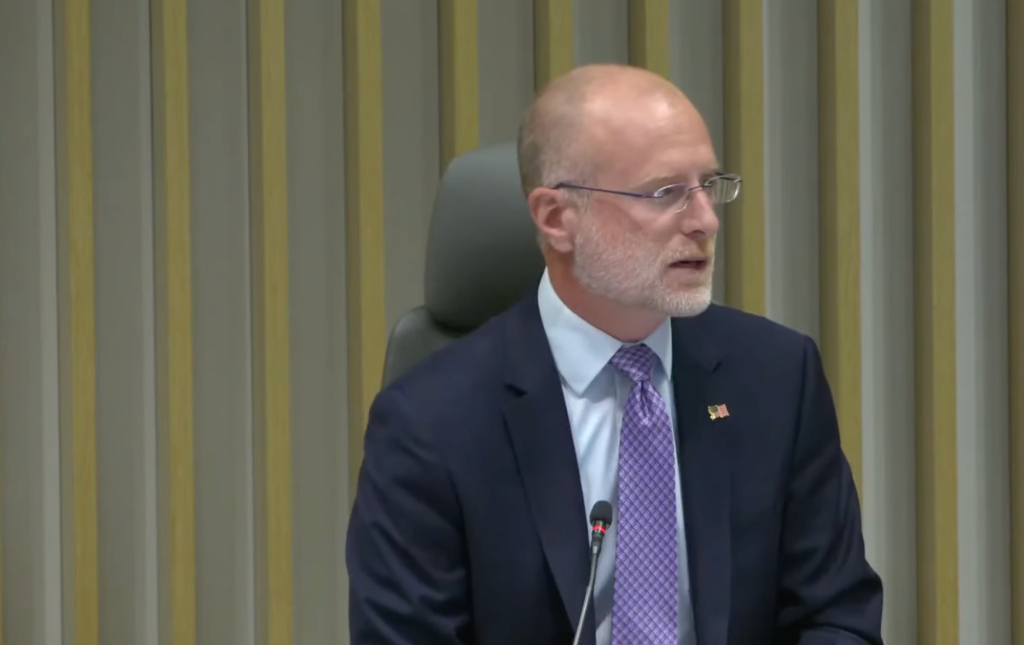
WASHINGTON, Nov. 20, 2025 – The Federal Communications Commission voted unanimously to seek input on procedures for its upcoming auction of upper C-band spectrum.
In a change from the public draft of the item, FCC Commissioner Anna Gomez said the adopted text included a question on whether to include a Tribal licensing window for the auction.
Tribal groups and consumer advocates had asked for such a window, in which Tribal governments and ISPs could apply for free spectrum licenses covering Tribal lands.
“Absent a Tribal licensing window, Tribal lands become part of a larger licensed service area and often are the last areas to see service, if at all,” Gomez said at the agency’s Thursday meeting. She said tribes grabbing their own licenses “allows them to begin providing connectivity to residents, rather than being forced to wait for a carrier to develop a business case for doing so.”
She said the window could likely occur during the auction – the carriers have opposed Tribal licensing windows partly on the grounds that they delay auctions – because “the tools that we would use to facilitate it have already been created at the commission, and it would involve only a discreet number of licenses that would become available to an identified set of Tribal nations.”
The agency is looking to make as much as 180 megahertz of the upper C-band, 3.98-4.2 GigaHertz (GHz), available to terrestrial wireless carriers.
Despite SpaceX interest, FCC isn't allowing additional satellite users
Low-earth orbit satellite company SpaceX had expressed interest in getting its hands on some of the airwaves, but the agency said in the public draft that because of the complexity of the task and the short timeframe handed down by Congress, it wasn’t looking to allow any additional satellite users in the band.
SpaceX also recently reached deals to buy spectrum licenses worth billions from EchoStar, satisfying some of its appetite for airwaves to support its direct-to-cell plans.
Under the One Big Beautiful Bill Act, the FCC has to auction at least 100 megahertz of the upper C-band band by July 2027, which FCC Chairman Brendan Carr said was a huge lift.
“Completing a rulemaking and finishing an auction in less than two years would be a tall order under the best of circumstances,” he said. “Here, though, the task is made even harder by the need to accommodate satellite users in the upper C-band and certain radio altimeters on board aircraft in the adjacent band.”
The wireless carriers and airlines have already settled on 180 megahertz as an amount that could be auctioned safely for the next generation of altimeters, which will be better able to mitigate interference. It’s not clear how much of the band can be easily cleared by the satellite providers currently providing video distribution services in the band, but the companies involved have said publicly that at least 100 megahertz should be doable quickly.
CTIA, which represents the major wireless carriers that are likely to be the top bidders, was pleased to see progress on the auction.
“We commend Chairman Carr for his steadfast leadership and vision and look forward to working closely with the Commission, as well as with partners in the satellite and aviation industries, to put this spectrum to work on a safe, efficient, and ambitious timeline,” CTIA CEO Ajit Pai said in a statement. Pai was FCC chairman during the first C-band auction in 2021.
Airlines were up in arms during that auction, citing similar altimeter interference concerns to the one carriers have worked to smooth over this time around.
Cybersecurity order rescinded
The agency also voted 2-1 to rescind a January order that imposed cybersecurity requirements on telecom providers. Gomez, the lone Democrat, dissented.
The order at issue was instituted under former FCC Chairwoman Jessica Rosenworcel in response to the Salt Typhoon hack, in which hackers linked to the Chinese government gained sweeping access to American telecom networks. The order interpreted federal wiretapping law to require telecoms to secure their entire network against hacks, rather than just the equipment and facilities used for law enforcement surveillance.
FCC Chairman Brendan Carr dissented from the order as a commissioner, arguing the wiretapping law didn’t provide for the requirement. He said Thursday that the order was “neither lawful nor effective.”
He said the agency had instead reached deals with the major carriers to “make extensive, coordinated efforts to harden their networks against a range of cyber intrusions.”
Major trade groups CTIA, NCTA, and USTelecom had been asking the agency to repeal the rule, calling the requirements “onerous and vague.”
Gomez said the cybersecurity agreements didn’t amount to much without a mechanism for the agency to enforce them.
“Partnership and collaboration that carry no enforceable accountability are insufficient by design,” she said. “Simply trusting industry to police itself is an invitation for the next breach.”
Gomez and Sen. Maria Cantwell, D-Wash., had publicly slammed the agency’s decision on Wednesday, making similar agruments.
The agency also approved an item that seeks comment on updating services that allow disabled people to make and receive phone calls, and an order deleting some Public Safety and Homeland Security Bureau rules.
Gomez approved in part and dissented in part from the latter, saying there were some substantive rules included in the batch set to be deleted.
CBRS
At the press conference after the meeting, both Carr and Gomez were asked about the future of the Citizens Broadband Radio Service. Users of the shared band have expressed consistent concern about the agency potentially auctioning off some of the airwaves as it looks to meet Congressional pipeline goals.
Carr said most of the agency’s energy on that front was being taken up by the upper C-band preparations and secondary market deals from EchoStar and others that the agency has to review.
He didn’t comment directly on CBRS.
“C-band has really taken up all the bandwidth, so to speak, at this point,” he said.
For her part, Gomez said “I don’t have a proposal before me on CBRS. I haven’t seen one.”
But she defended the band, calling it a success story and an important resource for smaller providers competing with bigger ISPs. She said if there were to be presented with an item on the issue she “will be concerned about what this does to the competitive ecosystem in our country.”
Cyber trust mark
The FCC paused its cyber trust mark program in June, citing concerns the testing company selected to administer it had a joint venture with a Chinese-owned company.
Of the pending investigation, Carr said he might have “more to announce on that at some point in the future here, but I think we’re getting closer on that.” He didn’t say whether the agency would go with a new administrator.


Member discussion