
FCC’s Carr Stresses Competition, Spectrum, SpaceX in Aerospace Summit Remarks
Carr highlighted U.S. progress in satellite technology and efforts to expand the space economy.

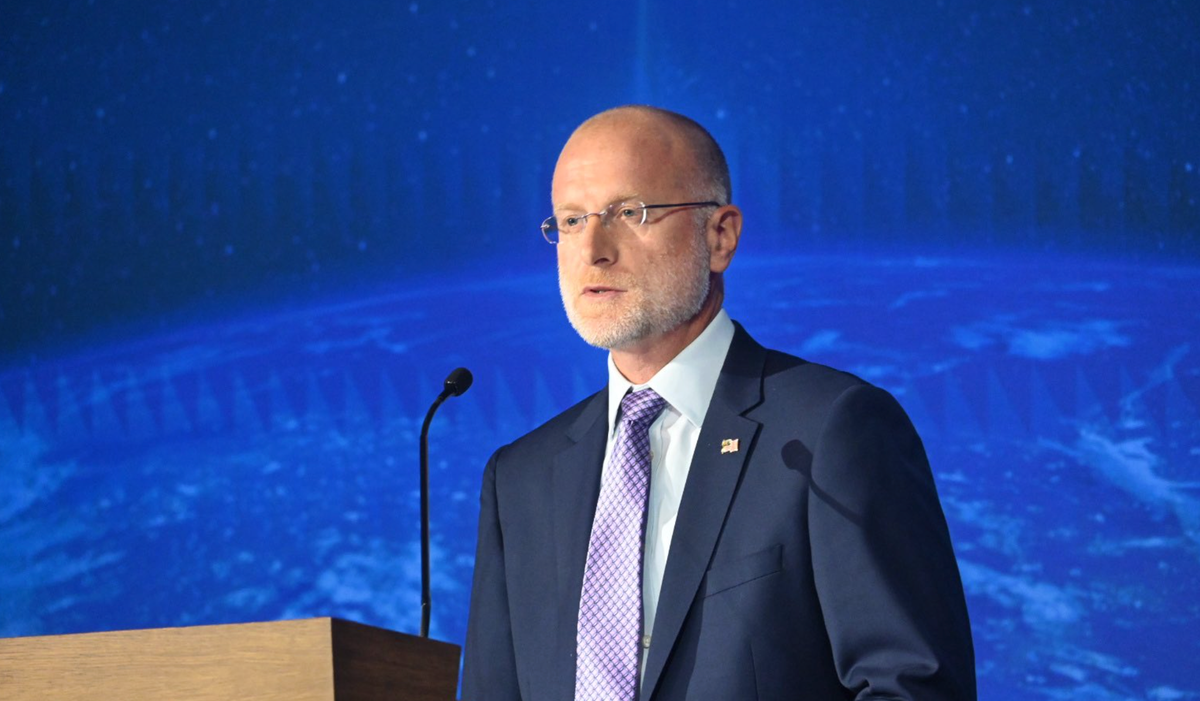
WASHINGTON, Sept. 12, 2025 — Federal Communications Commission Chairman Brendan Carr said Tuesday the United States is outpacing China in what he called a “Space Race 2.0,” pointing to breakthroughs in low-Earth orbit satellites and direct-to-cell technology.
Speaking at the U.S. Chamber of Commerce’s Global Aerospace Summit, Carr said expanding America’s space economy is a key pillar of the FCC’s “Build America” agenda.
“We now have new constellations of low-Earth satellites that make it possible to deliver high-speed internet to remote locations and connect Americans stuck on the wrong side of the digital divide,” Carr said.

He called direct-to-cell, or D2C, services a “potential gamechanger” for consumers, citing SpaceX’s $17 billion purchase of EchoStar’s AWS-4 spectrum this week to support a new satellite constellation.
“I want our policies to promote disruptive competition at scale while bringing underused spectrum to bear for the American consumer,” Carr said.
Musk, when asked about the spectrum purchase in a recent interview, stressed that Starlink is not seeking to replace existing mobile carriers.
“They’re still going to be around because they own a lot of spectrum,” Musk said. But he added that Starlink customers could soon have accounts similar to those with AT&T, Verizon or T-Mobile, offering service through home antennas as well as direct-to-cell connections.
Carr also pointed to satellite industry growth across the country, noting ribbon-cuttings in Louisiana, Texas and Virginia where he said optimism about jobs and investment is growing.
But he warned that China is moving aggressively to expand its satellite broadband footprint, with plans to deploy more than 27,000 satellites and market services worldwide. He raised concerns about Beijing’s history of censorship and information control. He used the term "Space Race 2.0.,” with China being the main competitor.
“China still relies on single-use rockets,” Carr said, contrasting that with U.S. advances in reusable launch technology. He noted SpaceX has more than 8,000 satellites in orbit, while Amazon’s Project Kuiper has launched 129 so far this year with 80 more missions scheduled.
Carr said the FCC has already cut its satellite application backlog in half since January and is streamlining approvals to speed innovation. He highlighted reforms such as a 30-day review period for earth station renewals and efforts to modernize decades-old spectrum rules.
“Our goal is to make sure the United States is the most friendly regulatory environment in the world for people to start, grow or accelerate their space operations,” Carr said.



Member discussion