Hochul’s Nuclear Push Collides With Data Center Moratorium Fight
The plan comes as lawmakers press Hochul to pause large data centers and keep their power costs off ratepayers.

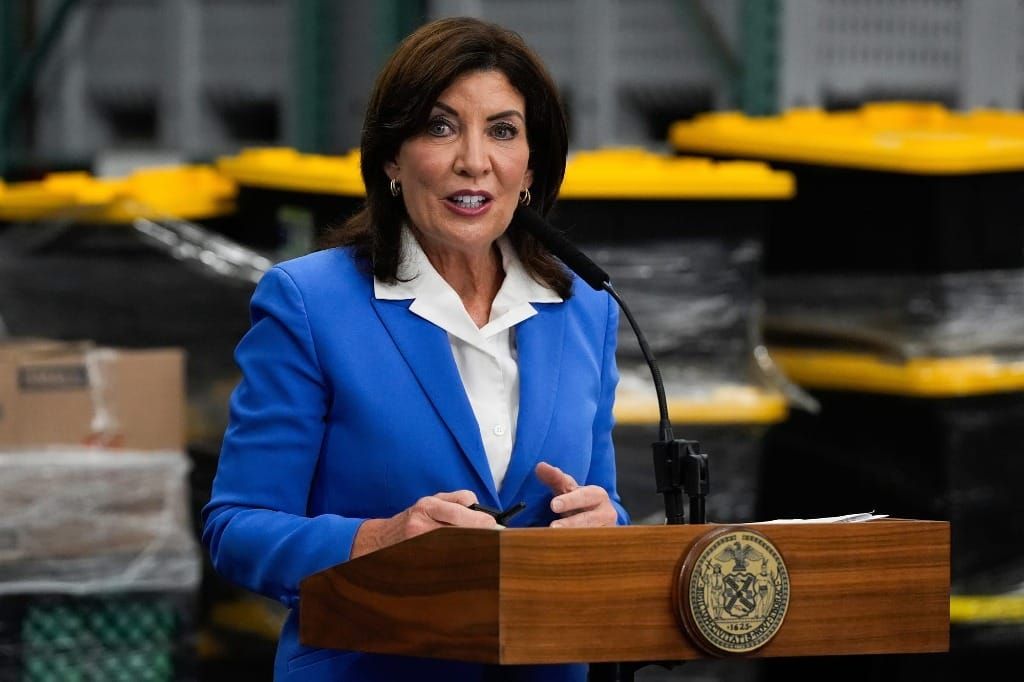
WASHINGTON, June 15, 2026 – Gov. Kathy Hochul, D, is pushing New York toward new nuclear power just as legislation to pause some large data center development is awaiting her signature.
That tension is turning the state’s nuclear roadmap into a test case for one of the biggest questions facing the artificial intelligence buildout: whether data center power demand should be treated as a public reliability problem or a private infrastructure cost.

A state options paper estimates that New York will need between $15.4 billion and $23.9 billion in public support over 40 years to add five gigawatts of new nuclear power by 2050. Five gigawatts is enough to power approximately 3.75 million homes indefinitely. There are approximately 8.5 million homes in New York State. One scenario built around small modular reactors assumed a guaranteed revenue level of $238 per megawatt-hour for a first-of-a-kind project.
The same paper also raised the possibility that hyperscale data center operators could help finance new nuclear generation, complicating the state’s case for public support.
The state has not publicly named a hyperscaler willing to underwrite the buildout, and NYSERDA’s request for information said the agency did not intend to publish responses.
The Legislature this month passed the Responsible Data Center Development Act, which would impose a one-year moratorium on permits for certain large data centers and require regulators to address the sector’s impact on electric and gas rates. Hochul has not yet said whether she will sign it.
Assemblymember Scott Gray, R-Watertown, urged Hochul to veto the moratorium bill, arguing that large, steady baseload customers like data centers could help make new nuclear projects financially viable.
His argument cuts to the core of the roadmap’s financing problem: the same data centers lawmakers are trying to slow could also become the anchor customers nuclear developers need.
Hochul framed the plan as a reliability measure for a grid facing rising demand.
“Advanced nuclear is one of the best available options to provide both relief to consumers and strengthen the resilience of New York’s grid with round-the-clock emission-free energy,” Hochul said Thursday.
New York lawmakers have also pushed back on nuclear subsidies themselves. Assemblymember Jo Anne Simon, D-N.Y., and Sen. Kevin Parker, D-N.Y., this spring proposed a 30-month moratorium on state funding or zero-emission credits for new or reopened nuclear facilities while an independent task force studied costs, waste and environmental impacts.
The Public Service Commission has opened a proceeding on the options paper, giving utilities, consumer advocates, nuclear developers and technology companies a venue to argue who should pay.