
House Democrats Want Non-Deployment Funds Maintained
West Virginia Gov. Patrick Morrisey (R) suggested he would push for his state to access its full allocation.

Jake Neenan
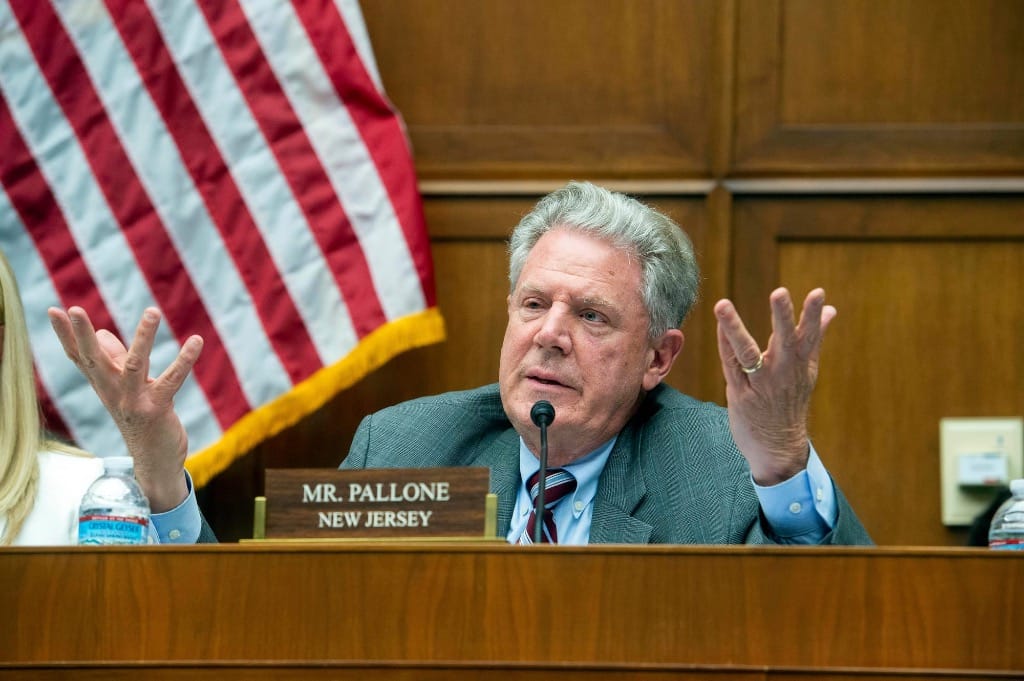
WASHINGTON, Nov. 25, 2025 – House Democrats are urging the Commerce Department to release to states $42.45 billion in Broadband Equity, Access, and Deployment program money, even if it’s not needed for broadband deployment projects.
Commerce’s National Telecommunications and Information Administration rescinded approval for any non-deployment initiatives, including some already underway, in June, saying more guidance would be forthcoming.
A draft executive order that circulated last week, but hasn’t been signed, would have directed the agency to withhold non-deployment funds from states that had “onerous” regulations on AI companies.
“Neither the law nor a directive from the President through an executive order empowers NTIA to impound tens of billions of dollars that Congress authorized and appropriated in full to achieve specific policy outcomes, including universal connectivity, affordability, scalable infrastructure, and broadband adoption,” the lawmakers wrote in a Tuesday letter to NTIA Administrator Arielle Roth.
“To the contrary, the Bipartisan Infrastructure Law expressly includes eligible uses beyond deployment and mandates that all remaining funds be used to further the BEAD program.”
The letter was signed by Reps. Frank Pallone, D-N.J., Doris Matsui, D-Calif., and Yvette Clarke, D-N.Y.
Pallone is the top Democrat on the House Commerce Committee, and Matsui and Clarke are the top Democrats on the Communications and Technology Subcommittee and the Oversight Subcommittee, respectively.
Before the Trump administration’s policy change, states had been planning to use their non-deployment funds on broadband adoption efforts, workforce development, and other things.
NTIA’s new posture led to fears, including among state broadband offices, that non-deployment funds essentially wouldn’t be available. Roth floated at least one use in an October speech.
“NTIA is also considering how states can use some of the BEAD savings – what has commonly been referred to as non-deployment money – on key outcomes like permitting reform,” she said. “No final decisions have been made, but this could be a powerful way to advance BEAD’s goals.”
A lot of money at stake
There’s a lot of money at stake. The Trump administration is focused on cutting costs, and states and territories have so far submitted tentative results more than $21 billion under budget.
“We urge you to release to each state and territory its full BEAD allocation, including all funds for non-deployment activities allowable under the statute,” the lawmakers wrote Tuesday.
When his state’s BEAD spending plan was approved by NTIA, West Virginia Gov. Patrick Morrisey (R) suggested he would push for the full allocation to be made available. The state is spending $546 million of its $1.2 billion in BEAD money on deployment projects.
“We’re going to continue working closely with the Trump administration and NTIA to ensure that this is just the beginning,” he said in a statement. “With additional investments in energy, health care, and technology, West Virginia is positioned to use this new broadband access to make major strides in our standard of living and economic strength.”
Some other Republicans, including Louisiana Gov. Jeff Landry (R) and Sens. Shelley Moore Capito, R-W. Va., and Roger Wicker, R-Miss., have said they also want their states to retain all the cash they were allocated.
A draft executive order that circulated last week would have directed Roth to prepare a memo making states with “onerous” AI laws ineligible for non-deployment funding. The order hasn’t been signed.
Sean Conway, former deputy chief counsel at NTIA, said in an email last week that a memo to that effect could create legal issues.
“Any legal implications of conditioning access to federal broadband funding on state AI laws would not be known until NTIA released its guidance articulating those conditions,” he said. “With that said, one could foresee conditions potentially raising grants law, appropriations law, and even constitutional issues depending on the substance of the conditions.”
Gigi Sohn, executive director of the American Association for Public Broadband, said last month on Light Reading’s The Divide podcast she was trying to shore up more support from Republican politicians.
“The only thing that’s going to turn this around,” she said, “is to try to get state legislators, governors – particularly Republicans – to weigh in and say, ‘That’s our money. By statute that’s our money.’”




Member discussion