
Illinois Court Tosses Local Application Fees for Broadband Projects
A judge ruled the fees were prohibited under state law.


Sept. 29, 2025 – An Illinois court ruled last week that cities in Illinois can’t charge broadband providers to use public rights-of-way.
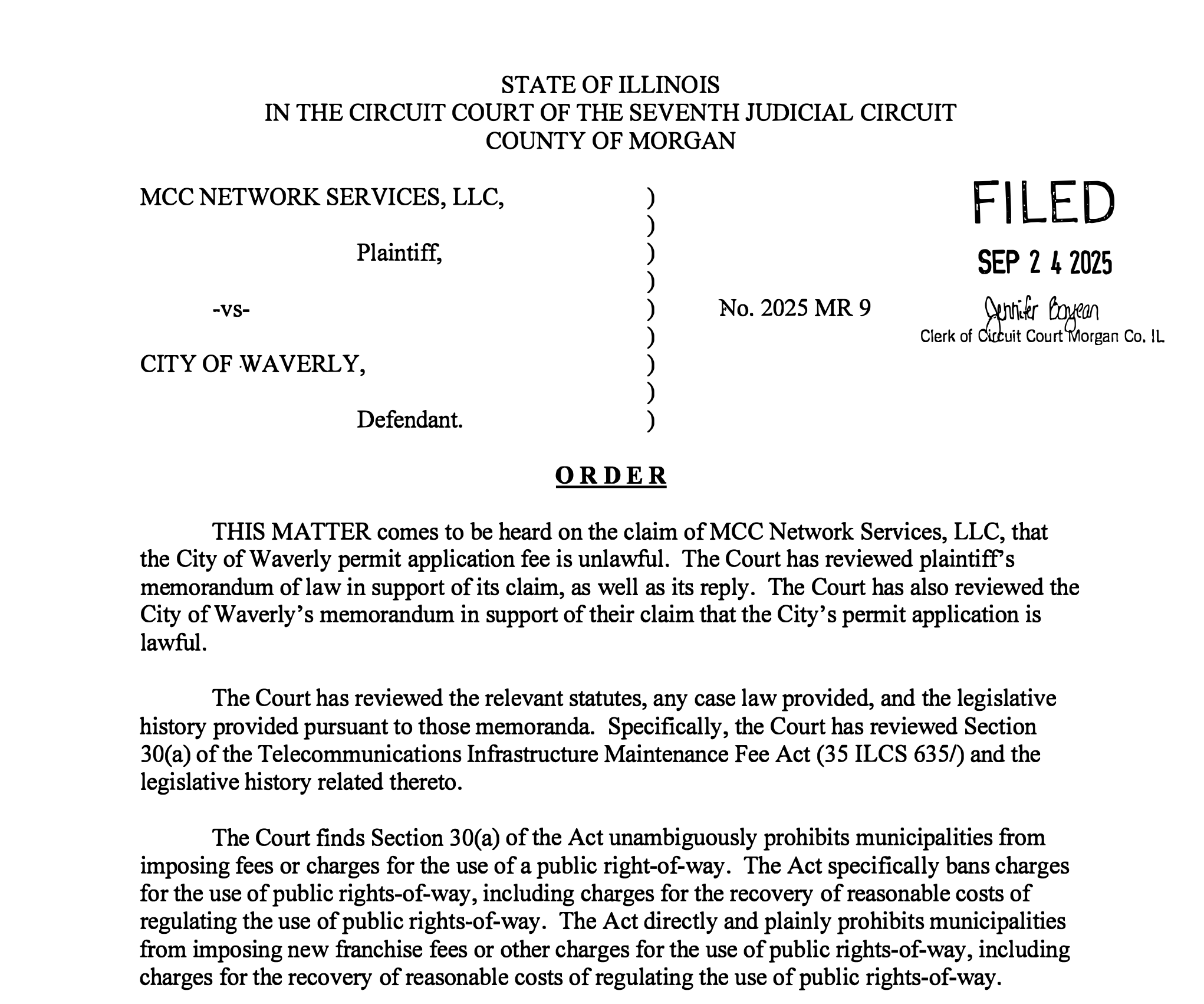
Illinois Circuit Court Judge Christopher Reif ruled that the Waverly, Illinois policy of levying application fees as part of the rights-of-way permitting process violated a state law called the Telecommunications Infrastructure Maintenance Fee Act.
“The Act unambiguously prohibits municipalities from imposing fees or charges for the use of a public right-of-way,” he wrote in a Sept. 24 order. “The Court hereby invalidates the City's ordinances establishing the application fee and further enjoins the City from enforcing, requiring, assessing, or collecting the application fee.”
A fiber provider called MCC Network Services sued the city of Waverly after the city tried to charge the company $87,000 in application fees for a right-of-way permit application in 2024.
The city had unsuccessfully argued that while franchise fees were prohibited by the law, its application fees were allowed.
“This ruling provides powerful support for challenging municipal fees, including permit application and regulatory cost-recovery fees,” Jonathan Marashlian, managing partner at the CommLaw Group, wrote in a blog post Friday. “Providers deploying fiber and other telecommunications facilities in Illinois can rely on the court’s reasoning and the statute’s plain language to seek removal of such barriers to right-of-way access and construction.”
The firm represented MCC Network Services in the case.
Marashlain said that “Similar or complementary arguments may be made under the federal Communications Act and under the laws of other states.”
Under Chairman Brendan Carr, the Federal Communications Commission has been working to make it easier for ISPs to deploy infrastructure. The agency is set to vote Tuesday on whether to take input on local regulations providers would like to see preempted by the FCC.
Trade groups have gone to the agency in recent months complaining of extensive delays from local permitting processes. Groups of municipalities have countered that the industry was leveling vague accusations in a bid to convince the FCC to quash their regulations.







Member discussion