
In Barcelona, Telecom CEOs Talk Sluggish Growth, EU Regulation and Geopolitics
European 'rip-and-replace' criticized, Eutelstat CEO promotes itself as only LEO system that is neither American nor Chinese


Akul Saxena, Drew Clark
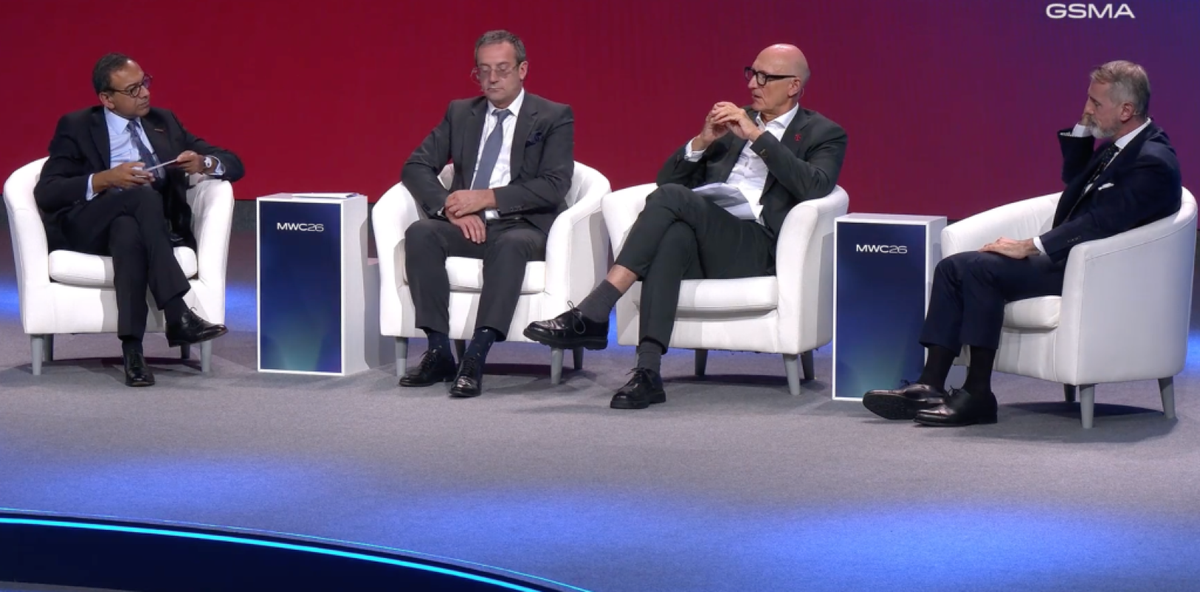
BARCELONA, March 3, 2026 — European telecom executives said Europe’s push for “technological sovereignty” will fall short without consolidation and faster growth on the continent.
Speaking in a keynote on the main stage here at the Mobile World Congress (MWC), the CEOs of Germany’s Deutsche Telekom, Spain’s Telefónica, and France's Eutelstat called for quicker European regulation, and for government anchor investments in cloud, chips, and satellite systems.
The panel on Monday was moderated by Vivek Badrinath, director general of the global mobile technology standards organization GSMA (originally Groupe Spéciale Mobile Association), which runs the global trade show MWC.
Badrinath said connectivity now underpinned sectors ranging from healthcare and manufacturing to energy and public services, and that demand for next-generation networks continued rising as Europe struggled to translate ambitions into scale, speed, and capital mobilization.
He cited Europe’s major initiatives, including the European Chips Act, a European Union program from September 2023 intended to expand semiconductor capacity, and the Digital Decade targets, the EU’s 2030 goals for connectivity and digital adoption. He said Europe remained heavily reliant on non-European suppliers in areas including semiconductors, cloud computing, and core network technologies.
Sluggish growth in Europe
Tim Hoettges, Chief Executive Officer of Deutsche Telekom, said “Groundhog Day” had defined the past year in Brussels. The European telecom industry invested 2 percent less than the year before, he said, falling further behind the United States and China, which he described as having market structures that supported stronger investment.
Hoettges criticized the January 2026 proposal of the European Commission, the executive body of the European Union, for its Digital Networks Act (DNA) – a major legislative initiative designed to modernize, harmonize, and streamline EU telecom regulations. It is currently entering the legislative negotiation phase in the European Parliament and Council.
Hoettges said the DNA won’t deliver the investment European policymakers are promising. Further, a pledged 50 percent reduction in bureaucracy had not materialized, and regulators have instead added 16 new tasks for the Body of European Regulators for Electronic Communications. BEREC is the body that coordinates national telecom regulators across the EU.
The policy debate needed to widen beyond mobile and fixed networks to include cloud computing, artificial intelligence, chipsets, graphics processing units, and “physical AI,” a term used to describe AI systems that control machines and robotics.
The need for scale and speed
Marc Murtra, Telefónica CEO, said Europe needed three elements to restore competitiveness: Scale, pro-technology regulation and speed.
Murtra said major technology products required deep investment and that regulation should prioritize “the creation of technology.” He said the pace of change in artificial intelligence had accelerated to the point that products leapfrogged one another in roughly three-month cycles while existing telecom regulation remained “already fifteen-years” antiquated.
He said Telefónica was reshaping internally by shedding obsolete technologies and business lines, shifting toward future skills, and adopting a more vertical structure that accepted calculated risk.
The panel’s most concrete EU-sovereignty case centered on satellites.
Eutelsat CEO Jean-François Fallacher said Europe needed to master low-Earth orbit (LEO) satellite constellations because they provide global broadband coverage and required long lead times and heavy capital to build.
Eutelsat operates the OneWeb constellation, which Fallacher described as the only operational system that was neither American nor Chinese. He said OneWeb operates about 650 satellites and that shareholders recently raised €1.5 billion ($1.7 billion), allowing Eutelsat to order an additional 440 satellites from Airbus, the European aerospace manufacturer.
Fallacher said it took seven years and about $7 billion in investment to make OneWeb operational. He said the business was growing about 60 percent year over year and generated more than €200 million in revenue, which he described as roughly 20 percent of Eutelsat’s turnover.
He also pointed to IRIS², the European Union’s planned secure connectivity constellation, as a long-term sovereignty project expected to run through 2030.
He said government demand had already moved from concept to contract. Eutelsat signed a €1 billion agreement with the French Ministry of Defense spanning 10 years for service use and constellation hardening, he said.
Fragmentation remains Europe’s structure disadvantage
Hoettges argued that fragmentation remained Europe’s structural disadvantage. He said telecom was “fragmented by design” across national markets, limiting operators’ ability to synchronize software and hardware deployment even as global platform players built systems at scale.
He said Europe’s antitrust approach discouraged consolidation and that capital markets did not reward mergers, despite the industry’s need for scale.
Hoettges said European operators had not built major cloud businesses earlier because margins and cash flow were too thin. He said Deutsche Telekom responded by launching an “AI industrial cloud” in Munich powered by 10,000 Graphical Processing Units (GPUs), scalable to 20,000 if there was either state support or deregulation.
He said the system combined Deutsche Telekom connectivity, a German-built data center, and a sovereign application infrastructure. He said the cloud’s “not sovereign” element was the use of Nvidia graphics processing units because Europe did not yet have domestic alternatives at that scale.
Hoettges said the missing piece was the state as an “anchor tenant,” meaning government agencies committing health and defense workloads to domestic facilities rather than choosing cheaper foreign providers.
Effort to replace Chinese telecom equipment critiqued
The panel returned to a January cybersecurity initiative from the European Commission, which some have described as a European version of the U.S.-based “rip-and-replace” Chinese telecommunications equipment. Badrinath said some in the industry viewed the initiative as an “own goal” if it forced networks like Deutsche Telekom or Telefónica to swap out hardware and divert capital from new networks.
Murtra, of Telefónica, said the hardware replacement focus was “the easy way out” and criticized the lack of analysis on cost and timelines. He also said policymakers missed opportunities to modernize rules allowing operators to offer and price differentiated latency and guaranteed bandwidth for distinct use cases.
Fallacher added that French authorities blocked Eutelsat from selling its earth station network, which he described as 41 fields of large antennas connected by redundant fiber, saying the government treated the infrastructure as a strategic asset.
The executives converged on a single pressure point. They said Europe’s sovereignty ambitions will depend on whether governments pair industrial policy with procurement commitments, consolidation rules, and faster regulation that matches the investment cycles of satellites, cloud, chips, and AI.



Member discussion