Jim Brisimitzis and Stephen Leotis: How CBRS is Powering Rural America's Agricultural Future
CBRS shared spectrum is solving rural farms' connectivity crisis, but proposed higher-power rules could dismantle the balance making it work.


Jim Brisimitzis, Stephen Leotis

Across rural America, agriculture and agritourism operations face a connectivity crisis that threatens their survival. In Washington State's Snohomish Valley, a family-owned farm faced a problem that no amount of preparation could have predicted. Swans Trail Farms draws 7,000 to10,000 visitors every week during its peak fall season. People come for the corn maze, the pumpkin patch, the apple orchards, and their famous apple cider donuts. But when thousands of people converged on their property simultaneously, the farm's connectivity collapsed.
Customers waited in line for donuts while their payment processors failed. Staff coordinated operations with spotty Wi-Fi. Scott Waller, chief technology officer of Khasm Labs, described it bluntly. The network had "one bar of junk," and that single tower was drowning under congestion. A Square transaction would take a full minute to process. Lose the network for an hour during peak season, and you lose revenue that a family farm cannot afford to lose.
This is the reality facing rural agricultural and agritourism operations nationwide. These businesses are essential to America's economy and way of life, yet they operate in connectivity deserts where commercial carriers find little incentive to invest.
The connectivity gap in rural America
Agriculture has become increasingly digital. Precision farming relies on connected IoT sensors to monitor soil conditions and irrigation systems. Agritourism operations depend on reliable payment processing and customer connectivity. Rural broadband gaps leave these enterprises stranded. Traditional solutions are expensive or simply unavailable in these areas.
When Swans Trail Farms needed a fix, traditional carriers quoted prices that were economically impossible. The only broadband option in the area was Hughes Net satellite service, delivering less than 10 megabits per second on a good day at premium prices. The alternative commercial cellular networks were priced to serve urban markets, not family farms.
Then we introduced Swans Trail Farms to Citizens Broadband Radio Service (CBRS), shared spectrum that allows organizations to build their own private cellular networks without paying commercial carriers for expensive licensed spectrum.
What CBRS made possible
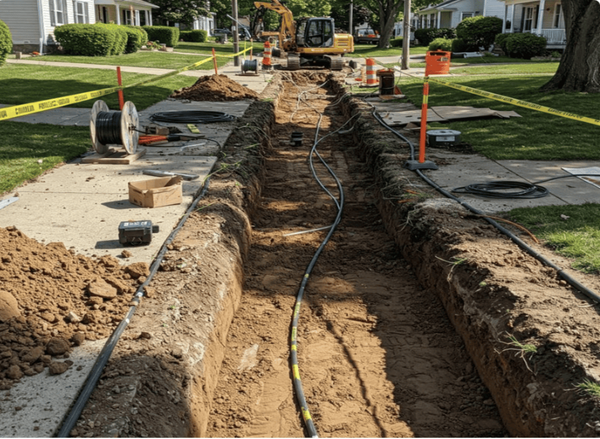
We deployed Moso Networks CBRS-enabled outdoor radios on two existing farm buildings.They covered more than 30 acres of the farm's 125-acre operation with enterprise-grade cellular coverage. The network used Starlink for backhaul, creating a complete private 5G system thatSwans Trail Farms controls and operates itself. More sophisticated deployments pair CBRS with carrier-grade backhaul and licensed spectrum partnerships, combining the flexibility of shared spectrum with the reliability of established network infrastructure.
The transformation was immediate. Payment transactions that once took 60 seconds are now completed in under one second. Staff equipped with cellular-connected devices can securely coordinate across the entire farm. The network reliability is so critical that when it goes down, the farm alerts its operators within seconds, because they simply cannot operate without it.
A one-time infrastructure investment in CBRS delivered infrastructure that the farm owns andcontrols at costs that reflect the economics of rural deployment.
Why this matters beyond one farm
Swans Trail Farms is not an isolated success story. CBRS currently supports over 430,000base stations deployed by more than 1,000 different operators across diverse sectors. In many deployments, CBRS operates alongside traditional carrier infrastructure, extending coverage into areas that licensed networks serve as backhaul or anchor connectivity, rather than replacing them. This shared spectrum model allows farms, manufacturers, hospitals, and rural internet providers to solve local connectivity problems without waiting for commercial carriers.
Agricultural enterprises nationwide face identical challenges to those Swans Trail Farms has experienced. They need reliable on-farm connectivity for operations and customer experience.They need it at a cost they can actually afford. The data is clear: when farms deploy CBRS networks, transaction failures drop to nearly zero, operational efficiency improves dramatically, and ROI timelines shift from years of carrier dependence to months of infrastructure ownership.CBRS provides that solution.
A blueprint for rural economic development
As policymakers consider how to support rural connectivity and agricultural innovation, they should recognize that CBRS represents a proven model already delivering results. This shared spectrum approach empowers local communities and rural enterprises to build the infrastructure they need without depending on federal broadband programs alone or commercial carriers. Swans Trail Farms took control of their connectivity challenge. They deployed a network that works for their business. That is the power of spectrum policy that trusts rural communities to innovate.
Proposals to allow higher-power CBRS operations risk fundamentally altering the band's design, reducing the channel availability and interference protection that small-cell deployments like Swans Trail Farms depend on. The carefully balanced spectrum sharing that is already delivering results would collapse into a landscape dominated by a few large players.
A recent technical analysis by Valo Analytica finds that even limited adoption of higher-power operations would have system-wide impacts, reducing available channels and degrading performance across existing CBRS networks. In modeled scenarios, interference from high-power deployments disrupted mission-critical operations and sharply reduced coverage for existing users.
Reliable connectivity is no longer optional for modern agriculture. It is foundational to competitiveness and survival. CBRS demonstrates that when rural enterprises are given the right tools, they can solve connectivity challenges with efficiency and speed. Protecting CBRS inits current form is protecting rural America's future.
Jim Brisimitzis stands at the forefront of technological innovation, boasting a career that spans over 24 years in business development, product management, strategic alliances, venture capital, and developer relations. As the founder of the 5G Open Innovation Lab, he has galvanized a community partnership championing advancements in connectivity, edge computing, and artificial intelligence. Under his leadership, the Lab has garnered the support of 20 global technology partners and has onboarded 127 multi-stage startups that have collectively raised an impressive $2.36B in venture capital.
Stephen Leotis is the CEO and founder at Moso® Networks, a US-based company building solutions for private and neutral host networks. At Moso, he is responsible for the strategic direction and growth of the business through key partnerships, solution development, and brand awareness. Prior to leading Moso, Stephen led product management and marketing at Sercomm Technology. He also held positions at ARRIS, Luma, and First Alert where he developed networking and smart home products for both the telecom and consumer industries. Stephen holds an MS and BS in Electrical and Computer Engineering from the Georgia Institute of Technology.
This Expert Opinion is exclusive to Broadband Breakfast.
Broadband Breakfast accepts commentary from informed observers of the broadband scene. Please send pieces to commentary@breakfast.media. The views reflected in Expert Opinion pieces do not necessarily reflect the views of Broadband Breakfast and Breakfast Media LLC.