Low-Cost Bank Loans Could Help Advance Universal Service, Broadband Investor Says
CWA also wants USF contributions to include broadband, enterprise connectivity, and cloud service review

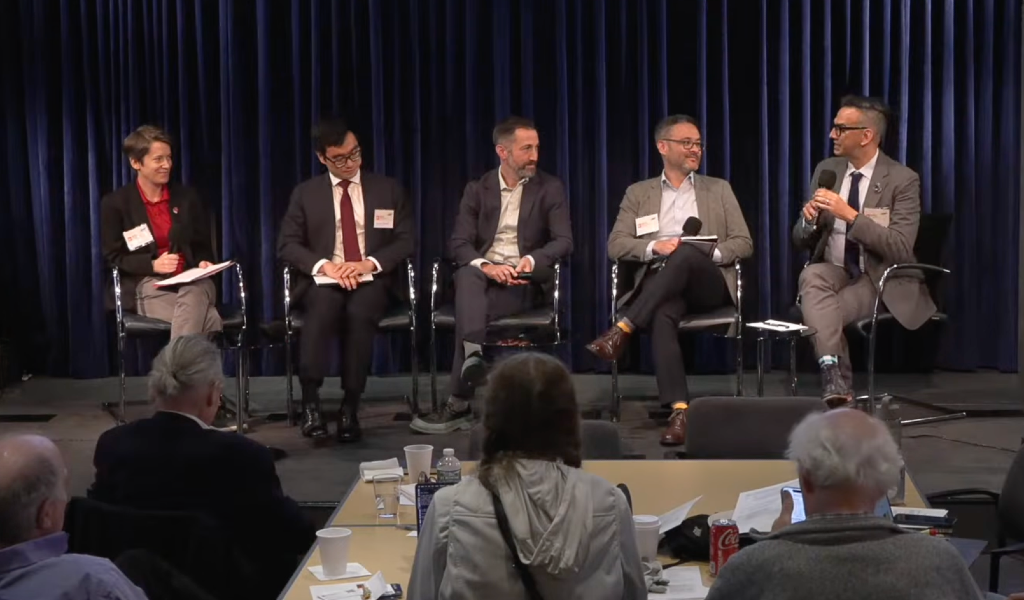
WASHINGTON, Sept. 25, 2026 – The Universal Service Fund needs updating to advance its goal, but it's not the only avenue for achieving universal service, experts said Thursday.
Brian Vo, CEO of broadband financing nonprofit Connect Humanity, said providers could look to loans provided under a law called the Community Reinvestment Act. He spoke at an event hosted by the Benton Institute for Broadband & Society.
The law requires banks to make available cheap loans for projects that benefit low-income areas in their vicinity. Broadband isn’t explicitly included in the law’s language, which was last updated in 1999, which Vo said has prevented many banks from being open to supporting broadband infrastructure projects.
He said almost $200 billion in community finance capital would be opened up for broadband projects if the CRA were to be updated to explicitly include them. In 2024 alone, government financial regulators found banks lent $138 billion under the CRA.
Banks and other community finance institutions might still face a learning curve in underwriting broadband projects, he said.
“It can be very difficult to engage with, particularly for communities who just say, ‘I just want the thing,’ and then they hear a lot of jargon about passive optical network equipment and strand count, right?” Vo said.
In July, banking regulators put forward a CRA regulation update for public comment. Vo said the broadband industry was pushing to explicitly include broadband projects as allowable.
In the late 2010s, some regional federal reserve banks encouraged broadband infrastructure and adoption projects under the existing CRA framework. In a 2018 piece, telecom consultant Doug Dawson said it could be difficult to make that work, given bank limits on individual loans, and other factors.
“Be a little bit leery of anybody that tells you that this a world changing decision,” Dawson wrote at the time. “Banks are still incredibly conservative and this won’t change their expectation for the metrics they will want a borrower to meet or the collateral they will expect to support a loan. But it ought to open the doors to have conversations with bankers that might not have been possible a few years ago.”
USF expansion
Congress has been working for years to modernize the $8 billion per year Universal Service Fund. It supports rural broadband networks and discounts but is funded by interstate voice revenues, a shrinking pool of cash.
Finding a new revenue base has proven a difficult task, with influential industries pointing the finger at each other.
Nell Geiser, head of research at telecom union Communications Workers of America, said the group supported levying fees on revenue from residential broadband, enterprise connectivity, and cloud services.
She said CWA estimated that revenue pool totaled more than $700 billion, and the contribution factor — the percentage of revenue contributed to the fund — could be kept below 3 percent and still support a USF nearly twice its current size.
The contribution factor for the fourth quarter of 2026 is set to be 42 percent.
While Congress is working to reform contributions, the FCC has initiated reviews of several USF programs, partly with the aim of rooting out fraudulent or unnecessary payments. The agency asked whether its infrastructure subsidy was entirely necessary in light of the expansion of satellite broadband.
Benjamin Dinovelli, a professor at Fordham Law School, said in markets where there weren’t enough consumers to support even a single ISP, subsidies in some form would likely be necessary. That could come from a company using revenues from denser areas to provide service, or government cash, he said.
He said in areas that would naturally support a single provider, price caps might be necessary to prevent extractive pricing.
Russ Hanser, general counsel for cable trade group NCTA, said the group opposed states setting broadband rates.
New York has a law on the books capping broadband prices for low-income households. ISPs participating in the federal Broadband Equity, Access, and Deployment program are supposed to be exempt from those laws, and Verizon and Spectrum, which have major presences in the state, won BEAD funding.
Asked by a reporter in the audience how that was playing out, Joshua Breitbart, senior vice president of the state’s broadband office, declined to comment.