
NTIA Optimistic About Upper C-band Auction
The agency said 150 megahertz could be sold off if new aircraft altimeters were widely installed.

WASHINGTON, August 5, 2025 – The White House’s top telecom advisor is optimistic the Federal Communications Commission will be able to auction as much spectrum as Congress wants in the upper C-band, provided the agency coordinates with the aviation industry and regulators.
The National Telecommunications and Information Administration, which manages federal spectrum, said it had been in talks with the nonprofit that makes operating standards for the aircraft altimeters that operate adjacent to the band. Altimeters measure the height of aircraft and are essential for pilots and air traffic controllers.
The group, RCTA, is factoring in some wireless operations in the upper C-band as it develops new guidelines set to be published by March 2027, which should make next-generation devices more resilient to interference.

“This process may make up to 150 megahertz available for auction for high-powered commercial wireless deployment and potentially even more for other commercial uses,” NTIA wrote in a filing with the Federal Communications Commission posted Tuesday.
Congress directed the agency to sell off 100 megahertz in the band in its recent budget legislation, plus 200 additional megahertz of other non-federal spectrum.
Sen. Maria Cantwell, D-Wash., the top Democrat on the Senate Commerce Committee, strongly criticized the bill over fears of interference with existing altimeters. The C-band auction raised similar concerns in 2021.
Despite confidence that next-generation altimeters would be able to avoid that interference, NTIA said current altimeters in use could need to be replaced and that a successful auction would depend on installing those new devices.
At the approximately 10,400 domestic and foreign airline planes that regularly fly in the U.S. – plus thousands of additional aircraft – “would likely require a retrofit to operate safely in the new environment,” NTIA wrote, since even those that were recently retrofitted might not work if wireless networks start operating above 3.98 GHz.
The agency added that the Federal Aviation Administration will first have to do a safety test on the next-generation devices once RCTA’s new altimeter standards are released and the FCC’s upper C-band operating rules are adopted.
“Before any decision by the FCC to permit commercial wireless operators to begin transmitting on the new frequencies, aviation stakeholders should be given sufficient time to assess any proposed FCC spectrum plan with high-powered transmissions beyond 3.98 GHz,” NTIA wrote.
The upper C-band sits at 3.98-4.2 GigaHertz (GHz). It’s above the C-band, which the FCC auctioned off to wireless carriers for $81 billion in 2021, and just below radio altimeters critical for air travel in the 4.2-4.4 GHz range.
The mobile carriers are eager to get their hands on the airwaves, both because it would make a larger contiguous block for their networks and because the FCC ability to sell off spectrum was lapsed for more than two years.
Policymakers looking to get more spectrum in the hands of the private sector have thus been eyeing the band. The FCC was already taking input on putting the upper C-band band to more intensive use when Congress called on the agency to sell off at least 100 megahertz in the recent budget legislation.
In addition to the wireless carriers, Elon Musk’s SpaceX told the FCC it would be interested in using some of the airwaves for direct-to-device satellite services.
The current occupants, satellite companies that distribute TV video content and were moved there to facilitate the original C-band auction, will have to be packed even further to accommodate another sale.
Adel Al-Saleh, the CEO of SES, which after closing its purchase of Intelsat will control the large majority of the band, has said it should be possible to quickly clear at least 100 megahertz and preserve video distribution.
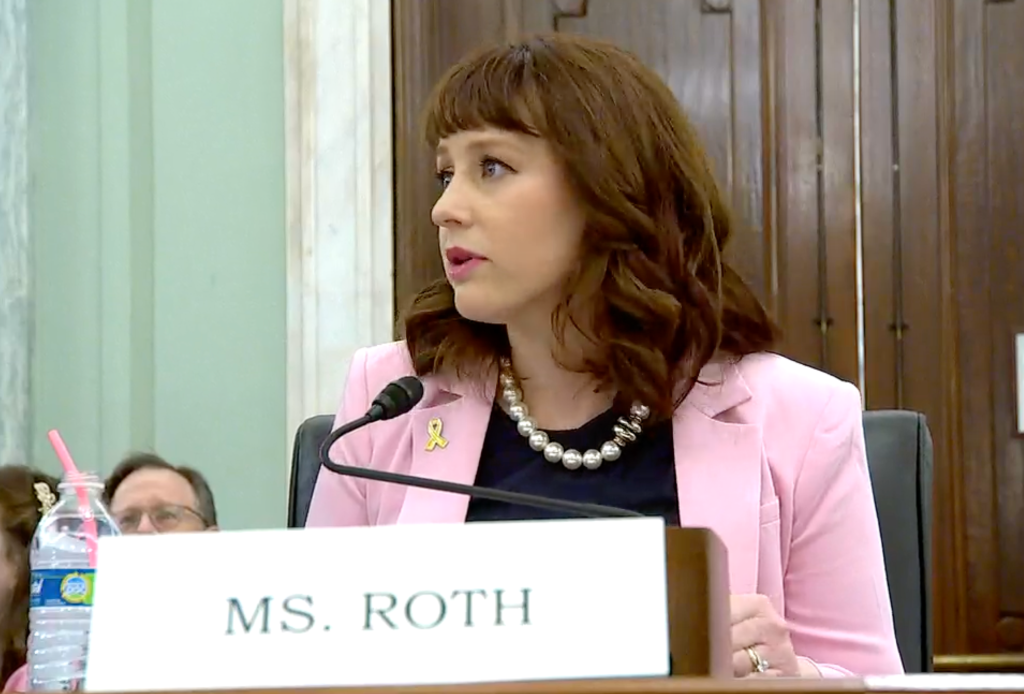
Arielle Roth, head of the NTIA and former telecom policy advisor to Senate Commerce Chairman Ted Cruz, R-Texas, was confirmed on July 23.








Member discussion