
Privacy Challenges Are Looming Behind AI Regulation, Say FBCA Panelists
Hosted by the Federal Communications Bar Association, the event featured lawmakers and aides from Connecticut, Massachusetts and Colorado

Lila Perl
WASHINGTON, Jan. 16, 2026 – Privacy challenges are looming behind the rise of artificial intelligence as a policy issue, warned panelists participating in a Federal Communications Bar Association event.
The first panel at the Monday event, “AI and Privacy: Perspectives from Policymakers and Regulators,” focused on how Colorado, Connecticut, and Massachusetts approach AI strategy in light of existing data privacy laws.
AI and privacy
Democratic state officials and aides to Democratic legislators voiced opposition to the Trump administration’s executive order seeking to deny federal funding to states with “onerous” laws restricting AI. “States can be the laboratory of democracy,” Massachusetts Assistant Attorney General Kaitlyn Karpenko said. Karpenko’s views were endorsed by the fellow panelists; no Republican officials were present on the panel.
The Democrats urged partnership, not preemption, between federal and state governments. They said law regarding AI should be firstly entrusted to states rather than governed by a blanket federal approach.
While the panelists agreed again that existing data privacy laws should be incorporated into AI policy, each differed in their statewide strategy.
Notably, Colorado passed the AI Act, set to go into effect in June 2026. This Act establishes a governance model that mandates high-risk systems to be transparent with the state concerning algorithmic disparities to vulnerable communities,
Edgar Rivas, senior policy aide to Sen. John Hickenlooper, D-Colo, explained that despite already existing data privacy laws, the state will continue to revisit the law and continue negotiations to ensure total AI consumer safety through June.
Massachusetts enforces existing state laws and advisories regarding consumer civil rights and discrimination protections to enforce privacy in AI, Karpenko stated. Though officials in the state are open to future AI-specific legislation, Karpenko said that the state administration feels confident in its current laws, including the recently updated Shield Act to protect gender-specific healthcare and reproductive rights.
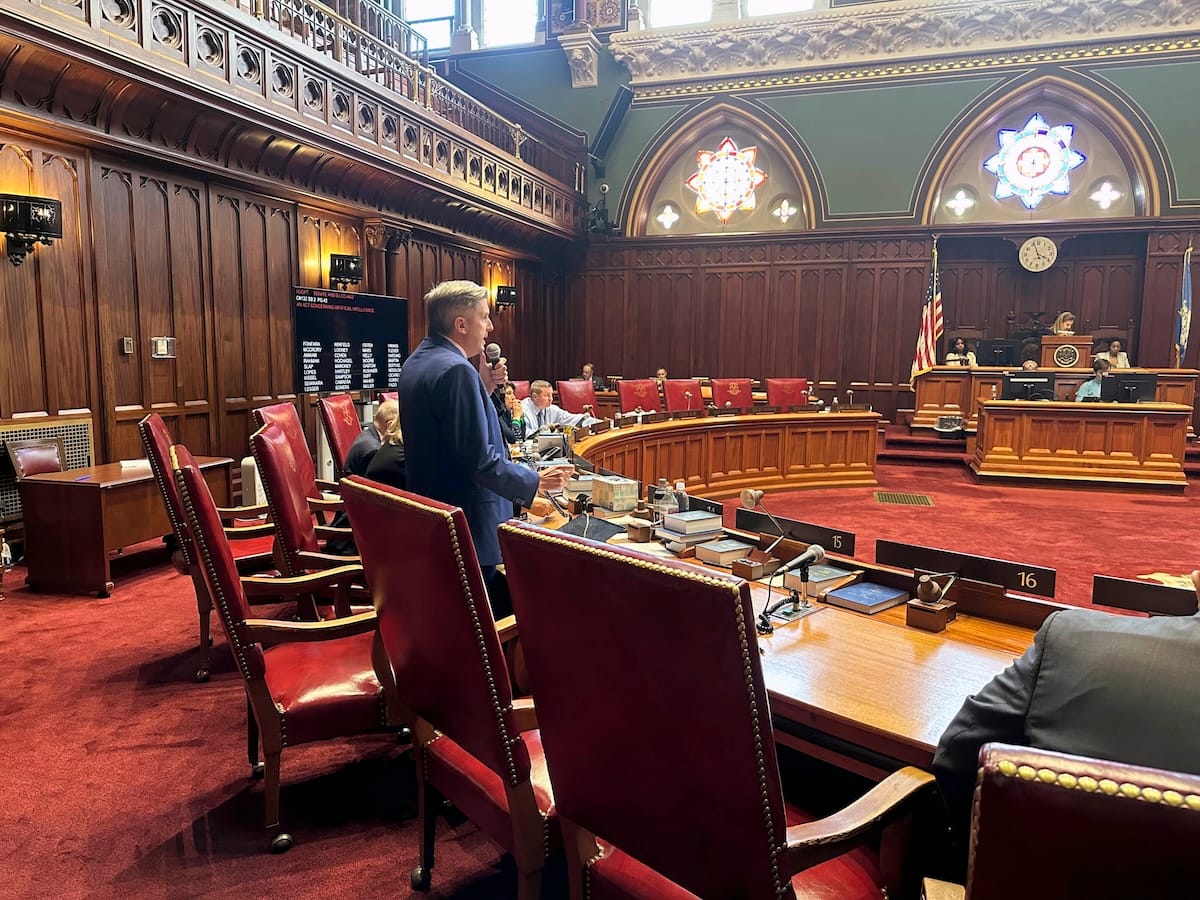
Connecticut is the fifth state to pass data privacy laws, but Connecticut state Sen. James Maroney has sponsored SB 2, an AI-specific law requiring transparency in employment, with support from Democratic state Sens. Bob Duff and Martin Looney.
By contrast with Massachusetts, Maroney said, Connecticut is not confident that its current data privacy laws will protect citizens in the AI era, given the laws’ exceptions in transparency for organizations regarding issues such as employment.
Keeping pace with AI developments
The secondary panel analyzed how companies navigate the privacy challenges accompanied by the use of AI in business operations, including brief discussion of broadband in the scheme of the evolving regulatory AI landscape.
In response to a question about the intersection of general privacy laws with sector specific obligations, USTelecom Senior Vice President Paul Eisler warned about the addition of broadband-only AI rules, cautioning the creation of “an uneven playing field without any benefits for the consumer” that would further complicate broadband and AI policy, rather than conform to a consistent regulatory approach.
Comcast Vice President Rudy Brioché supported Eisler’s statement within a practical framework.
Broadband providers commonly share overlap with other general technology and cybersecurity services, he argued. While uniform rules are useful for consumer protections, they are additionally useful for enforcing service competition.
Future of Privacy Forum Senior Director of Legislation Tatianna Rice added to Brioché’s statement, emphasizing that companies navigate the challenges of state-by-state data privacy laws through risk mitigation. Organizations prioritize high-risk areas, such as health data and AI policy, while also considering sector-specific distinctions-like broadband-when seeking commonalities across regulations.
A national regulatory framework would create a beneficial consistency across states, added CTIA – The Wireless Association Vice President David Valdez.






Member discussion