Rebecca Stone: What ISPs Need to Know About ‘Work from Home’ Habits
ISPs should treat the home network as business-critical infrastructure, since remote-work usage patterns differ sharply between the U.S. and Europe.


The home network is becoming more like a corporate information technology network. One of the main reasons is the explosive growth of remote work since the pandemic. Working from home is now a global phenomenon, but it can look completely different depending on which side of the Atlantic you're on.
Aggregated network data from millions of subscriber households across the U.S. and Europe reveal that, although remote work is global, the underlying usage patterns differ dramatically: in session length, bandwidth intensity, application mix and the shape of the working day itself.

For ISPs still planning capacity around a one-size-fits-all residential optimization model, the implications are significant. The home network is now business-critical infrastructure, and the data shows we need to treat it that way.
Same tools, different usage patterns
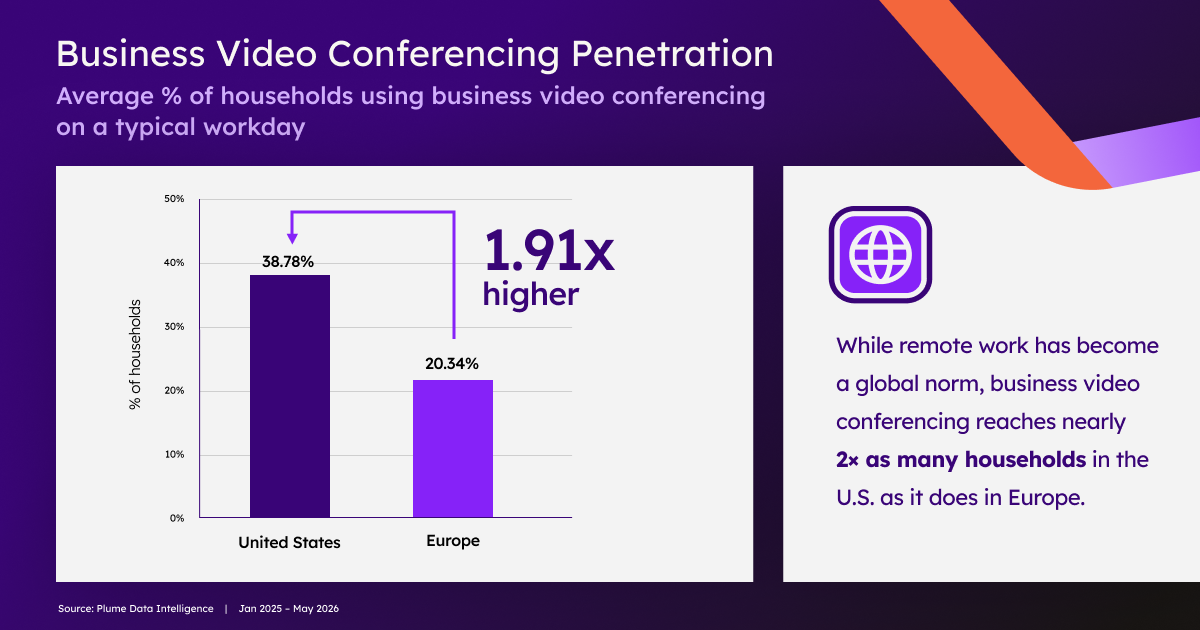
Business video conferencing is now a fixture of the working week on both sides of the Atlantic. In the U.S., nearly two in five households (38.78 percent) are conducting a business video call on any given workday. In Europe, the figure is 20.34 percent, one in five. Both markets are growing at roughly four percentage points year-on-year, with no sign of plateauing.
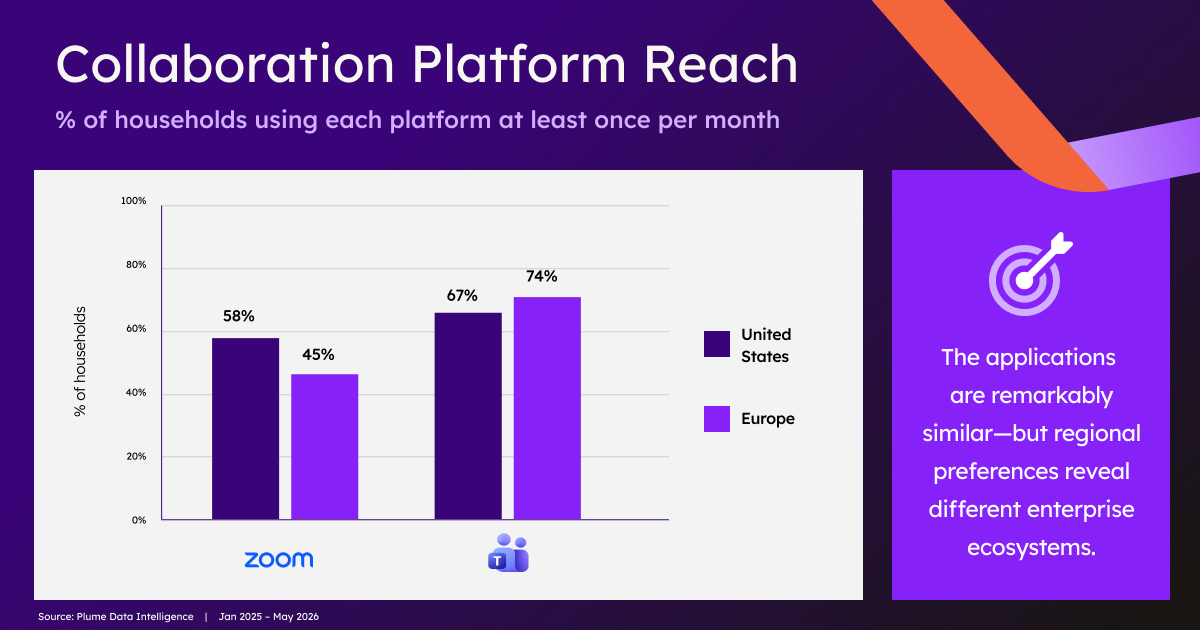
The application landscape for both markets is remarkably similar. Microsoft Teams and Zoom together account for approximately 77-78 percent of business video-conferencing households in both markets. But beneath that structural similarity, the split is instructive. Zoom carries a 13-percentage-point higher reach in the U.S. (58 percent versus 45 percent in Europe), while Teams is used more in European households (74 percent versus 67 percent).
The picture shows two markets with the same applications but different institutional usage patterns: Europe leaning deeper into Microsoft's enterprise stack, and the U.S. retaining a stronger Zoom foothold. Neither is better or worse. They simply reflect the enterprise purchasing patterns and overarching IT governance strategies of each region.
Europeans call less, consume more bandwidth
This is where the data becomes a bit surprising. European households make fewer video calls than their U.S. counterparts, but when they do, they stay on significantly longer and consume far more bandwidth.
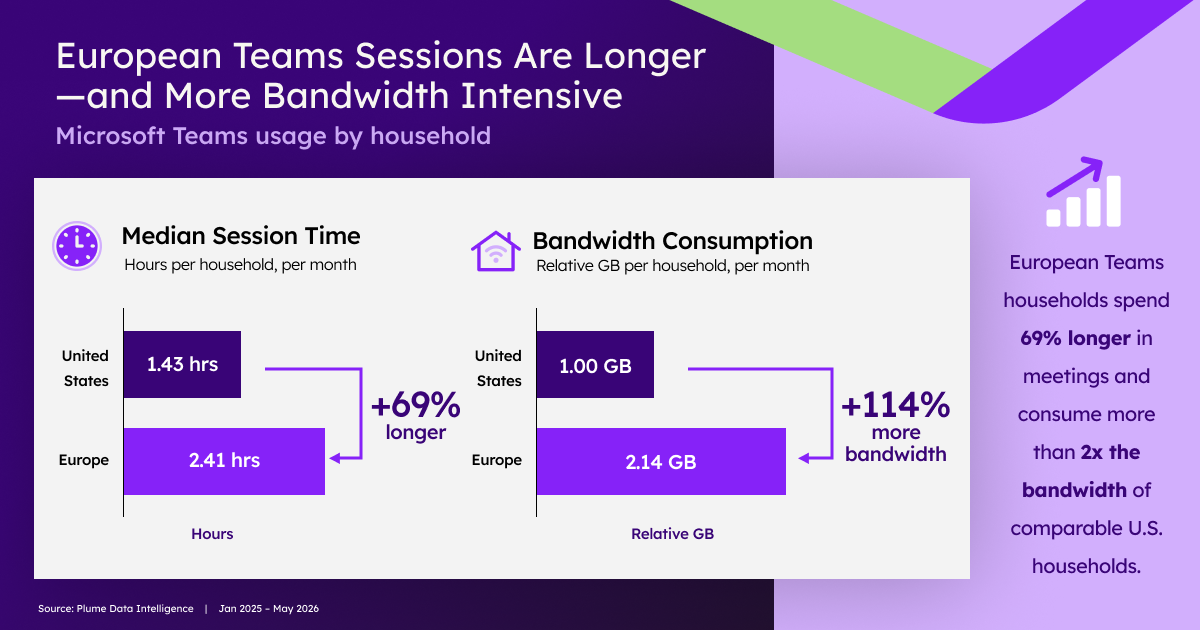
In Europe, the median Teams session runs 2.41 hours per household per month, 69 percent above the U.S. equivalent of 1.43 hours. That is not a marginal difference. It points to a structurally different meeting culture: fewer, longer, more substantive sessions versus the shorter, higher-frequency check-ins that tend to characterize the U.S. workforce. Bandwidth confirms the pattern. European Teams households consume 2.14 times as much bandwidth per month as their U.S. counterparts.
Cultural norms shape the work day
The working-hours data adds context to the cultural differences. In the U.S., the active window for business video calls runs from 7:00 am to 5:00 pm local time. In Europe, that window is smaller: 8:00 am to 4:00 pm. Both markets peak in per-household intensity between 10:00 and 11:00 am.
The midday pattern is equally telling. European households show a pronounced two-hour dip in call volume at lunchtime, which is approximately 20 percent below the morning peak. The U.S. equivalent is lower at around 10 to 15 percent, and compressed into about one hour. European working cultures have historically placed a greater emphasis on protected hours and defined breaks. What we are seeing is that cultural norm expressed at the network level.
What this should tell the industry
These findings should have direct implications for how service providers approach network planning, subscriber experience and commercial messaging.
First, a single global network optimization model is insufficient when usage patterns differ this sharply by region. European households need different Quality of Experience (QoE) parameters than U.S. households. They need different peak-time provisioning, different session-length assumptions, different bandwidth profiles. One-size-fits-all capacity planning will underserve one market or the other.
Second, application-layer visibility is becoming table stakes. An operator who sees only aggregate household throughput can't distinguish between a home streaming a movie and a home running a six-person Enterprise Teams call with screen sharing. The bandwidth may look similar, but the consequences of degradation are entirely different. When a work call drops, it is not a minor inconvenience. It is a potential point of failure the subscriber will attribute to their provider.
Third, the definition of "working from home" is itself expanding. Video conferencing may be the most visible workload, but it is no longer the only one. Autonomous AI agents or Large Language Model (LLM)-powered tools that research, draft, summarize and execute tasks in the background are rapidly becoming part of the professional workflow inside the home. These agents run in parallel with a video call, not instead of one, adding persistent, session-based demand that looks nothing like traditional browsing or streaming. The home network is becoming a workplace not just for the person on camera, but for the AI tools working alongside them.
This creates a meaningful opportunity for service providers to reframe their value proposition. The conversation can move beyond speed tiers and into an ideal work-from-home configuration: a home network optimized not only for a Zoom or Teams call but also for everything running concurrently. That is a message with genuine commercial resonance for the growing segment of subscribers whose livelihoods depend on their residential connection.
The ISP that treats the home network as business-critical infrastructure, optimizes it for customized usage patterns and effectively communicates that value proposition to end users will win the subscriber confidence and Quality of Experience battle.
This analysis is based on anonymized, aggregated network data from U.S. and European deployments, covering January 2025 to May 2026. Penetration rates reflect daily averages across active households. Session time uses median values. All cross-market comparisons are per-household normalized.
Rebecca Stone is Chief Customer and Marketing Officer at Plume, a global SaaS platform delivering AI-native network intelligence that powers connected experiences for 450-plus ISPs across 58 countries. Ms. Stone is responsible for overseeing the complete customer lifecycle, from brand awareness and market positioning through onboarding, adoption and retention. This Expert Opinion is exclusive to Broadband Breakfast.
Broadband Breakfast accepts commentary from informed observers of the broadband scene. Please send pieces to commentary@breakfast.media. The views expressed in Expert Opinion pieces do not necessarily reflect the views of Broadband Breakfast and Breakfast Media LLC.