
Rural Co-op Executives Press Congress to Modernize Universal Service Fund
Witnesses pressure lawmakers to update funding model and prioritize affordability.

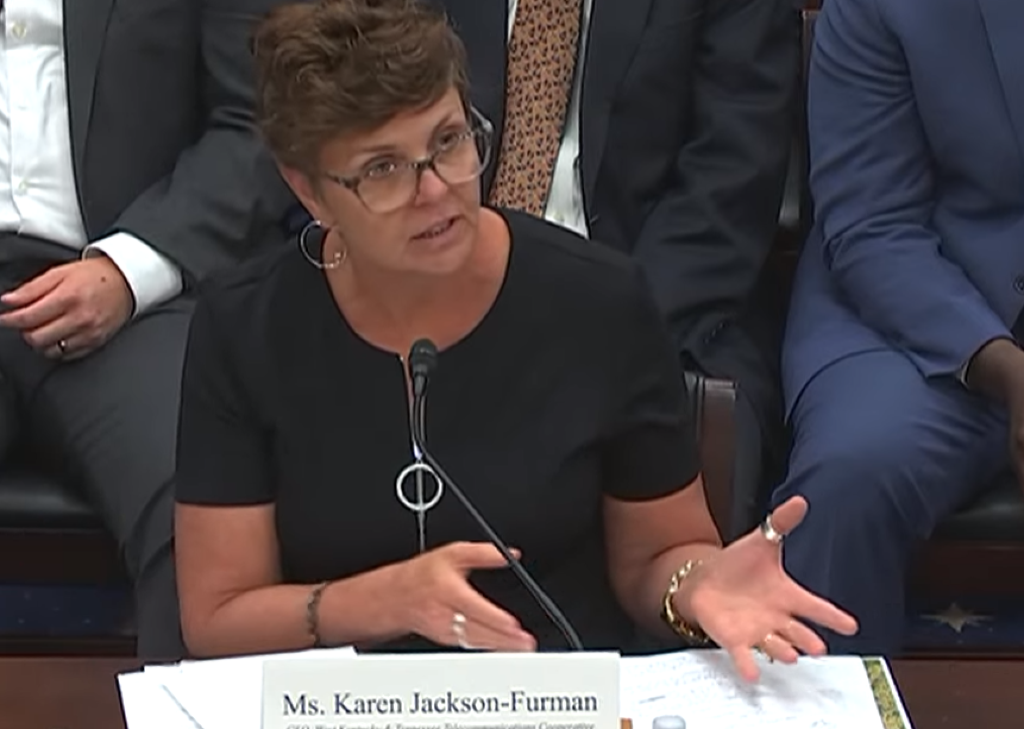
WASHINGTON, Sept. 3, 2025 – Rural broadband executives told lawmakers Wednesday that Congress must modernize the Universal Service Fund to keep small town networks affordable and sustainable.
“USF doesn’t just cover network construction, but also ongoing operations, maintenance, and upgrades,” said witness Karen Jackson-Furman, CEO of West Kentucky and Tennessee Telecommunications Cooperative. For a rural co-op like WK&T, she added, the program was often “the difference between operating and not operating.”
Her testimony came during a hearing of the House Committee on Small Business centered on how expanding broadband may revitalize rural, small businesses. Lawmakers and witnesses also discussed permitting delays, flawed federal mapping, and the Trump administration’s changes to the Broadband Equity, Access, and Deployment program that removed its emphasis on fiber technology.

Witnesses agreed that while the USF remains indispensable, its financing model has become outdated.
Witness Kristi Westbrock, CEO of the Minnesota-based rural broadband cooperative CTC, warned that the fund’s reliance on shrinking revenues from legacy telecom services has pushed the contribution factor above 36 percent and was not sustainable. She urged Congress to broaden the base so that all providers and platforms benefiting from broadband contribute.
Jackson-Furman added that USF modernization must also address the affordability gap left by the lapse of the federal Affordable Connectivity Program. “As Congress looks to modernize USF, finding a solution to the affordability question must be part of the discussion,” she said.
Witnesses argue fiber should remain the priority for federal dollars
Beyond USF reform, the hearing repeatedly returned to the question of technology standards. Witnesses agreed that fiber should remain the gold standard for federally subsidized builds, even as low-Earth orbit satellite services such as SpaceX’s Starlink gain attention.
Witness Jimmy Todd, CEO of Kansas cooperative Nex-Tech, was blunt.
“Fiber is the do-it-once, do-it-right technology. It is the most reliable, scalable and cost-effective solution, and it supports smart agriculture, telehealth, remote education – and it will for decades,” he said.
Todd serves on the Federal Communications Commission’s Precision Ag Task Force and sits on the board of the Fiber Broadband Association.
“I urge Congress to ensure federal broadband funding continues to prioritize fiber,” Todd said.
Jackson-Furman stressed the need for fiber.
“We’ve chosen to deploy fiber because we want our communities to have more than just ‘good enough’ service today,” said Jackson-Furman of WK&T. “They deserve a high-speed, scalable network that will provide opportunities for decades to come. During the destructive EF-4 tornado in December 2021, our buried fiber network never went down, allowing emergency services to stay connected and potentially save lives."
Witness Jeff Vander Werff, a Michigan farmer, said Starlink has provided some relief in hard-to-reach areas but remains too costly for most rural households.
“While innovations such as Starlink have helped tremendously, often they are cost prohibitive, putting a further burden on rural America, where poverty levels can match those of our most populated cities,” Vander Werff said. “I believe there is a better answer.”
Vander Werff’s family has tried to improve connectivity in their rural community of Sparta, Michigan, by installing and hosting broadband internet equipment on their farms, utilizing the farm’s elevation and 130-foot-high grain systems to boost signals to help more folks access high speed internet.
Lawmakers say Trump’s BEAD changes sell rural America short
Another flashpoint in the hearing was the Trump administration’s changes to the $42.5 billion Broadband Equity, Access, and Deployment program, created under the bipartisan infrastructure law.
Under the Biden administration, BEAD projects were required to heavily prioritize fiber to reach rural and Tribal communities underserved by private investment. But a recent policy notice removed that preference, putting satellite and wireless bids on equal footing.
Ranking Member Nydia Velázquez, D-N.Y., called the shift a betrayal of rural small businesses. She credited the Biden administration’s BEAD as “the single largest investment” in fiber infrastructure, but warned that President Donald Trump was “selling rural America short” by prioritizing what she described as “cheap work” over durable networks.
However, early state-level data show that fiber still leads in both total locations and especially funding. A New Street Research analysis of 25 states found that approximately 68 percent of BEAD-eligible locations are slated for fiber, compared to 18 percent for satellite and 12 percent for fixed wireless. Of course, some states like Montana were outliers, preliminarily awarding nearly 65 percent of locations to LEO satellite providers.
Rep. Morgan McGarvey, D-Ky., argued that the program was designed to help co-ops like WK&T connect the hardest-to-reach places with fiber.
“Fiber is a better quality than satellite,” he said. “It lasts longer than satellite, and even though it might be more expensive up front, it is cheaper over the long term.”
Jackson-Furman said that under the program’s new rules her cooperative lost BEAD-eligible locations in Tennessee to satellite applicants.
“The short answer is that it will create a landscape of haves and have nots for fiber connectivity, which is faster, more reliable and scalable,” she said. “Some folks will be left with an inferior service, and that's unfortunate.”




Member discussion