Senate Commerce Advances Kids’ Online Safety Bills
From chatbots to connected toys, senators push new guardrails for kids online

WASHINGTON, August 5, 2026 – The Senate Commerce Committee gave children’s online safety advocates plenty to celebrate Wednesday.
The committee voted unanimously to advance the Kids Online Safety Act along with three other measures aimed at regulating how technology platforms and artificial intelligence chatbots interact with children and teens.

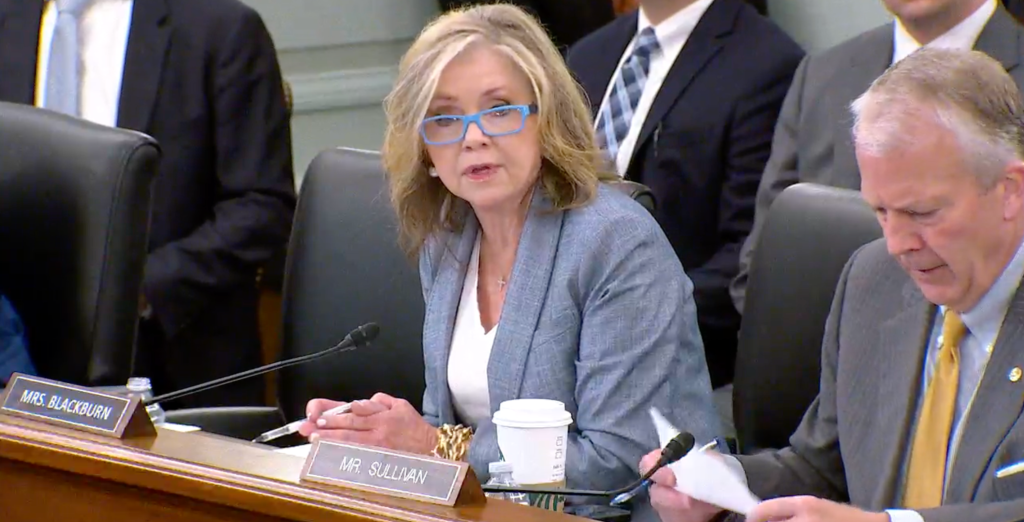
The committee reported KOSA favorably as amended by a substitute from Sen. Marsha Blackburn, R-Tenn., who told colleagues the bill now carries 75 Senate co-sponsors.
KOSA, a bipartisan bill sponsored by Blackburn and Sen. Richard Blumenthal, D-Conn., would require covered online platforms to take reasonable measures to prevent and mitigate specified harms to users under 17, including risks related to suicide, eating disorders, sexual exploitation, bullying, substance abuse and addictive platform design. The bill would require platforms to provide minors with the most protective privacy and safety settings by default.
Contrast with House version of the measure
The bill passed the Senate with broad bipartisan support in 2024, winning a 91-3 vote, but later stalled in the House. Blackburn used Wednesday’s markup to draw a contrast with the House version of KOSA passed by the House earlier this summer.
“The Senate cannot and will not accept the version that the House passed earlier,” she said, calling it “toothless” and “a pale imitation” of the Senate’s approach.
Sen. Dan Sullivan, R-Alaska, offered – then withdrew – an amendment to fold in his Ads for Mental Health Act, requiring platforms to report annually to the Federal Trade Commission on mental health public service advertising provided.
Two more bills cleared the committee without recorded objection: the CHATBOT Act, sponsored by Committee Chair Ted Cruz, R-Texas, and Sen. Brian Schatz, D-Hawaii, as amended, would establish parental controls and privacy protections for minors using AI chatbots; and the Children’s Artificial Intelligence Toy Safety Act, sponsored by Sen. Tammy Duckworth, D-Ill, would examine and address potential privacy and safety risks posed by AI-enabled toys marketed to children.
The panel also advanced the Youth AI Privacy Act, sponsored by Sen. Ed Markey, D-Mass., but not before a debate over how long AI chatbots should be allowed to retain minors’ personal information.
As introduced, the bill would have directed the Federal Trade Commission to establish limits on how long AI chatbots could use a minor’s personal data to shape future responses. The committee’s substitute removed that FTC rulemaking authority and instead created a 30 day default retention limit, while allowing parents to extend the period through verifiable consent.
Markey opposed a separate amendment that would have eliminated the 30 day cap, warning that it could allow chatbots to build effectively permanent memories of minors’ personal disclosures. “The 30-day limit is a reasonable guardrail against effectively having a permanent memory for minors,” he said. The committee ultimately adopted the substitute, preserving the cap.
Privacy advocates called the bill’s advance a win
Privacy advocates said they viewed the bill’s advancement as a win. The Electronic Privacy Information Center and more than a dozen coalition organizations urged the committee to support the measure in a letter Tuesday, citing provisions aimed at limiting manipulative chatbot design, restricting targeted advertising to minors, and protecting minors’ personal data from certain uses, including AI model training.
Not all bills fared as well. The SCREEN Act, from Sens. Mike Lee and John Curtis, R-Utah, failed to advance after the committee couldn’t reach quorum, with a 15-13 tally falling short despite four additional proxy votes. Ranking Member Maria Cantwell, D-Wash., said she could not support the legislation “as written today.”
The Computer & Communications Industry Association, whose members include Google, Meta and Amazon, sent a letter to the committee ahead of the markup outlining opposition to several of the bills, including KOSA, the Youth AI Privacy Act, and CHATBOT Act.
CCIA said it shares lawmakers’ goal of protecting young internet users but argued parents, using tools already available to them, should remain the primary drivers of their children’s online habits.
The group warned that the bills under consideration would replace that parental discretion with “prescriptive federal mandates” built on standards it called vague and inconsistent, raising constitutional concerns, threatening to restrict lawful speech, and creating significant compliance burdens for digital services.