
So Far, Approved BEAD Plans Largely in Line with Public Drafts
NTIA has approved 29 state plans; see updated BEAD charts with Breakfast Club Membership

WASHINGTON, Dec. 10, 2025 – The Commerce Department has approved broadband spending plans for 29 states under its $42.45 billion broadband expansion plan. So far, most of the approved plans don’t differ much from the draft results released by state broadband offices.
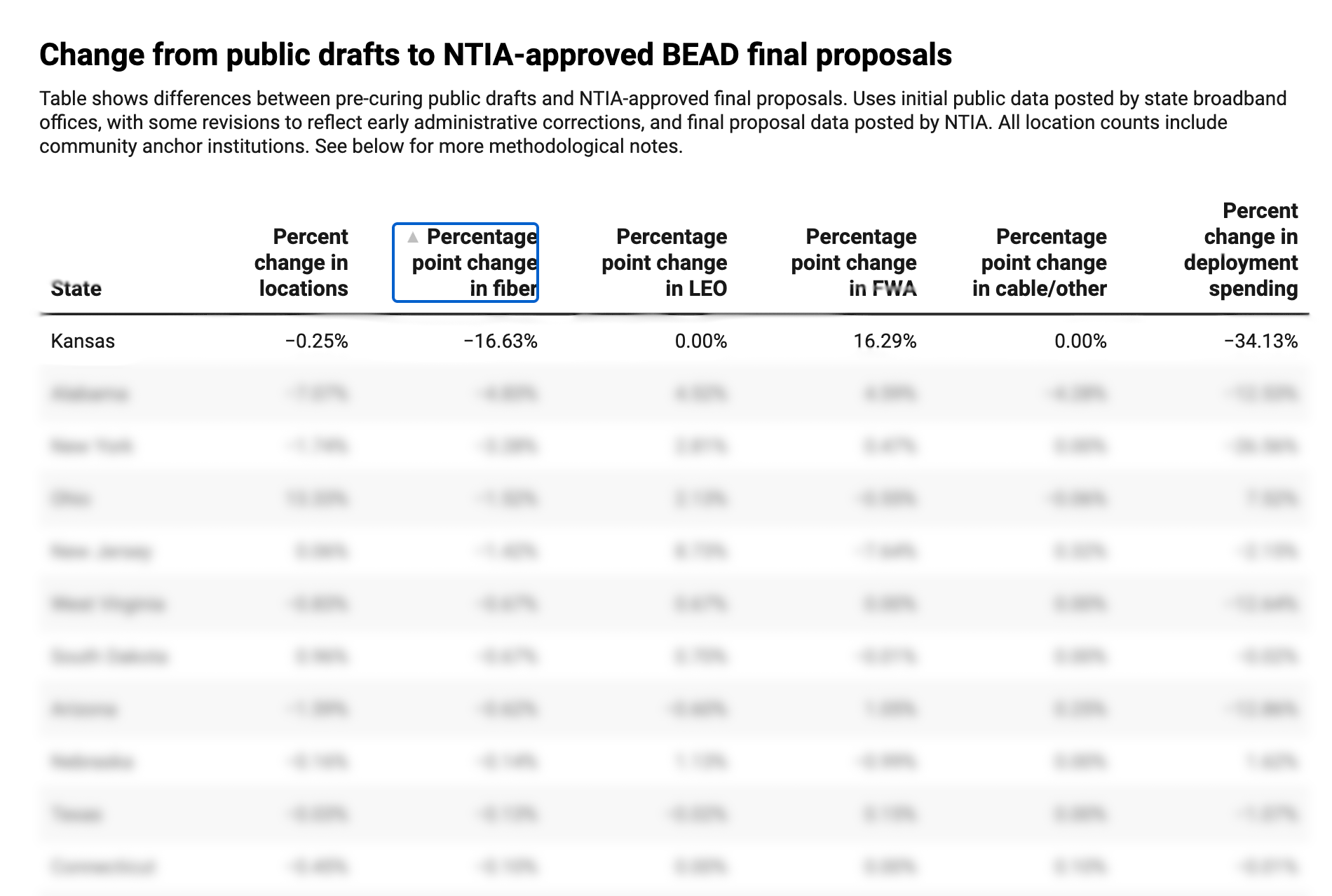
Kansas’s proportion of locations set to receive fiber fell by far the most of the approved states, a more than 16 percentage point drop. There was a corresponding increase in locations in line for fixed wireless, and a 34 percent drop in total deployment spending, the third largest of any state so far. The state’s total BEAD location count stayed roughly the same at about 26,600.
Fiber offers higher speeds and is considered more “future-proof” infrastructure, but costs more to deploy. The Trump administration has focused on cutting deployment costs and reversed an explicit Biden-era preference for fiber.
Alabama, the next largest reduction, saw a more than 4 percentage point drop in its share of both fiber and cable locations. There were corresponding increases in the share of locations receiving low-earth orbit satellite and fixed wireless. The state’s location count dropped by 7 percent and its deployment spending fell by more than 12 percent.
Some states, like Hawaii, Rhode Island, and New York, saw substantial spending decreases without major changes to their technology splits.
In Ohio, the total location count increased by more than 13 percent, the only state to see a material increase, and a 7 percent increase in spending. Iowa and Maine saw the largest reductions, at 12 percent and 13 percent respectively. Iowa’s deployment spending fell by more than 17 percent, while Maine’s was largely unchanged.
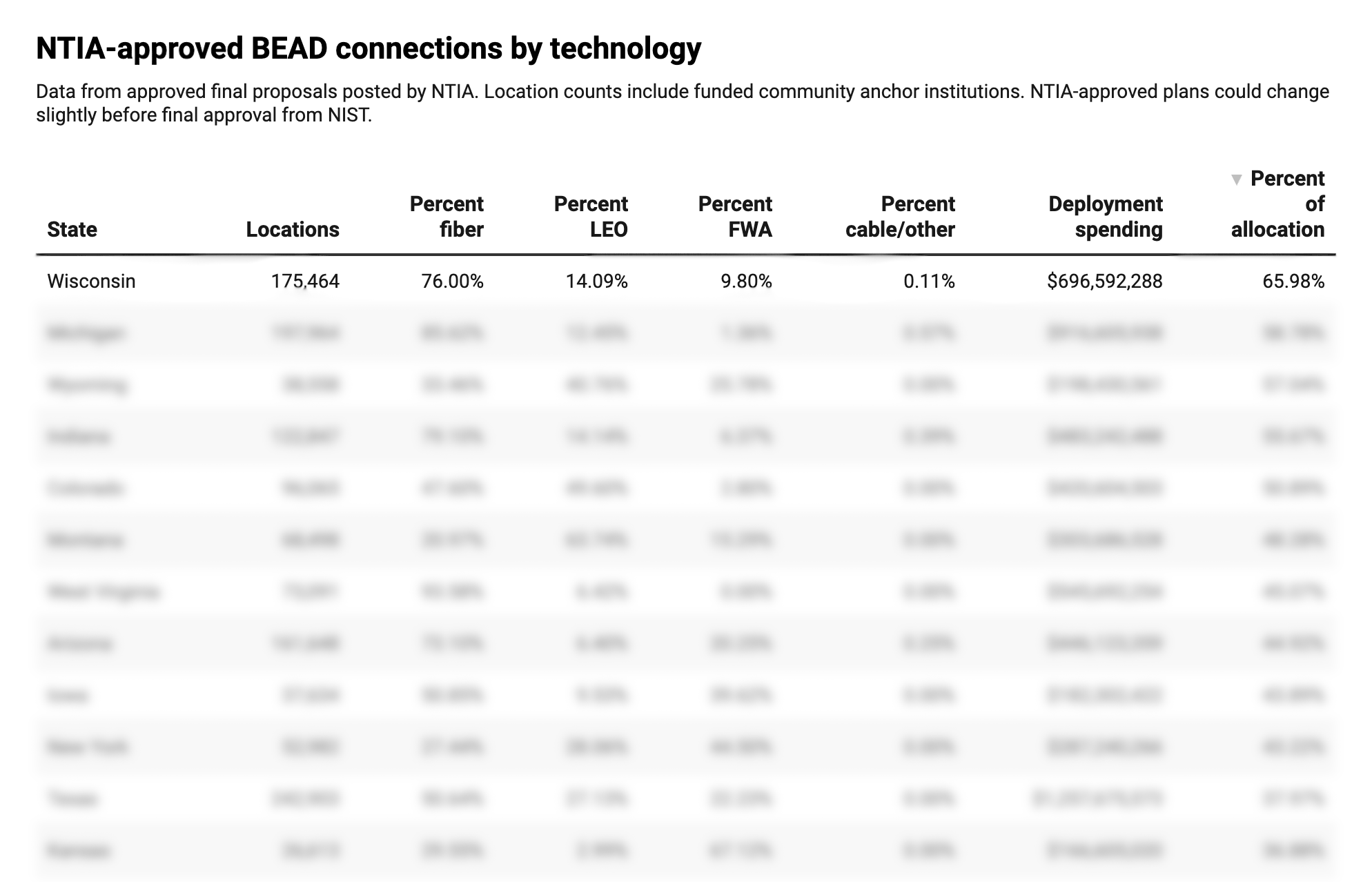
Among currently approved states, Wisconsin, Michigan, and Wyoming are spending the most of their allocations on deployment, at 66 percent, 59 percent, and 57 percent respectively. States like California and Oregon are planning to spend more of their allocations, but haven't been officially approved yet.
After approval from the National Telecommunications and Information Administration, the Commerce agency handling BEAD at the federal level, state plans need to be reviewed by a separate Commerce agency, the National Institute of Standards and Technology, before states can access their funding.
At least one state, Louisiana, is through that process and can sign contracts with grant winners and draw down its funding.
As part of the curing process, NTIA is asking states to negotiate down the prices of certain grants, those above state-specific per-location cost caps, and potentially award them to other providers that submitted cheaper bids. The draft bidding results that states posted for public comment before submission also had to be tentatively cleared with NTIA.
Based on the draft results from all 56 states and territories, around two-thirds of the 3.8 million BEAD locations will receive fiber, more than some fiber proponents had feared when the Trump administration updated BEAD’s rules in June but likely less than would have been the case originally. About 20 percent of locations are in line for satellite service, either from SpaceX’s Starlink or Amazon’s nascent Leo service.
NTIA Administrator Arielle Roth has said the agency expects states and territories to come in about $21 billion under budget for their deployment plans. It’s not clear what will happen to that cash, but Roth said last week the agency was “operating under the assumption that the states will get to use their BEAD savings. But again, nothing has been finalized.”
She said the agency would have more guidance to share on the issue in early 2026. Roth last month suggested she would support using some of the funds to streamline permitting in advance of a wave of BEAD-funded projects across the country.
Amid fears that Commerce Secretary Howard Lutnick would prefer handing the money, commonly called non-deployment funds, back to the Treasury, a group of more than 160 state legislators penned a letter to the agency Tuesday pushing for states to retain access to the funding.
“Bipartisan leaders at every level – governors, members of Congress, and state legislators – support unlocking these funds,” they wrote. “To do otherwise would ignore the law and leave rural and disconnected Americans behind.”





Member discussion