
‘Social Media is a Cancer’: Making Sense of the Charlie Kirk Assassination
Connecting the dots between Utah politics and culture, the hyper-partisan world of social media, and a tragic political assassination.
The name of our country, the United States of America, highlights that our sovereign nation is itself a federation of sovereign entities we call “states.” This “dual sovereignty” of federalism is a reality in law, in politics and in culture.
In this essay, I want to address one of these states and the spotlight into which it has been thrust by the assassination of 31-year-old conservative commentator and activist Charlie Kirk, on Wednesday in Orem, Utah.
The shocking event is still fresh and potent. Utah Gov. Spencer Cox (R) even termed our nation’s response to the incident as a potential “turning point for our country,” he said at the Friday press conference at which the apprehension of a suspect was announced.
The shooting took place on Wednesday around noon at Utah Valley University, a state school in Orem. Kirk had brought his Turning Point USA organization, based in Arizona, to engage in debate with students on college campuses. Kirk is a fiery and controversial figure. He has been given much credit for mobilizing the youth vote for Donald Trump in the 2024 election.
Part of that success has to have been his willingness to confront ideological hostile students, as he was doing at the very moment he was shot.
The assassination’s impacts could be dramatic. My intention in this essay is to speak to, or at least touch upon, a few of these issues, including:
- The cultural diversity of our states, including the state of Utah, and how states bring a diversity of views into the national federal republic;
- How important it is for citizens in the public square must interact with civility;
- How, if “social media is a cancer,” those involved in internet technology and internet access can and should approach social media in positive ways.
Utah Valley: More conservative than Salt Lake City
I lived in Orem, Utah, from 2013 to 2019. Living in Orem and playing an active role in its legal and civic affairs (even running, unsuccessfully, for city council in 2017), I spent a good bit of time at Utah Valley University, a state university of 48,000 students. My oldest son and daughter, then in their teenage years, practiced orchestra at UVU. That son did his Eagle Scout Project at UVU. His graduation from a nearby charter high school was held at UVU, in and around that now-scarred courtyard.
My ties to the university continue even now, making these past several days disorienting. My oldest daughter has attended UVU; many of her friends are UVU students; and some were in the courtyard when Kirk was killed.
Orem and neighboring city of Provo make up the heart of “Utah Valley,” a name more common than its official Utah County. Orem is 40 miles south of Salt Lake City. Perhaps because of its proximity to Provo and the 150 year-old Brigham Young University, the 35,000-student university of the Church of Jesus Christ of Latter-day Saints, Orem and Utah County — and also Washington County, in the very south — are among the most conservative parts of the state.
But what does “conservative” mean today, anyway? In this context, it means that, generally speaking, Utah Valley has a higher degree of membership in and activity in the church than in Salt Lake County. “Conservative” in the Utah context also used to mean a higher degree of allegiance to the Republican Party. Although that, as we’ll see, may be changing.
Not approving of Donald Trump, at least initially
Mormons were not particularly approving of Donald Trump’s takeover of the Republican Part in 2016. Remember that one of their own, Mitt Romney, was GOP presidential candidate in 2012 (when he was from Massachusetts). Then, as U.S. Senator from Utah from 2018 to 2024. Romney became Trump’s biggest critic within the Republican Party.
I also saw this hesitance toward Trumpism through a state-wide vantage point I had briefly as Opinion Editor of, and later columnist for, the Deseret News. The Deseret News is the daily news publisher owned by the church. And while it doesn’t endorse political candidates, the newspaper drives the dimensions of debate in the state’s civic sphere.
Politically, what are the contours of such debate in Utah? Traditional Republican. I would sum that up as being (1) socially conservative and supportive of religion and religious freedom; (2) Reaganite in its approach to free markets and national defense; and (3) focused on civility in public discourse and engagement.
Even though now only about half of Utah’s population are Latter-day Saints, the governor, both senators, and most representatives and state legislators are members of the Church of Jesus Christ of Latter-day Saints. The church has a significant effect on religious and public life in the state. Church President Russell M. Nelson, whom Latter-day Saints regard as a prophet, has in the past several years increasingly emphasized that important role of civility in political discourse. In his most recent semi-annual address at the church’s General Conference, in April, he said:
True charity towards all men is the hallmark of peacemakers! It is imperative that we have charity in our discourse, both public and private. I thank those of you who took my previous counsel to heart. But we can still do better.
The present hostility in public dialogue and on social media is alarming. Hateful words are deadly weapons. Contention prevents the Holy Ghost from being our constant companion.
As followers of Jesus Christ, we should lead the way as peacemakers.
 President Russell M. Nelson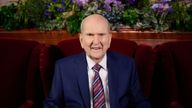
Nelson’s “peacemaker initiative” has been gathering steam. While it's certainly not partisan in any way, it is attempting to lower the pressure of political polarization.
For at least two generations, the Democratic Party has not been relevant in Utah politics. Yet Utah was one of only two states, Republican or Democratic, in which the Democratic Party candidate did slightly better in the presidential contest of 2024 than in 2020.
This hasn’t led to a full renaissance for the Democratic Party, there has been an uptick of support for it. And, statewide, there has clearly been a more persistent emphasis on the need for civility, and the need to de-escalate partisanship.
Yet there are many voices in politics
Yet Utahns - and even Republican Utahns - are not uniform. While Romney’s Senate tenure was marked by criticism of Trump, the other Utah GOP Sen. Mike Lee has taken another path. He’s moved from being a Trump skeptic who voted against his candidacy in 2016 to being one of the most MAGA-aligned legislators in the Senate.
Both in his tweets on his “BasedMikeLee” X account, and in his tactical work in the chamber, Lee has become deeply intertwined with the far more pugnacious and populist Republican Party of 10 years later. Lee’s posts have been rancorous. After the political assassination of Minnesota State Democratic legislator Melissa Hortman and her husband Mark in June, Lee posted a mocking reference to Minnesota Gov. Tim Walz, D. One tweet was Titled “Nightmare on Waltz Street.” The other read, “This is what happens When Marxists don't get their way.” Lee deleted the tweets after he was confronted in the U.S. Capitol by Sen. Amy Klobuchar, D-Minn.
In a brief aside from an a very thorough interview with and feature story about Charlie Kirk that Deseret News Reporter Brigham Tomco conducted in August – previewing his imminent tour of two Utah college campuses, including UVU – Kirk told the Deseret News that he text-messaged with Lee “every day.”
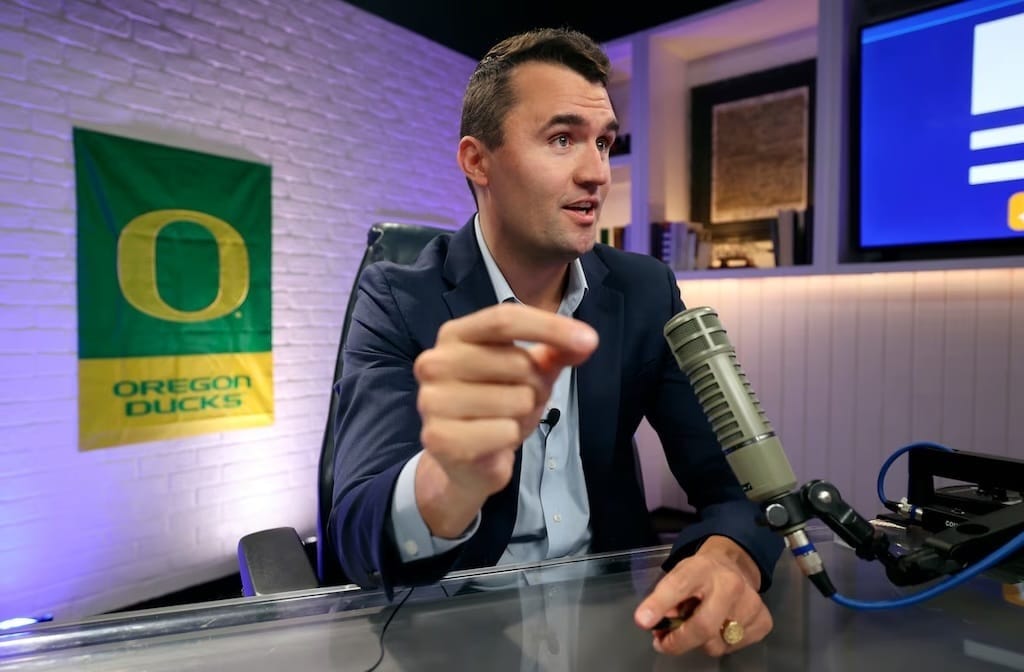
Another Deseret News article by Reporter Emma Pitts, published the day before the event at which Kirk was killed, recounted the events leading up to Kirk’s appearance at UVU. That included petitions seeking to get university administrators to un-invite Kirk. The article noted that Kirk had asked Sen. Lee to appear on his video podcast, and Kirk asked Lee what the negative reaction was all about.
“People are very angry. They’re calling for my cancelation,” said Kirk. “This is a greater response than when I go to Berkeley. Sen. Lee, what is going on in the beautiful state of Utah?”
Lee responded that despite the critics, he expected Kirk’s visit to be productive and a necessary defense of free speech and intellectual diversity, which he said so many college campuses don’t provide for their students.
The manhunt for the killer and Gov. Cox’s moment
The shooting unleashed many emotions, and Gov. Cox was leading the nation through the tragedy, with important messages for the future of democracy and technology along the way.
On Wednesday, Cox urged everyone – including those “who hated what Charlie Cook stood for” to “put down their social media and their pens and pray for his family.”
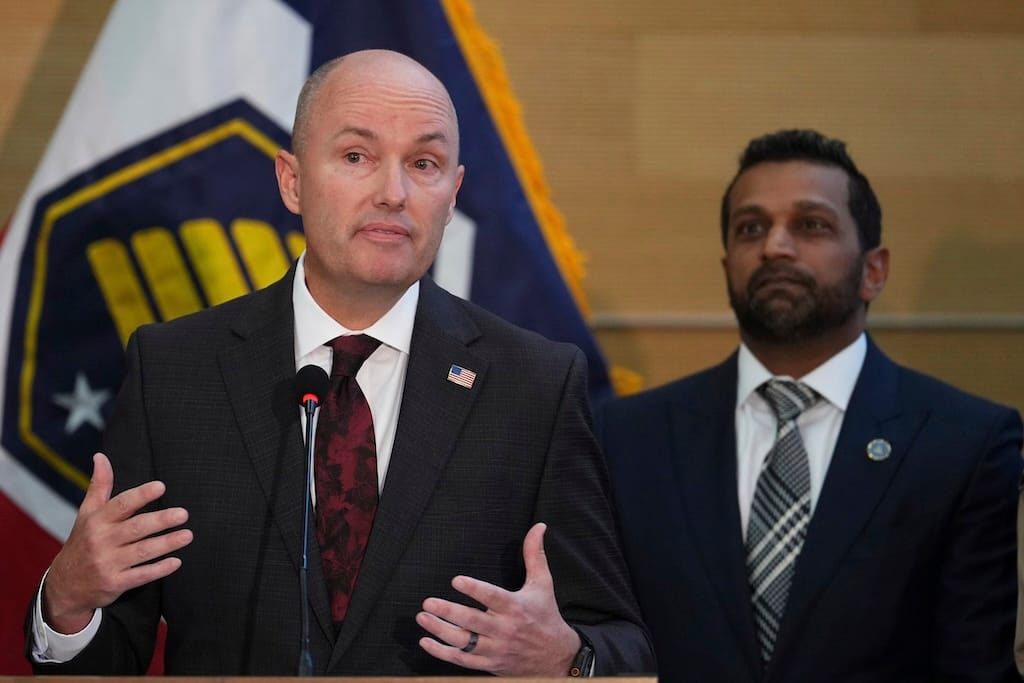
On Thursday night, when the suspect was still at large, Cox spoke side-by-side with FBI Director Kash Patel. Cox displayed at the press conference a video of the suspect fleeing UVU’s rooftop, from which the shooting had taken place. He thanked the media for its work is disseminating information that would, he hoped, lead to a tip.
And then at a press conference on Friday morning, Cox, Patel and Utah County Sheriff Mike Smith laid out the evidence liking the suspect to the shooting, and discussed the 33-hour manhunt before Cox offered some additional important words.
After Cox laid out the facts about the apprehension of the suspect, 22-year-old Tyler Robinson, FBI Director Patel briefly thanked Cox and said, “This is what happens when you let good cops be cops.”
Sheriff Smith, a beefy bearded cop wearing a Cattleman’s hat, came next. He thanked the FBI, the sheriffs across Utah. And then, “most of all, I would like to thank the public, and specifically I would like to thank the public who turned to prayers and who turned to positiveness for us.” He said those prayers sustained the police during the manhunt.
How to have civil discourse in an uncivil time
Then Cox delivered this message. To those who questioned why the police and the state were so invested in tracking down the assailant when there is violence all across the country “and every life taken is a child of God who deserves our love and respect and dignity,” Cox offered this eloquent answer:
Charlie Kirk’s assassination was “much bigger than an attack on an individual. It is an attach on all of us. It is an attack on the American experiment. It is an attack on our ideals. This cuts the very foundation of who we are, of who we have been, and who we could be in better times.
“Political violence is different than any other type of violence for lots of different reasons,” he continued.
In having Kirk’s life cut short in the very act of “that freedom of expression that is enshrined in our founding documents,” the crime “makes it more difficult for people to feel like they can share their ideas, that they can speak freedom. We will never be able to solve all the other programs, including the violence problems that people are worried about if we can’t have a clash of ideas safety and security. Even especially - especially - those ideas with which you disagree. That’s why this matters so much.”
But he continued, turning to advice he attributed to having received from Kirk: “Charlie said, when people stop talking, that’s when you get violence. He said the war can never forgive. Forgiveness is the attribute of the story. The only way out of the labyrinth of suffering is to forgive.”
He addressed young people: “You are inheriting a country where politics feels like rage. It feels like rage is the only option… Your generation has an opportunity to build a culture that is very different than what we are suffering through right now. Not my pretending differences don’t matter, but by embracing our differences and having those candid conversations.”
Finding an off-ramp
Cox specifically rebutted a concern that he said he hears often: “I hear all the time that words are violence. Words are not violence. Violence is violence. And there is one person responsible for what happened here, and that person is now in custody, and will be charged soon and will be held accountable.”
To that clear statement of accountability, individual rights and responsibilities, Cox did venture to express his prayer - an unanswered prayer - that the assailant “wouldn’t be one of us,” wouldn’t be from Utah, or wouldn’t be from the United States. But he was. Media reports suggest that Robinson was raised as a Mormon, in a strongly Latter-day Saint community in southern Utah.
“That prayer was not answered the way I hoped for,” Cox acknowledged. But he laid out this certainty: “We can return violence with violence, we can return hate with hate. And that’s the problem with political violence is it metastasizes. Because we can always point the finger at the other side. And at some point, we have to find an off-ramp or it’s going to get much, much worse.”
“History will dictate if this is a turning point for our country. But every single one of us gets to choose right now if this is a turning point for us. We get to make decision. We have our agency. And I desperately call on every American, Republican, Democrat, liberal, progressive, conservative, MAGA, all of us to please, please, please. Follow what Charlie taught me.”
‘Social media is a cancer on our society right now’
Cox has taken a lead on another issue regarding the role of social media in society. Specifically, he is attempting to curb its influence with youth.
Several months after Utah became the first state to pass laws regulating children’s social media use in 2023, it sued TikTok and Meta for allegedly luring in children with addictive features.
 Clara Easterday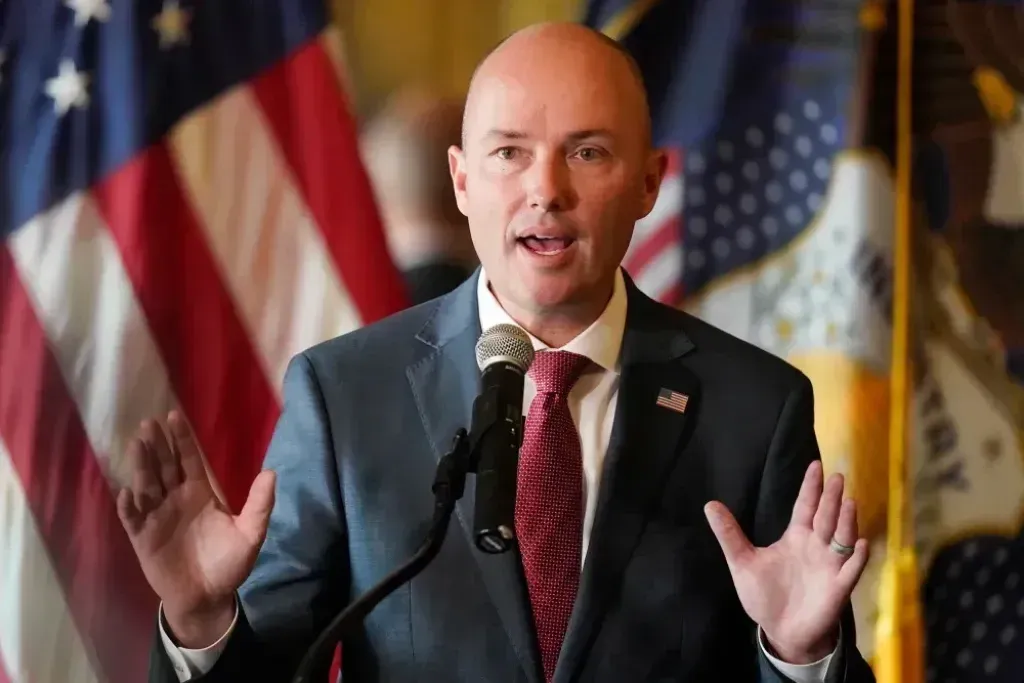
Under the 2024 Utah law, default settings for minor accounts would have been required to restrict access to direct messages and sharing features and disable elements such as autoplay and push notifications that Cox and Utah lawmakers argue could lead to excessive use. The settings also limit how much account information social media companies can collect.
Throughout this past week at the bully pulpuit, Cox returned again and again to the ill effects of social media, from having to witness the viral images of the death of Charlie Kirk, and others, and also from polarization exacerbated by social media
“Social media is a cancer on our society right now. And I would encourage people to log off, turn off, touch grass, hug a family member, and go do good in your community.”
Ratcheting the political partisanship down?
Cox, as chairman of the National Governors Association in 2023-24, made his initiative “Disagree Better: Healthy Conflict for Better Policy,” a hallmark of his service on the national stage.
More recently – just two weeks ago – Cox was back in Washington at the National Press Club, on stage with Maryland Gov. Wes Moore, a Democrat. They were specifically extolling the need to work together, and Moore recounted how, in the wake of the shipping tragedy at the Baltimore Harbor on March 26, 2024, Cox was one of the first to reach out with words of support.
When tragedy strikes it is an opportunity to come together, Cox had said.
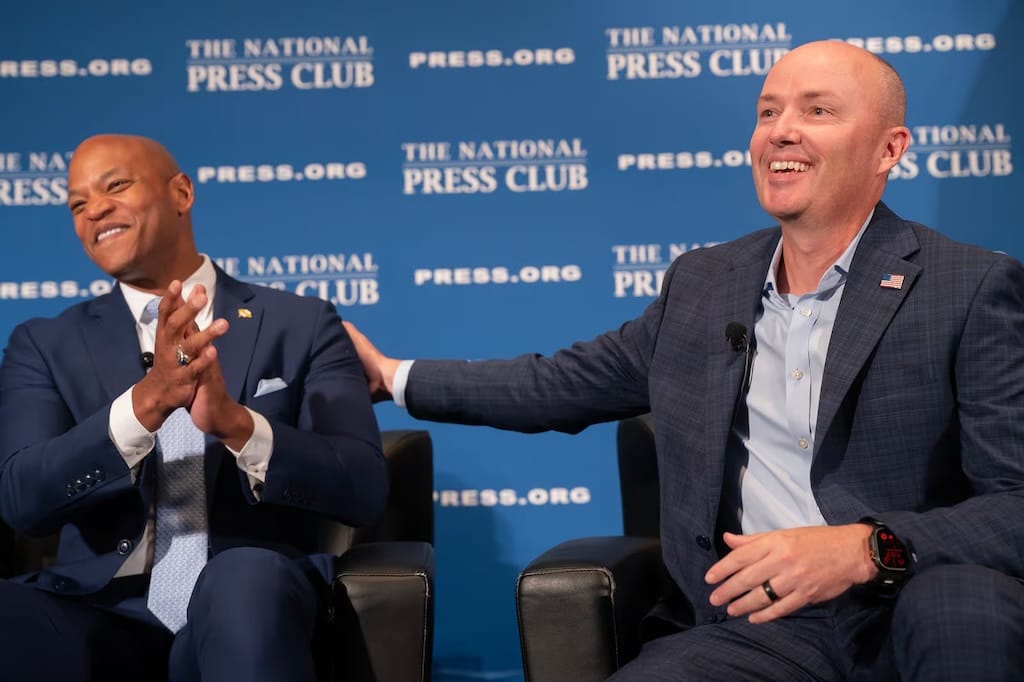
“Everything is becoming politicized,” Cox said at that forum on Sept. 4. “Usually, we would get a few days when something terrible happened in our nation, before we went to our partisan corners. And now you don’t even get a few minutes.”


Member discussion