SpaceX Logs Thirteenth Starship Launch, First Starlink V3 Test
MoffettNathanson analysts don’t expect the rocket to reach reusability this year

Jake Neenan
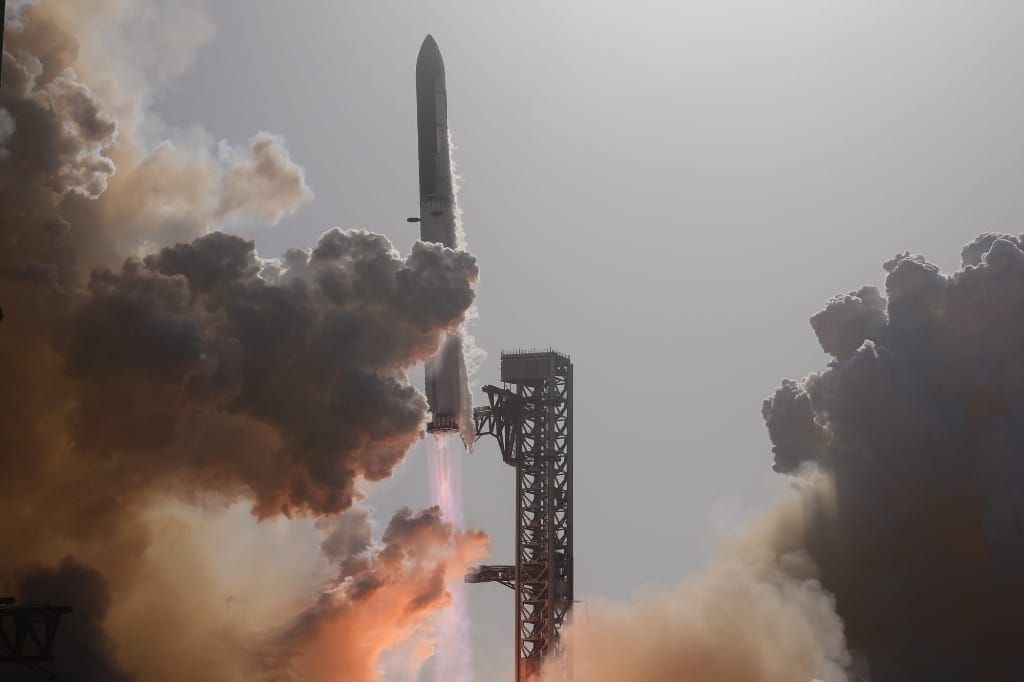
WASHINGTON, July 27, 2026 – SpaceX successfully launched its massive Starship rocket for the thirteenth time Friday, testing 20 next-generation broadband satellites in the process.
The rocket splashed down intact in the Indian Ocean. Its booster landed harder than expected in the Gulf of Mexico after some engines failed to reignite.

SpaceX’s ultimate goal is for both components to be entirely reusable; after falling through the atmosphere, they would reignite their engines to slow down and be caught midair by large mechanical arms. The reusability and massive size would dramatically reduce launch costs for the already dominant rocket company.
The landed Starship unit provided “critical views of an intact heatshield for the first time,” the company said. A reusable Starship will need to be able to repeatedly withstand the high temperatures of reentering the atmosphere at high speed.
The company scrubbed a planned launch last week after some of the booster’s engines failed to fire, but the rescheduled test Friday went largely as planned. Those engines were replaced before the launch.
Once Starship is up and running, it would be a workhorse for launching SpaceX’s direct-to-device and broadband satellites — the company is currently seeking approval for 15,000 and 100,000-satellite constellations for those services — plus satellites used by other companies paying for the launch service.
The unit can hold four times as much as Spacex’s current go-to Falcon 9 rockets, and the company has ambitions for an even larger version that could hold nine times the payload.
That extra capacity will be a necessity for the huge constellations the company is planning and the much larger satellite that will compose them, MoffettNathanson analysts said in a Monday investor note.
SpaceX plans to start Starship use this year, but the analysts expect it will take longer to get off the ground.
“Our own expectation is that Falcon 9 continues to be used for the bulk of launches associated with external workloads, and Starship ramps to ~50-60 flights annually to serve largely internal workloads by the latter half of the decade,” the analysts wrote. They included founder Craig Moffett and analysts Julie Zhu and Nick Del Deo.
The test launch was the second featuring both Starship and the latest booster, called Super Heavy V3, and the first launch with next-generation Starlink V3 broadband satellites.
Those satellite units are expected to provide much better performance than the V2 units, of which more than 9,000 are in orbit. Analysts have said they still expect Starlink to be primarily a rural service even with the speed and capacity boost.
Friday’s launch won’t add any benefit to the current constellation, though. It was a test run aimed at making sure the V3 units could communicate with ground stations and other satellites.
The 20 test satellites were then sent to burn up in the atmosphere.
“SpaceX engineers were able to successfully communicate with every satellite using radio frequency and laser links and downloaded key telemetry from the satellites,” the company said. “The Starlink satellites were deployed on the pre-planned trajectory and are expected to have demised upon reentry approximately 20 minutes after deployment.”
SpaceX reports its first quarterly results as a public company Aug. 4.