SpaceX Scheduled 2027 Launch of 1,200-Satellite Mobile Constellation

SpaceX said its Starlink Mobile connected thousands during California's wildfires and Japan's earthquakes.


SpaceX Scheduled 2027 Launch of 1,200-Satellite Mobile Constellation
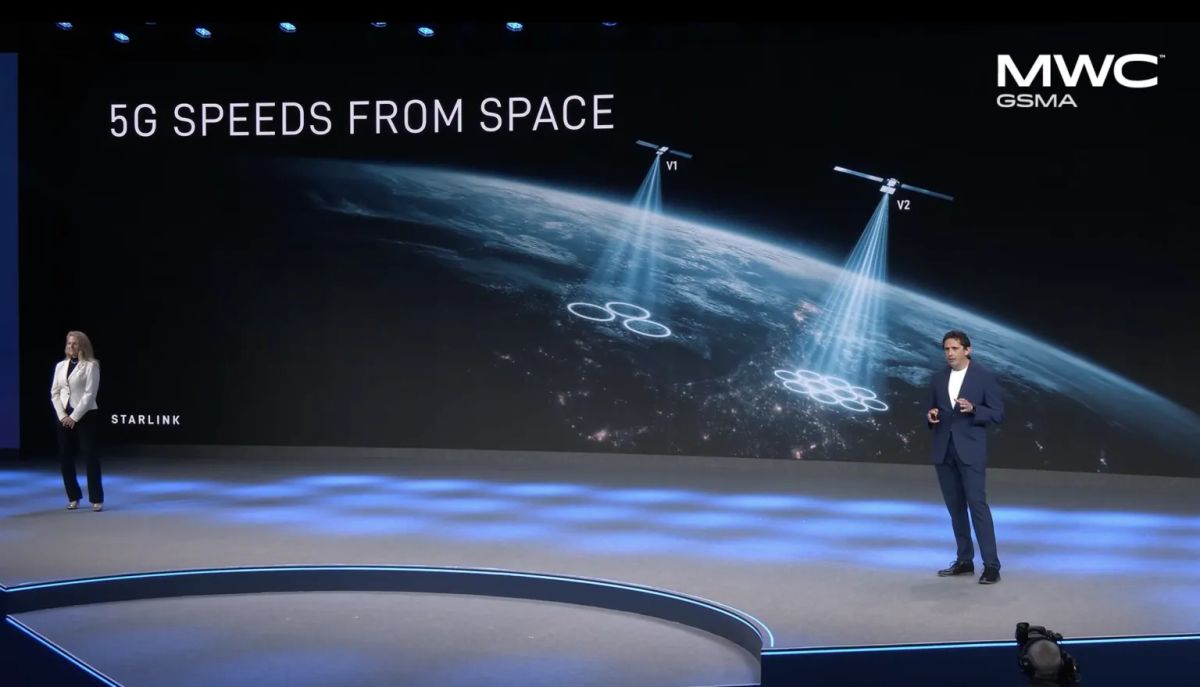
Photo of Gwynne Shotwell, SpaceX president and chief operating officer, and Starlink Senior Vice President Michael Nicolls, from Mobile World Congress

BARCELONA, March 3, 2026 — SpaceX, the Elon Musk-led aerospace company, said Monday it does not intend to compete with wireless carriers as it expands Starlink Mobile, its direct-to-cell satellite service.

“We are not building a replacement for terrestrial mobile networks,” Michael Nicolls, senior vice president of Starlink engineering at SpaceX, said during the company’s Mobile World Congress keynote. He said the system was designed to extend carrier coverage into remote areas and maintain service when towers or backhaul links fail.

SpaceX said it has fully deployed its first-generation direct-to-cell constellation and will begin launching a second-generation system in 2027 designed to deliver download speeds of up to 150 megabits per second.

First-generation deployment

Nicholls said the first-generation Starlink Mobile system consists of 650 satellites operating at roughly 350 kilometers in low Earth orbit and is fully operational across five continents.

The broader Starlink network now includes nearly 10,000 satellites in low Earth orbit, he said, making it the world’s largest satellite constellation.

Starlink Mobile has connected more than 16 million unique users and averages 10 million monthly active users, Nicholls said. SpaceX projected monthly active users would exceed 25 million by the end of 2026.

Nicholls said the direct-to-cell system connects standard LTE smartphones, meaning devices using Long Term Evolution technology, in areas without ground-based coverage. When the program launched in 2024, roughly 90 percent of the Earth’s surface lacked terrestrial mobile service, he said.

Purpose and global expansion

Gwynne Shotwell, president and chief operating officer of SpaceX, said the company was founded 24 years ago to build rockets and spacecraft capable of enabling human settlement beyond Earth.

“You cannot live on the Moon and Mars without connectivity,” Shotwell said, adding that Starlink was designed both to support future space missions and to expand access to banking, healthcare, education and emergency services for underserved populations here on Earth.

Starlink began launching satellites in 2020, she said, with a focus on extending service to remote and disaster-prone regions.

Emergency communications

Shotwell said satellite connectivity was deployed during the 2025 Los Angeles wildfires, connecting more than 400,000 people and transmitting more than 250,000 SMS messages and 150 wireless emergency alerts.

The system was also used following earthquakes in Kamchatka and Aomori, Japan. Shotwell said more than 4.4 million people globally had connected to Starlink Mobile during emergencies.

SpaceX has provided Starlink broadband and mobile services in Ukraine since the start of Russia’s invasion, Shotwell said, with more than 3 million customers subscribed.

Second-generation constellation

Nicholls said SpaceX will begin launching a second-generation direct-to-cell constellation in mid-2027 using its Starship rocket.

The company plans to deploy about 1,200 satellites within six months to provide global voice and data coverage.

Nicholls said the service is expected to use S-band spectrum, a radio frequency range commonly used for satellite communications, subject to regulatory approvals in individual countries.

Member discussion

Popular Tags