State Broadband Leaders Frustrated by Federal Changes to BEAD Program
States like Kentucky are including less fiber (58%) than in earlier BEAD proposals (85%).

Naomi Jindra
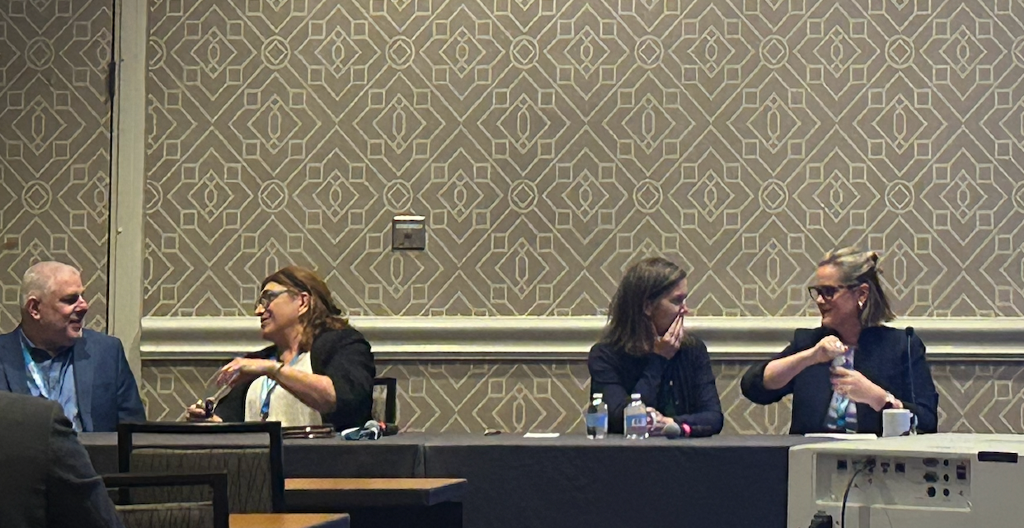
ARLINGTON, Va., Oct. 30, 2025 — State broadband representatives expressed frustration Thursday about the many recent changes made to the Broadband Equity Access and Deployment program this year.
“This is an infrastructure project, and renting space on satellite is not,” said Christine Hallquist, executive director of the Vermont Community Broadband Board, speaking at the AnchorNets2025 conference here hosted by the Schools, Health and Libraries Broadband Coalition.
Hallquist said her team has spent long nights fielding repeated questions about Vermont’s BEAD application and facing pressure from National Telecommunications and Information Administration to include satellite coverage.
“Not only will we get pressure on satellite, the only questions we got about the business plan were about our community networks,” she said. “So it appears to me like this administration does not like community networks in Vermont.”
The state’s plan, now awaiting final federal approval, aims to reach 97% of addresses with fiber, 2.7% with hybrid cable, and only 0.3% with satellite.
"In Vermont, if you look at the 1,358 locations that are going to be served by satellite, half of them will not get service because of the geographic issues, the mountains are in the way and [because of] the heavy foliage"
Shifting Kentucky’s project mix
Meghan Sandfoss, executive director of Kentucky’s Office of Broadband Development, noted that recent changes in federal guidance and cost priorities have shifted Kentucky’s project mix.
While early BEAD proposals were 85% fiber, that number has dropped to 68%, with 25% low-Earth orbit satellite, about 6% fixed wireless, and less than 1% coaxial cable. The increased focus on lower-cost solutions, she said, led some providers to drop out and reshaped the state’s broadband strategy.
Michael Baldino, director of the Massachusetts Broadband Institute, said the state initially saw potential benefits in the federal program’s loosened requirements.
But the reality proved more complicated. “A lot of the requirements for the program had been eliminated, climate, the affordability, requirements, workforce. And those are all very valuable model policy goals. We did think [that] because we had so few locations left, that actually having fewer requirements of the program would generate more interest among providers who are sitting on the sidelines for BEAD.”
But that didn’t materialize.
Baldino explained that new federal deadlines created additional hurdles. “There’s a 90-day shot clock that was very problematic,” he said. “Every state had to run their process roughly at the same time, and providers were signaling very early that was going to be a challenge because they had to decide where to allocate their resources.”
As a result, he said, “a lot of providers in Massachusetts decided the juice isn’t worth the squeeze” because of the low number of locations available in the state.
Currently, about 48% of Massachusetts’ remaining broadband serviceable locations are slated for low-Earth orbit satellite coverage, with the rest served through fiber or hybrid fiber-coax systems.
Potential uses for non-deployment funds
When asked about how they plan to use non-deployment funds, all three broadband leaders emphasized flexibility and digital inclusion. Hallquist said her state hopes to invest in workforce development, cybersecurity, and rural initiatives like precision agriculture and telehealth. Additionally, Vermont hopes to build an internet exchange point with those funds.
Baldino outlined plans to use roughly $120 million to expand access for community institutions, strengthen digital equity and cybersecurity programs.
Sandfoss said her state’s remaining funds could go toward improving cell service, public Wi-Fi, and Next Generation 911 — investments she said are vital for safety and keeping rural communities connected and economically viable.
Member discussion