States Working on Finalizing BEAD Contracts, Beginning NEPA Reviews
Most states now have approval to sign grant agreements with ISPs under the program.

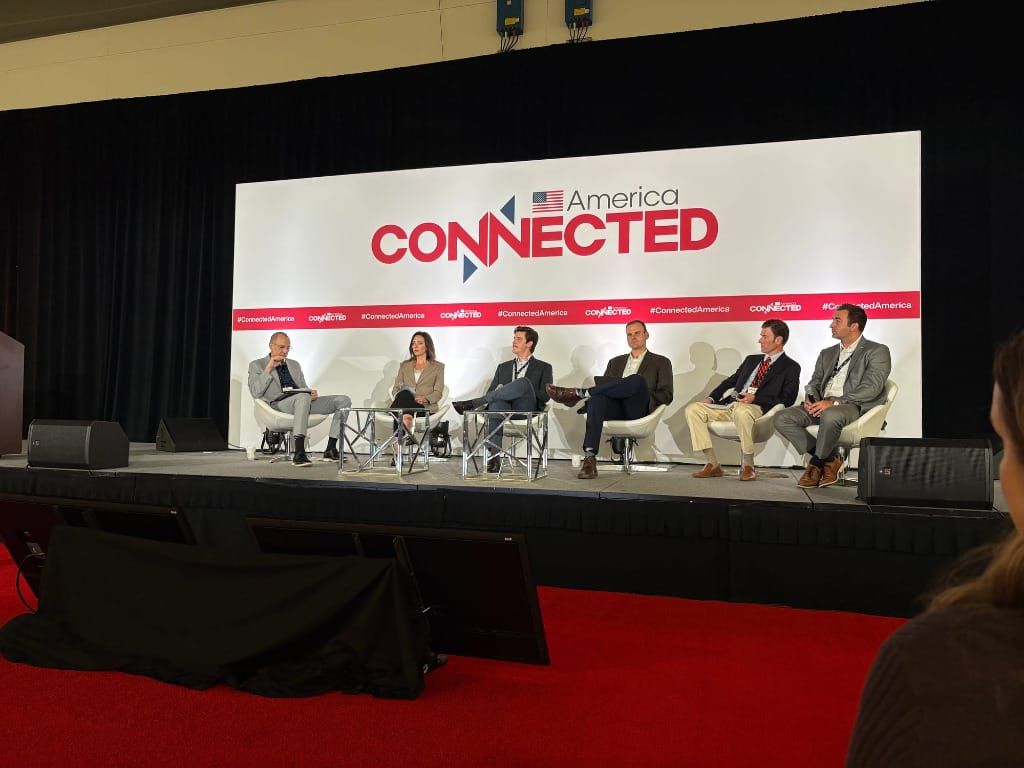
DALLAS, April 15, 2026 – After getting final approval on their spending plans under a $42.45 billion broadband grant program, states have six months to finalize contracts with participating ISPs.
That and other prep work are taking a lot of state broadband offices’ attention, officials said at the Connected America show in Dallas Tuesday.
For the Broadband Equity, Access and Deployment program, Commerce’s National Institute of Standards and Technology had to give the final go-ahead on states’ final spending plans. The National Telecommunications and Information Administration, another Commerce agency, is handling BEAD and evaluating spending plans on a policy level.

As of April 13, most states and territories had received NIST approval and signed those award agreements, unlocking their funds. Just California, Oklahoma, and Illinois are still awaiting NTIA approval.
“After the state gets NIST approval, and in our case in Arizona it was December 29, we have six months to do all of this,” said Nicholas Capozzi, director of Arizona’s broadband office. “So it’s really critical that we’re doing all of these things concurrently.”
That includes finalizing the text of grant agreements ISPs will sign – those tend to be uniform among all participating providers in each state – as well as preparing for environmental and historical reviews.
Brandy Reitter, executive director of Colorado’s broadband office, said the state had sent grant agreements to all of the ISPs selected for BEAD awards in the state.
“Those are due at the end of July,” she said. “Hopefully folks sign them.”
Colorado awarded nearly half of its roughly 90,000 BEAD locations to satellite providers SpaceX and Amazon. Earlier this year SpaceX asked states to agree to waive certain BEAD performance testing requirements that it said could make satellite participation in the program “untenable,” a request that NTIA ultimately rejected.
Bryant Clayton, head of Texas’s broadband office, said the state had sent “a number of” agreements to ISPs and was “finalizing” the rest of them. Those will have to be signed by June 4.
Virginia is in the “final phases” of preparing the text of its grant agreement after taking ISP input, said Chandler Vaughan, acting director of the state’s broadband office, and was in the early stages of environmental reviews.
Capozzi said Arizona was in a similar boat with respect to environmental reviews, but was hoping to have ISPs’ grant agreements signed “in the next couple of months.” He said the state had solicited input from its BEAD winners on its contract language.
Aquiles Trujillo, deputy director of New Mexico’s broadband office, said the state was “about two days” from signing its award agreement after securing NIST approval on March 20.
NEPA
Under the National Environmental Policy Act, BEAD projects will have to undergo reviews for their potential impacts on the environment and historical sites.
NTIA has spent years making an electronic system for handling those reviews and expanding its suite of exemptions to allow as many projects as possible to avoid granular, time-consuming reviews.
Vaughan said Virginia had collected ISPs’ planned fiber routes and tower locations to get started on that filing work. In what he said was a unique arrangement, the state is contracting with local governments to handle much of the NEPA process for participants.
He said he expected the NEPA process to take 90 days for most projects, but like that work can start before ISPs’ contracts are officially signed.
Capozzi said Arizona was convening state historical preservation offices, which will need to sign off on the historical reviews, and BEAD providers to preemptively smooth over any issues in that process.
Vaughan said BEAD participants laying fiber should have environmental reviews done on both sides of any given road they plan to follow. That way if plans changed during construction, a build wouldn’t be held up for another 90 days waiting for a separate review.
Defaults
Reitter said she and her team “fully anticipate having to cover defaults” in Colorado. She said her office was trying to work with participants as much as possible throughout the builds to shepherd them through a program that’s much more complicated than other broadband funding efforts.
Trujillo said established providers in New Mexico “didn’t participate that much” because of uncertainty about whether they would be able to continue collecting Federal Communications Commission operational subsidies throughout their footprint if they did. There was concern about that last year, but NTIA later said companies would only be barred from taking new opex support for BEAD locations.
He said the office was used to being hands on with smaller ISPs in other programs and would likely do so with newer BEAD providers, but that he was still concerned.
Vaughan said broadband providers that bid on BEAD locations but were unsuccessful should tell states if they’re still interested in serving those areas. He said if the preliminary awardee pulls out, guidance from the NTIA “gives a lot of flexibility to state broadband offices” on finding a replacement ISP to serve those locations, even if it involves spending more money.
BABA, supply chain
Klein Law Group attorney Philip Macres, who moderated one of two discussions with state broadband officers, said he had heard of providers still having issues securing fiber that complied with BEAD’s domestic manufacturing requirements.
Vaughan said Virginia had heard from “a couple companies” that this was an issue, but he advised other states to verify that orders had actually been disrupted.
“I think state offices would be wise to try to secure documentation from those fiber providers that that is actually the case,” he said. “There might be a financial issue that’s masquerading as a fiber shortage.”
Major suppliers like Corning have insisted they will have enough supply to meet demand from both BEAD winners and tech companies building out data centers.
Vaughan and Capozzi both said they interpreted NTIA’s Buy America rules to require them to do site visits and verify that the required materials are actually American made.
Financing
Vaughan noted that for ISPs opting for a performance bond as part of their BEAD project, those had to be secured within 60 days of signing a grant agreement with the state. For providers going with a letter of credit, those had to be secured before the grant agreements were signed.
The amounts of those can vary from 10 to 25 percent of the total project cost depending on the state.