Systems Emerging to Balance Data Center Environmental Impacts
The industry is experimenting with ways to reduce its footprint, panelists said.

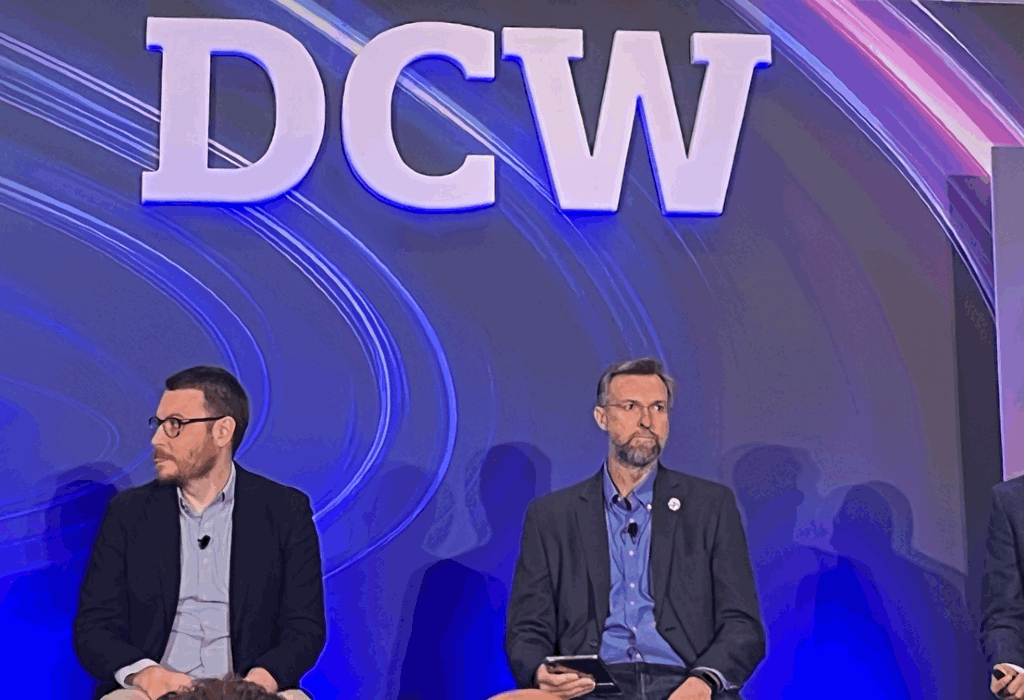
WASHINGTON, April 21, 2026 – Challenges arising from rapid AI data center growth are widely misunderstood, panelists said Tuesday at Data Center World.
Hyperscale AI clusters now require 10 to 20 times more power per site, pushing campuses that once ran at 50 to 100 megawatts toward one gigawatt. That expansion is colliding with grid constraints, public scrutiny over water use, and a tightening labor market.
William Hassel, sustainability program manager at Turner Construction, said data centers are increasingly integrated into grid operations. “Data centers are actually helping enable the grid,” Hassel said, pointing to aging transmission infrastructure.

Data centers are beginning to act as grid-balancing infrastructure through demand response and load shifting, he said, citing the Texas heatwave in 2023, when operators “stabilize[d] that grid.”
Andy Masley, director of Effective Altruism DC, said this challenges a common perception.
“There are a lot of potentially positive-sum ways that data centers can interact with the grid,” Masley said.
As operators procure more renewable energy, panelists said embodied carbon from construction is becoming more significant.
“We’re not that great at reporting and recording all this data yet,” Hassel said, referring to the pollution created during the manufacturing and construction of infrastructure.
Pingbo Tang, associate professor at Carnegie Mellon University, said better execution can reduce waste.
“A very experienced floor manager can save about one-third of the waste,” Tang said.
Water concerns are often overstated, panelists said. “The reality is more like one milliliter or so,” Masley said, adding, “Most of the water that we use is not in our homes at all.
“All cooling systems have a trade-off between water and power use,” he said, arguing that water use should be prioritized over power consumption.
Hassel said hybrid systems are emerging to balance both.
Panelists said public perception is increasingly shaping policy decisions, even as the industry struggles to communicate its sustainability progress.
“There’s a lot of data center operators that are doing great things,” Hassel said, describing a shift toward “green hushing,” with companies not publicly announcing their sustainability efforts.
That disconnect comes as labor constraints intensify alongside project scale.
Data centers require many workers to build, but far fewer to operate, Tang said, pointing to the imbalance between construction and long-term employment.
At the same time, impact on construction remains uneven. “AI is supporting designers but not the field worker,” Tang said, highlighting a gap in the utilization of digital tools in on-site execution.
The challenge is not just a shortage of workers, but a lack of integration across the workforce, panelists said.
“We need to know how to integrate those engineers together,” Tang said, emphasizing coordination across mechanical, electrical and plumbing systems.