
Trump Releases AI Regulation Framework to Congress
The three-page document provides rough guidance that outlines the Administration's priorities on AI regulation.


WASHINGTON, March 20, 2026 – President Donald Trump released a policy roadmap for AI legislation on Friday, outlining his wish list of priorities for Congress to advance into law.
While the roadmap is very broad, it recommended attention into six distinct areas including: Child safety, intellectual property rights, state law preemption and technology literacy, among others.
“The Trump Administration is committed to winning the AI race to usher in a new era of human flourishing, economic competitiveness, and national security for the American people,” the White House said in a statement. “Achieving these goals requires a commonsense national policy framework that both enables American industry to innovate…and ensures that all Americans benefit from this technological revolution.”

Shortly after the announcement, House Republican leaders released a joint statement indicating that they will try to work in a bipartisan manner to implement the White House’s vision in an effort to win the AI Race against China.
“Today, the Trump Administration took a critical step in releasing a framework that gives Congress a roadmap to pursue legislation that provides innovators with much-needed certainty, while protecting consumers and prioritizing kids’ online safety,” the statement said “AI has begun to demonstrate its potential to improve Americans’ lives…[and] Congress must take action.”
Congressional Action on Big Tech
Kids online safety has been a focus of Congress in recent weeks. The Energy and Commerce committee voted four child online safety measures out of committee on March 5, including the Kids Internet and Digital Safety Act, which would add a slew of new regulations on Big Tech to reduce exposure of harmful content to kids and provide parents with additional tools to monitor their kids' activity online.
The Senate Commerce, Science and Transportation Committee also held a hearing on Wednesday exploring reforms to Section 230, a provision of the Telecommunications Act of 1996 that provided a liability shield to technology companies for content posted by third-party users on their platforms.
While appearing skeptical of an outright repeal of the law, Senators like Brian Schatz, D-Hawaii, recognized that Big Tech needed to be further regulated, especially to protect children online from scams, harassment and abuse.
State law preemption
In response to the proposal laid out by the Administration, a group of House Democrats introduced new legislation in a statement that underscored the uphill climb to bipartisan consensus on state law preemption.
Their bill the "Guaranteeing and Upholding Americans’ Right to Decide Responsible AI Laws and Standards” (GUARDRAILS Act) would repeal Trump’s December Executive Order that established a moratorium on state level AI regulation.
“Through Trump’s AI Executive Order and now National AI Policy Framework, the administration has been bending over backwards to strip states of the ability to enact commonsense AI safeguards—all while there are no meaningful federal protections in place” said Doris Matsui, D-Calif., in a post on Bluesky.
State law preemption on AI has received pushback from several state leaders, including California Gov. Gavin Newsom, D,. In response, Newsom said that the Trump Administration was “running a con” by allowing Big Tech to set the guardrails and preventing states from stepping in to regulate.
“California is working on behalf of Americans by building the strongest innovation economy in the nation while implementing commonsense safeguards and leading the way forward,” Newsom said.
Energy Affordability
The policy also hopes to codify Trump’s “Rate Pay Protection Pledge” proclamation into law. Announced at the State of the Union, the pledge aims to prevent rate hikes to consumers as tech companies connect data centers to the grid.
At a gathering at the White House on March 4, some of the country's largest tech companies signed onto the proclamation agreeing to follow through on this promise. If passed into law, this policy would commit these companies to providing their own power generation to offset the capacity usage for data centers.
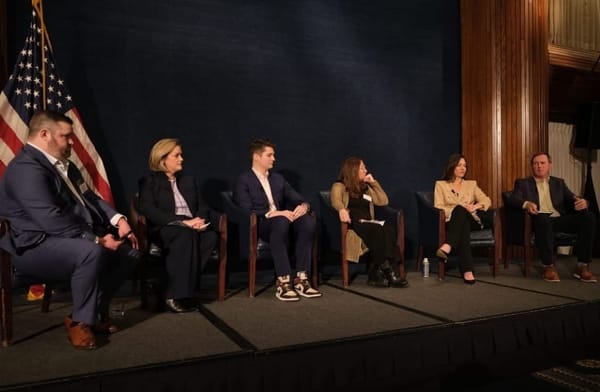
The mid-atlantic region has seen some of the most significant rate increases from data centers in the country. During a presentation at the Brookings Institution on March 3, a panel of energy experts noted that companies have sucked up capacity faster than power generation projects have been able to come online.






Member discussion