U.S. Pushes 6 GHz Wi-Fi Strategy Against China
The fight over 6 GHz could shape future global telecom networks.

Georgina Mackie
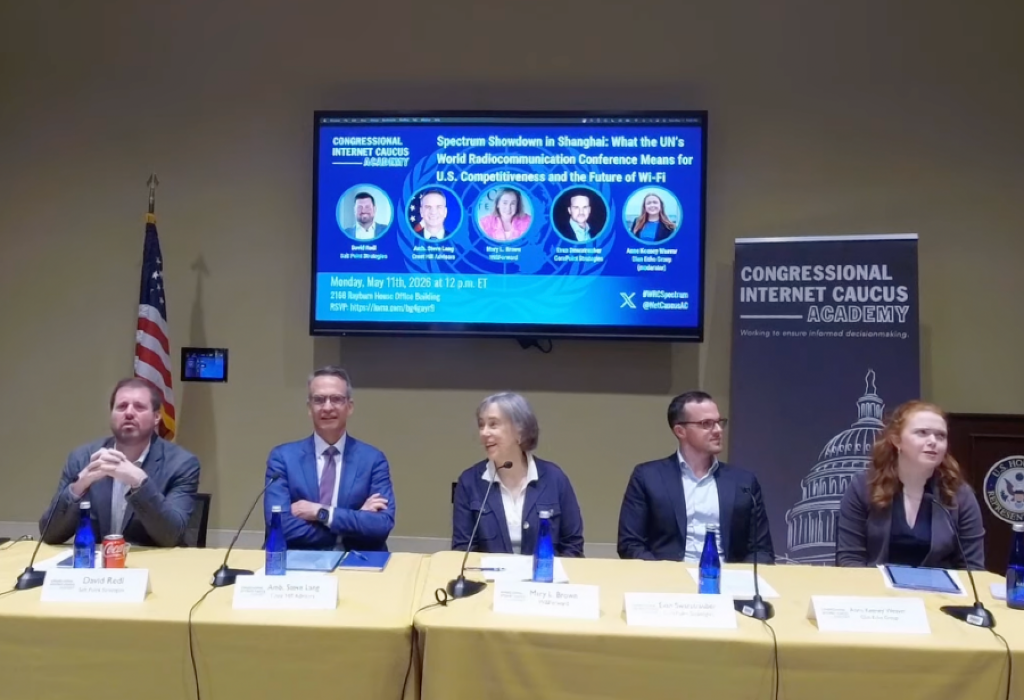
WASHINGTON, May 11, 2026 – Global spectrum negotiations in 2027 could determine whether countries build future wireless networks around American Wi-Fi technology or Chinese telecom infrastructure tied to Huawei.
Telecom officials and industry experts warned Monday that the fight over the 6 GigaHertz (GHz) band has become a broader geopolitical contest between U.S. Wi-Fi systems and Chinese-backed cellular infrastructure, during a briefing hosted by the Internet Education Foundation.
“The United States sits at one end of this and says the 6 GHz band should be fully unlicensed and used for Wi-Fi,” said David Redl, founder of Salt Point Strategies and former administrator of the National Telecommunications and Information Administration. “China, on the other hand, is pushing for there to be no Wi-Fi in 6 gigahertz at all.”
Redl said Huawei was currently the only company manufacturing licensed mobile equipment for the band, giving China a direct commercial incentive to push countries toward cellular deployment instead of Wi-Fi.
The World Radiocommunication Conference, held by the International Telecommunication Union every three to four years, sets international spectrum frameworks that shape wireless equipment markets, satellite operations, and telecom standards worldwide. The next conference will take place in Shanghai in 2027.
The FCC opened the full 6 GHz band for unlicensed Wi-Fi use in 2020 after determining Wi-Fi could coexist with existing users in the band, including utilities, public safety systems, and satellite earth stations.
“The companies that lead the global market for Wi-Fi equipment are American,” said Evan Swarztrauber, principal at CorePoint Strategies. He pointed to Cisco, Broadcom, and Hewlett Packard Enterprise.
“If countries adopt unlicensed use in the 6 GHz band, they are by default not going to buy Chinese equipment for those networks,” Swarztrauber said. “They’re far more likely to buy it from U.S. companies.”
“It is the U.S. position, backed by substantial evidence, that Huawei equipment enables espionage and surveillance by the Chinese government,” Swarztrauber said.
He said the FCC rejected proposals to split the band between Wi-Fi and licensed cellular use because cellular deployment would have required relocating tens of thousands of incumbent operations.
“These telecom policy and spectrum policy questions are adjuncts to their Belt and Road Initiative,” said Mary Brown, executive director of WifiForward and former Cisco policy executive.
Brown said China had already pressured smaller countries to adopt spectrum policies favoring licensed mobile use in the band.
She said 114 countries had already opened the 6 GHz band in whole or in part, while North American shipments of 6 GHz consumer devices were projected to rise from 95 million in 2024 to 367 million in 2029.
“By 2027 all of Wi-Fi is going to be delivering $2.4 trillion in economic value,” Brown said, citing research from Telecom Advisory Services.
Brown and Swarztrauber also tied the debate to rural broadband deployment, arguing spectrum decisions at WRC-27 would influence future network costs and equipment availability for U.S. broadband expansion projects.
The panel also warned that hosting the conference in Shanghai would create security and diplomatic challenges.
“China is one of the most proactive and effective users of cyber espionage,” said Steve Lang, former State Department coordinator for international communications and information policy.
Lang said the United States could still succeed at WRC-27 if regulators, Congress, and industry coordinated early and worked closely with allies ahead of the conference.
Brown said bipartisan congressional engagement mattered because foreign governments closely watched signals from Washington.
“China is reading those letters,” Brown said, referring to congressional statements supporting U.S. spectrum positions. “They’ll know: is Congress paying attention or does Congress not care about this?”
Redl said the United States would need to present a united front during negotiations.
“Good planning and good execution” would be critical, he said, adding that U.S. officials and industry representatives would need to “act as one on the ground.”
He urged policymakers to evaluate WRC decisions through the lens of technological competition with China.
“Does it benefit U.S. companies and U.S. technologies,” Redl said, “or does it benefit Chinese companies and Chinese technologies?”
The 6 GHz band is widely viewed as critical for next-generation wireless capacity, including Wi-Fi 6E, Wi-Fi 7, and future high-bandwidth applications.