
White House Issues Order Pledging to Withhold BEAD Funds From States With 'Onerous' AI Laws
Order tones down language of leaked draft, but continues restriction on dispensing remaining BEAD funds to states with 'onerous' AI laws.

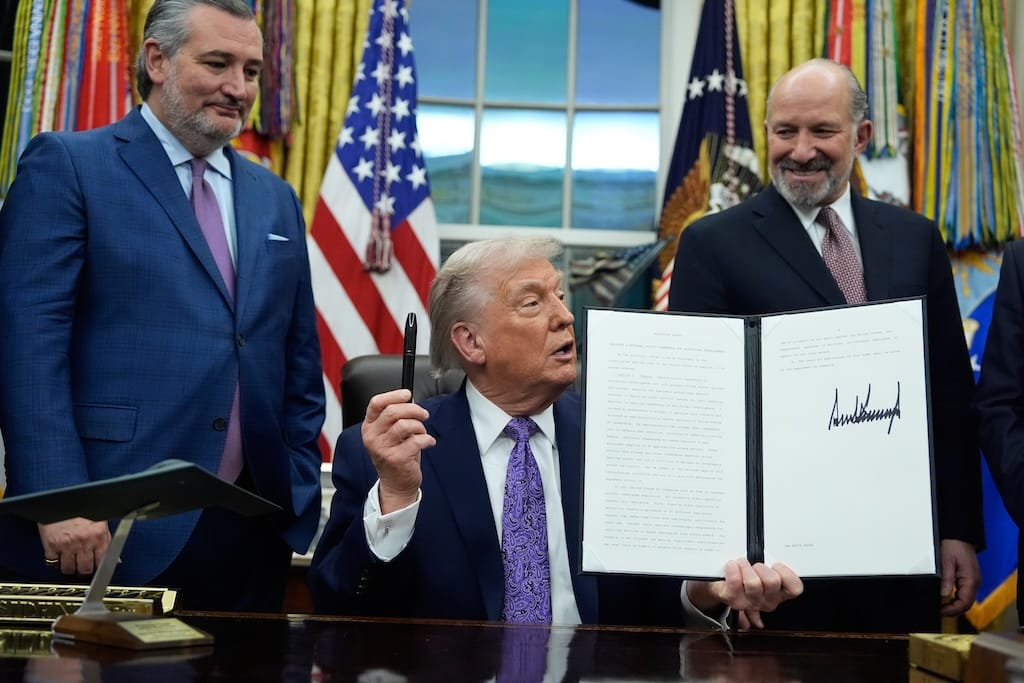
WASHINGTON, Dec. 11, 2025 – President Donald Trump on Thursday signed an executive order aimed at bolstering federal authority over artificial intelligence policy, and requiring the Commerce Department to restrict Broadband Equity, Access, and Deployment funding if states’ laws on artificial intelligence are too “onerous.”
The Executive Order, "Ensuring a National Policy Framework For Artificial Intelligence," makes minor modifications to the Nov. 19 draft executive order as reported by Broadband Breakfast. The draft version contained the aspiration that a single “minimally burdensome national standard” of AI regulation would exist.
But the final executive order suggests that this is a goal to be achieved with Congress, and said that the to-be-developed framework "should also ensure that children are protected, censorship is prevented, copyrights are respected, and communities are safeguarded" – all new language added to the official executive order.
These changes do not impact the core conclusion that the National Telecommunications and Information Administration Administrator Arielle Roth must issue a policy notice within 90 days “specifying the conditions under which states may be eligible” for non-deployment funding under the $42.45 billion BEAD program.
In signing the order, Trump framed the effort as a matter of geopolitical and technological competition. “There’s only going to be one winner here," Trump said during the Oval Office signing, "And that’s probably going to be the U.S. or China. And right now, we’re winning by a lot.”
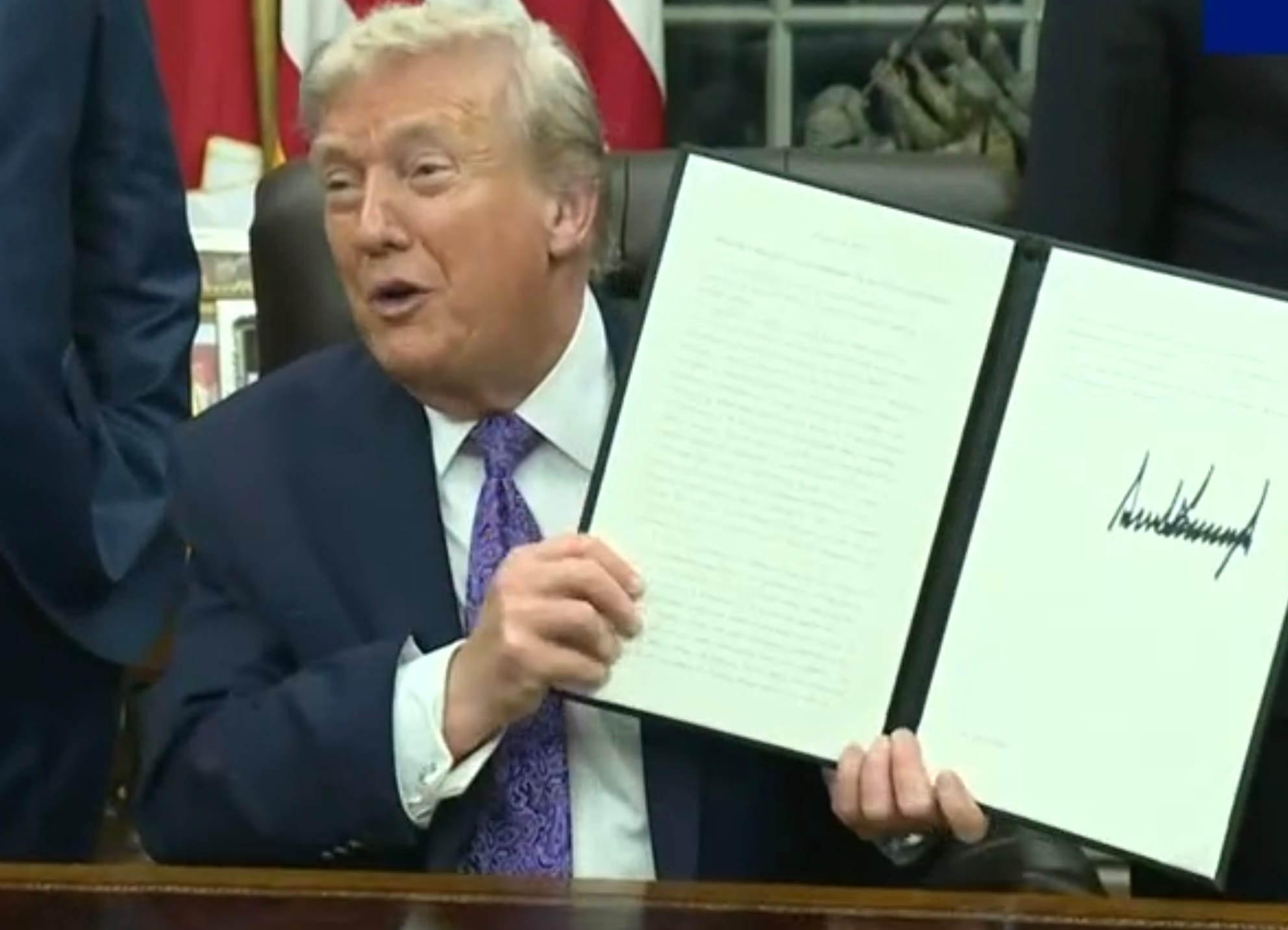
Trump linked the order to a broader effort to speed permitting for AI data centers and their power supplies, saying firms will be allowed to build their own electricity generation and will receive “rapid approvals” from the federal government.
“If they had to get 50 different approvals from 50 different states, you could forget it," Trump said. "All you need is one hostile actor and you wouldn’t be able to do it.”
More detail of the signing
After opening with the geopolitical framing of the conflict, Trump turned the floor to David Sacks, the special advisor to the White House for AI and crypto, who highlighted the outpouring of state legislation dealing with AI–more than 1,000 bills, with more than 100 of them having already passed.
"We're creating a confusing patchwork of regulation, and what we need is a single federal standard," said Sacks. "The policy of the administration is to create that federal framework."
Unlike a previous failed effort to preempt state AI laws on through the budget reconciliation measure signed July 4, the executive order does not purport to preempt state law, but seeks to constrain states based upon federal funds remaining from the BEAD program - as well as other "discretionary grant programs."
Speaking after Sacks at the Oval Office, Senate Commerce Committee Chairman Ted Cruz, R-Texas, called the race for AI "the single most important economic questions in the country and in the world. Who wins the race for AI?"
Cruz compared the AI order to an executive order signed by former President Bill Clinton "that put into law a light touch regulatory approach to the internet." Cruz contrasted that Clinton decision to the European Union's "heavy-handed regulatory approach" that led the United States to have grown significantly more in the past 30 years than has the EU.
Differences between the draft and final executive orders
The Nov. 19 draft, entitled “Eliminating State Law Obstruction of National AI Policy” would create a Department of Justice litigation task force that would within 30 days identify state AI statutes to be challenged on interstate commerce and state authority grounds. That provision exists substantially the same in the final executive order.
Under the draft executive order, a group of senior administration advisors are tasked – within 90 days – of publishing an evaluation of existing state AI laws that are "onerous" and that "conflict" with the "policy of the United States to sustain and enhance the United States’ global AI dominance through a minimally burdensome national policy framework for AI."
"That evaluation of State AI laws shall, at a minimum, identify laws that require AI models to alter their truthful outputs, or that may compel AI developers or deployers to disclose or report information in a manner that would violate the First Amendment or any other provision of the Constitution" - language that also existed in the draft version.
Finally, the provision in Section 5 of the executive order that pertain to BEAD – that "States with onerous AI laws" are "ineligible for non-deployment funds, to the maximum extent allowed by Federal law" – also remains substantially the same as in the draft version.
The order would give NTIA 90 days to issue a policy notice on the topic, which is consistent with a statement Roth made recently about further guidance from the agency coming in the first quarter of 2026.
The most significant changes between the draft and the final executive order, however, are: (1) the removal of a paragraph attacking California's SB 53, an AI disclosure law, as a "complex an burdensome" disclosure regime, per the draft order; and (2) the addition of language that legislative recommendations to be proposed on AI by the Trump administrations "shall not propose preempting otherwise lawful State AI laws relating to: (i) child safety protections; (ii) AI compute and data center infrastructure, other than generally applicable permitting reforms; (iii) State government procurement and use of AI; and (iv) other topics as shall be determined."
Reactions
A few initial reactions to the executive order came in on Thursday night.
"President Trump's executive order represents a critical step toward ensuring that America will maintain its leadership in the global AI race," said INCOMPAS CEO Chip Pickering. "The executive order follows through with what INCOMPAS has long been championing for, eliminating the fragmented patchwork of state regulations that threatens to strangle American innovation."
INCOMPAS applauded the incentivization of states' BEAD nondeployment funds and highlighted what the trade association, which represents competitive telecom and tech companies, highlighted as "the strategic alignment we have long advocated for between infrastructure investment and innovation policy."
"By aligning broadband infrastructure investment with sound AI policy, we can ensure that federal dollars continue to advance America’s technological leadership," the association said.
A key House Democrat had a different take.
“This is illegal federal coercion, plain and simple,” said Rep. Doris Matsui, D-Calif. "Trump’s order threatens states enacting responsible safeguards with costly, wasteful federal lawsuits and attempts to hold hostage the broadband funding Congress specifically authorized for our communities."
“With no federal AI framework in place, states like California have stepped up with common-sense safeguards that protect the public while keeping innovation and competition strong. These measures build trust and keep people safe.”
Fact Sheet from the White House:
 The White House
Executive Order from the White House:
 Executive Orders
Prior version stoked concern
Based on states and territories’ preliminary results, more than $21 billion of the program’s money will likely be non-deployment funding, meaning won’t actually be used for broadband deployment projects.
The money’s future is already up in the air, although states would prefer to hang on to it and advocates have argued the law standing up BEAD requires them to.
The draft executive order would also have direct Federal Communications Commission Chairman Brendan Carr to "initiate a proceeding to determine whether to adopt a Federal reporting and disclosure for AI models that preempts conflicting state laws." That provision remains unchanged in the final order.
See more articles in Broadband Breakfast on AI and BEAD
 Jake Neenan
 Broadband Breakfast
 Drew Clark
This article was published at 8:46 p.m. and updated at 11:48 p.m. ET with more details about the signing, the order and differences with the draft, plus reactions from INCOMPAS and House Democrats.



Member discussion