Yearslong Data Center Dispute Heads to Virginia Supreme Court
Two lower courts ruled against the development, saying Prince William County supervisors violated Virginia code and local zoning ordinance

WASHINGTON, June 3, 2026 – A yearslong legal battle over what developers have touted as the world’s largest data center campus is headed to Virginia’s highest court.
The proposed Digital Gateway campus would include 37 data centers and 14 electrical substations, spanning more than 2,000 acres in western Prince William County.

The project appeared to be halted March 31 when a unanimous three-judge panel of the Virginia Court of Appeals issued a partial stay, upholding a lower court’s ruling that Prince William County officials did not give residents proper notice, violating state code and local zoning ordinance.
But the dispute was revived when operator QTS Data Centers filed a last-minute appeal April 30 seeking review by the state's highest court to reinstate zoning for the project, even as two main backers dropped out. The high-stakes battle could shape future land use and data center development disputes across the state.
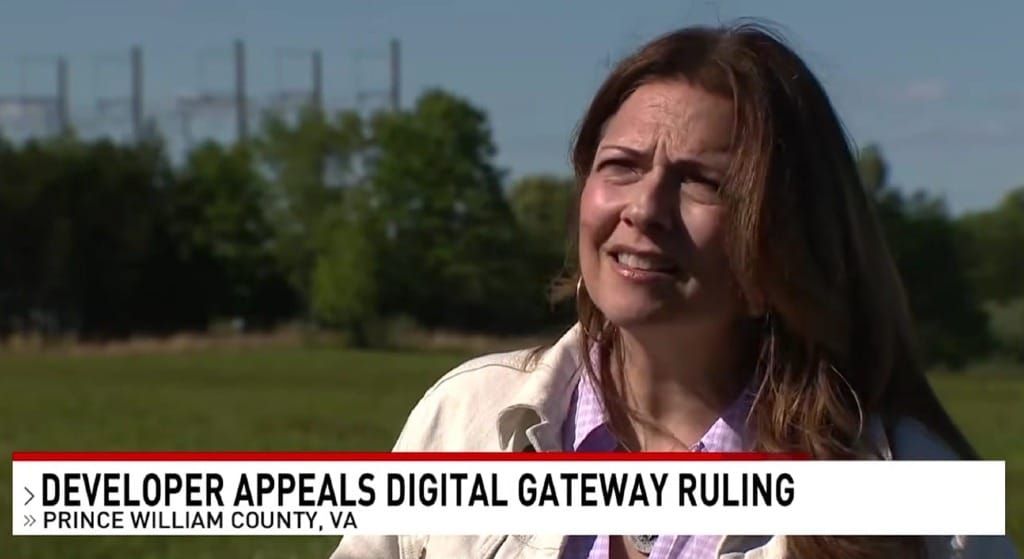
“This has been a week of whiplash,” Elena Schlossberg, executive director of the Coalition to Protect Prince William County, said responding to the QTS appeal in early May. “Shame on QTS and their parent company Blackstone for holding this community hostage.”
The case traces back to late 2023, when county officials scheduled a public hearing to consider the rezonings needed for the project. A required public notice for the hearing failed to appear in The Washington Post as scheduled after county staff did not confirm the advertisement before the newspaper's deadline.
To hold the hearing in compliance with county zoning ordinance requirements, the Board planned for the first ad to run in the Post on November 28, fourteen days before the Dec. 12 hearing. The Board’s clerk emailed the Post shortly after noon on Monday, November 20, submitting the requested ad and run dates.
The Post replied two hours later, noting that the ad would cost $7,509.48. Two minutes later, the Post sent another email advising the clerk to confirm the publication request by 3 p.m. the next day. The clerk failed to call or respond by the deadline.
Despite that, officials went forward with the December rezoning hearing.
Latching onto that technicality, residents and the American Battlefield Trust in January 2024 filed suit to stop the project, naming operator QTS, developer Compass, and governing jurisdiction Prince William County, as defendants.
The County argued—“County staff did everything properly,” according to an internal Nov. 30 email obtained by the advocacy group Coalition to Protect Prince William County, which acknowledged there would “likely be a legal argument.”
Several land preservation nonprofits, environmental justice organizations and Prince William locals have rallied against Digital Gateway since its inception, partially because of its proximity to the historic Manassas Battlefield and a Virginia state forest.
“The failure to properly notice the public hearings on the proposed development is indicative over a rush to judgement and a failure to adequately assess the impacts on local, regional, state and national resources, ranging from historic and cultural sites to water quality,” Chris Miller, president of the Piedmont Environmental Council, said in a statement following the Court of Appeals’ ruling.
“At a minimum, this project would have required two to three gigawatts of power, equivalent to the current energy used by ALL current data centers in Northern Virginia combined,” he said.
The American Battlefield Trust on May 26 urged the Virginia Supreme Court to reject the appeal from QTS in the wake of the lower court rulings. Defendants Compass and Prince William County have since withdrawn from the case.
QTS, for its part, has called the Court of Appeals’ nullification of its zoning amendments in Prince William County “unprecedented,” saying projects would have brought “tens of billions of dollars in investment, and thousands of jobs, to Virginia,” according to the operator’s appeal.
The case is unfolding as Virginia lawmakers remain deadlocked over whether to extend a key tax incentive for data centers.
The General Assembly is expected to reconvene its special session June 18 in the House and June 22 in the Senate as lawmakers continue negotiations on a compromise budget that must pass both chambers and reach Gov. Abigail Spanberger’s desk before the June 30 deadline.
The biggest point of contention is a Senate proposal that would begin phasing out the state’s 5.3 percent sales and use tax exemption on server equipment and software. Lawmakers estimate the exemption, which is currently set to expire in nine years, costs the state about $1.6 billion annually.
Virginia hosts the world's largest concentration of data centers, with more than 600 facilities operating statewide and hundreds more in development. Prince William County, just outside Washington, hosts 55 existing data centers and has at least 46 additional projects in the pipeline, according to county data.
Support for data centers in northern Virginia has waned substantially, with an April poll showing 59 percent of voters now opposed to new data center construction, compared to 24 percent in 2023.