Capex to Consume Nearly All Hyperscaler Operating Cash Flow in 2026
A London-based tech equity research firm projects a $600 billion gap as the largest cloud companies commit more money to data centers

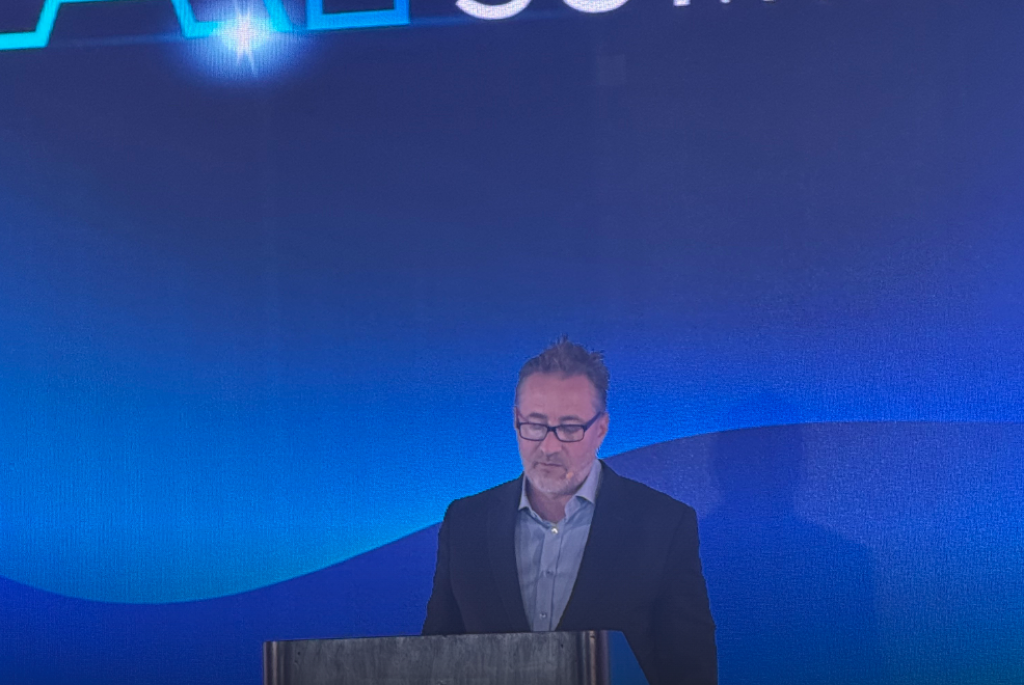
SANTA CLARA, Calif., Sept. 21, 2026 – The four largest hyperscalers are expected to spend $1.8 trillion on capital investments through 2028, about $600 billion more than their underlying businesses generate in cash over the same period, a technology equity analyst said at the AI Infra Summit here.
Hyperscalers are companies that build and buy cloud infrastructure by the campus, with single sites drawing 300 megawatts to more than a gigawatt, the top of that range matching the output of a nuclear reactor. The group includes Alphabet, Amazon, Meta and Microsoft, four of the world's largest buyers of data centers, servers and AI computing equipment.

The projection comes from Arete Research, a London-based independent technology equity research firm. The four companies are expected to generate about $1.2 trillion in underlying cash flow through 2028, founding partner Jim Fontanelli said in a summit presentation titled "A Market Outlook: Is AI in a Capex Bubble?"
The financing gap arrives before other buyers are accounted for, Fontanelli said. Specialized AI cloud companies, enterprises and governments building their own systems add borrowing needs of their own.
Their capital expenditures, or capex, pay for assets expected to remain in service for years. Those include data centers, servers, networking equipment and the electrical systems serving them.
Advertising revenue at Alphabet and Meta, e-commerce and cloud revenue at Amazon, and software and cloud revenue at Microsoft historically generated enough cash to finance much of their infrastructure internally. AI is pushing that spending up quickly, both for training models and for inference, the generative work of running a trained model to respond to a request.
More of the expansion is consequently being financed through bonds, construction loans, leases and outside investors, he said.
The scale is approaching $700 billion annually. J.P. Morgan, the largest U.S. bank by assets, estimates the five largest U.S. hyperscalers will spend $697 billion in 2026, an estimate the bank has raised by $173 billion since the beginning of the year. Fontanelli displayed the bank's research on screen during his presentation.
$9.6 billion goes in before any revenue comes out
The spending extends beyond the graphics processors that train and run AI models. Nvidia, the dominant maker of those chips, designed them in the 1990s to render video game graphics, and the same parallel design now trains AI models.
An AI data center needs servers, high-speed networking and cooling equipment. It also needs enough electricity to operate them. Some projects require substations, transmission equipment or on-site generation before the computing equipment can be switched on.
Those costs can reach billions of dollars before a facility produces revenue, he said. J.P. Morgan originated $9.6 billion across two construction loans for Stargate, an AI data center campus under construction in Abilene, western Texas. The money finances the buildings years before they produce the cash that repays the loans.
Companies spread the cost of long-lived assets, such as buildings and servers, across the years those assets stay in service. That treatment, called depreciation, means a data center paid for in 2026 keeps reducing reported profits well into the 2030s, he added. The buildout charges earnings long after the cash is gone.
The $600 billion gap measures financial cushion
The $600 billion difference is not exactly a funding shortfall, he said.
The four companies held roughly $430 billion in cash and marketable securities at the end of the first quarter, money they can spend immediately or raise by selling investments quickly. They are expected to generate about $575 billion this year in operating cash flow, the cash a company's day-to-day business produces, according to J.P. Morgan Asset Management.
What is changing is the share of that operating cash flow the infrastructure requires. Capital spending consumed about 60 percent of operating cash flow in 2025 and is expected to consume 90 to 100 percent in 2026, according to J.P. Morgan.
When capital spending takes nearly every dollar the business generates, the cushion thins, he said. Less cash remains for acquisitions and share repurchases. Less remains as protection if AI revenue arrives more slowly than planned.
The financial risk is overbuilding, Fontanelli added. Companies that add more computing capacity than customers ultimately use still carry the depreciation, financing costs and operating expenses of those data centers and servers.
Demand remains strong today. More than 70 percent of data center capacity under construction is already leased, while cloud revenue at major platforms grew an average 44 percent from a year earlier in the first quarter, according to J.P. Morgan Asset Management.
Combined annualized revenue at OpenAI and Anthropic should pass $25 billion by year end, Fontanelli said.
Token prices, what customers pay for a unit of AI output, have been flat or rising since January, he said, and he treats that as the real test of demand. Payback on deployed computing now takes one to two years.
Smaller AI clouds carry more financing risk
Specialized AI cloud providers face the same construction costs without large advertising, e-commerce or software businesses generating cash alongside them, he said.
These companies rent out AI computing capacity and can add servers and data center space faster than hyperscalers can build their own. However, financing that expansion often requires heavy borrowing before customer revenue arrives, he added.
Fontanelli pointed to British AI cloud provider Nscale to illustrate the imbalance. It reported $140.6 million in revenue in the first half of 2026 and a $1.02 billion net loss.
It has also agreed to sell $3.1 billion in convertible bonds, debt that can later turn into shares, including $1 billion to Nvidia.
Its largest customer accounted for 52 percent of first-half revenue, he said.
Advanced chips, data center space and electricity remain the physical limits on AI expansion. Financing is becoming the next one, he said.
Not every borrower is investment grade. Neither OpenAI nor Anthropic, the San Francisco-based AI model developers, holds an investment-grade credit rating, the threshold at which institutional lenders buy debt freely, Fontanelli said.
The industry is adding capacity faster than in any earlier computing buildout, he added, and on a two-year view he does not expect it to be enough. The risk he sees is a borrower that cannot repay its debt, not an empty data center.