Carr: FCC Open to Ideas on Tentative Rural Subsidy Inquiry
He didn’t say how the agency felt about House lawmakers’ effort to block the NextNav petition.

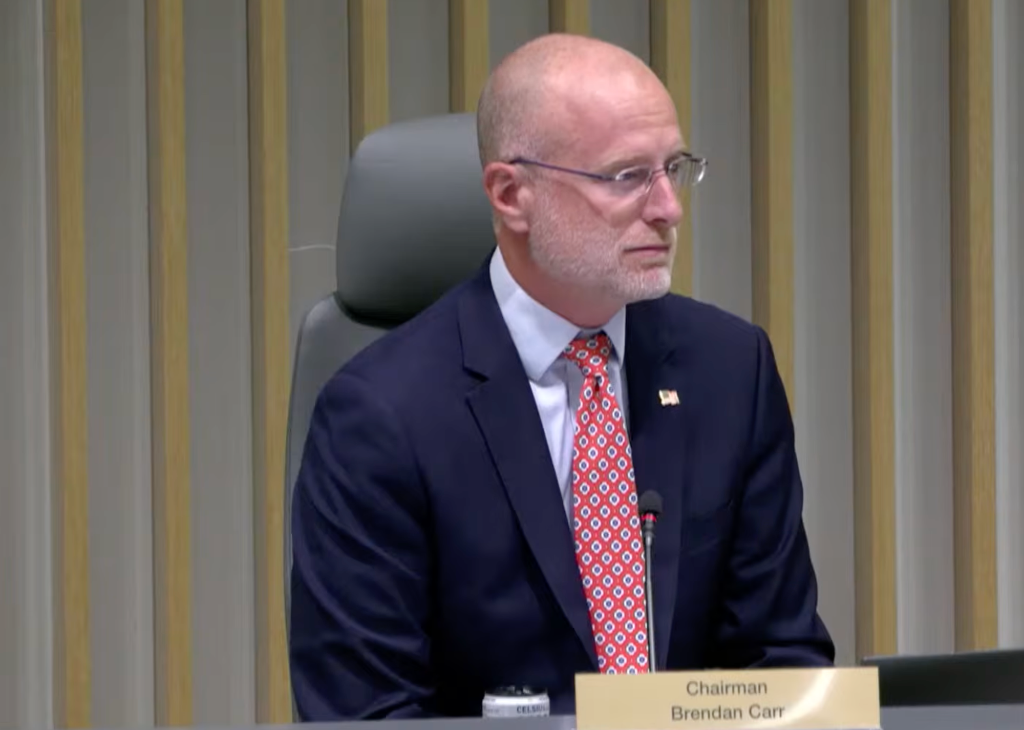
WASHINGTON, May 1, 2026 – A potential federal inquiry into modernizing rural broadband subsidies will be longer term and open ended, the head of the Federal Communications Commission said Thursday
“These are legacy programs that haven’t had a fresh look in a long time, and maybe we maintain it exactly the way it is, maybe we increase support. It’s just teeing up a range of questions,” FCC Chairman Brendan Carr said at the agency’s press conference.
The FCC is set to vote at its May meeting on an inquiry seeking comment on how to move forward with three subsidies under its High Cost program umbrella that are set to sunset in 2026 or 2028. The High Cost program supports the construction and maintenance of rural broadband and telecom networks.

The public draft of the item also asks how it should consider its rural broadband subsidies in light of the burgeoning low-Earth orbit satellite connectivity offerings from SpaceX and Amazon.
The draft notes standard Starlink plans from SpaceX are $80 to $120 per month, while the FCC provides $200 per location for some of its legacy subsidies. The item would ask whether it should potentially make areas already served by LEO operators ineligible for subsidy support, but also whether doing so might cause LEOs to jack up prices in the absence of competition for rural subscribers.
That doesn’t mean the agency has definite ideas on how exactly it will proceed, according to Carr.
“I think now is the right time to just be very reasonable, be sensitive to all of the stakeholders, be sensitive to the investments that are in here,” he said.
Under consideration in the item are three sets of programs that the FCC said account for roughly $1.6 billion of the High Cost fund’s $4.5 billion budget.
Two of those, Connect America Fund Broadband Loop Support and High Cost Loop Support, are legacy programs that fund either slower internet service or voice lines. They’re not set to expire and together accounted for $1.2 billion in 2025.
Three other buckets of broadband deployment funding under the Alternative Connect America Cost Model, the remaining $400 million, are set to expire at the end of 2026 or 2028.
The draft would ask whether it would make sense to separately modernize all the programs in question, combine them into a single program, or simply do nothing and allow the sunsetting programs to expire while keeping the legacy programs in place.
“There are many steps to go before final Commission action,” Kevin Taglang, the Benton Institute for Broadband & Society’s executive editor, wrote in a blog post. He noted it could be changed before official adoption, and that comments would be taken for 90 days before the FCC reviewed all the input and made official changes.
He said the LEO comparisons and other word choices in the draft “suggest the FCC is, at a minimum, skeptical that current support levels are warranted across all areas.”
NextNav
Carr was also asked about the House Appropriations Committee’s move to block the FCC from moving forward with a proposal by NextNav to create a GPS backup. Appropriators attached a provision last week to an FCC funding bill that would prevent the agency from moving forward with the proposal.
“We’re always open to feedback from Congress. Anything that they pass, we will do,” he said.
NextNav is asking the FCC to alter the 902-928 MegaHertz (MHz) band to give the company 15 megahertz in support of a terrestrial GPS backup and 5G broadband. Current users of the band like railroads, utilities, and security system providers have been strongly opposed to the idea, and House lawmakers said they were convinced by their claims of potential interference.
Carr said the agency was consulting with the Office of Management and Budget on next steps in its rulemaking on position, navigation, and timing (PNT) systems to supplement GPS, but the process was ongoing.
“Until that process completes, there’s no official position from us and there’s no final agency action,” he said. “So, we’re just going to continue to work through the process and remain open-minded about different paths forward.”
NextNav has been approved for multiple coexistence tests to gauge the impact of its planned system. The company has continued pushing for its plan in a filing posted Friday, arguing it could help the FCC’s desire to bolster the American drone industry.
The company’s planned network could be used to track drones more precisely in packers where GPS signals are weak, helping both drone operators and airports or military installations looking to prevent drone use.