Carr Grilled on Broadcasting, Also Testifies on Spectrum and Universal Service
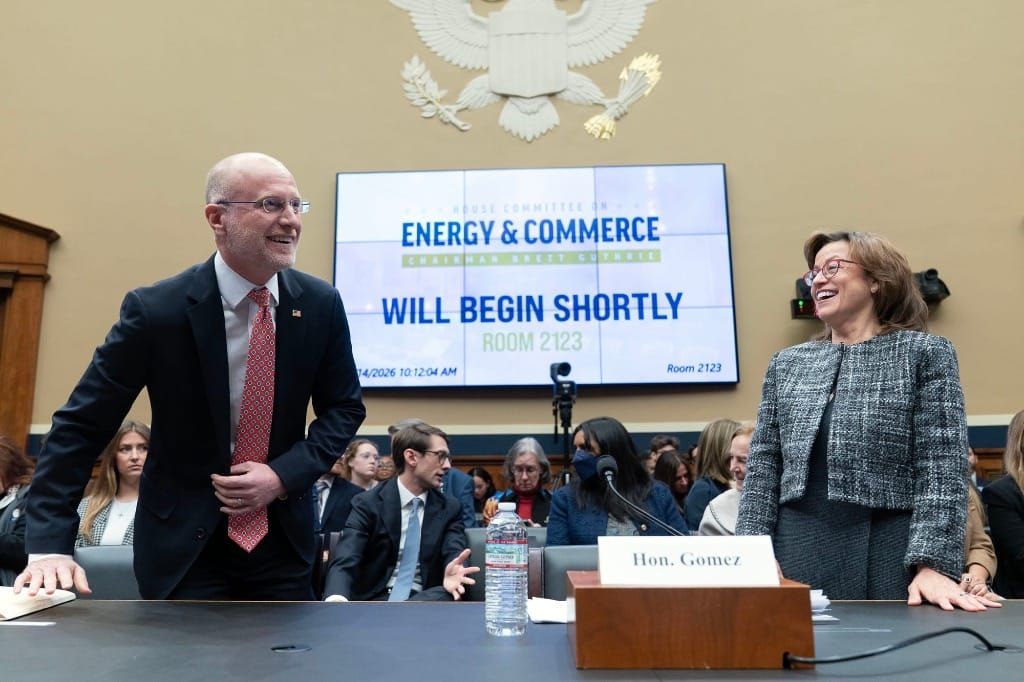
The three-hour hearing was largely focused on broadcast regulation and accusations the agency was pressuring media companies critical of the White House.

Jake Neenan
WASHINGTON, Jan. 14, 2026 – The Federal Communications Commission was urged Wednesday to require wireless carriers bidding in its upcoming spectrum auction to pay for airplane retrofits that will be required to avoid interference.
The Federal Aviation Administration has estimated those will cost about $4.5 billion.
Rep. Jay Obernolte, R-Calif., who has a pilot’s license, made the request as top agency officials testified for nearly three-and-a-half hours Wednesday during a House oversight hearing.
Also at the hearing, FCC Chairman Brendan Carr said the agency would be seeking input on updates to its High Cost broadband subsidy program.
The event was largely focused on the agency’s broadcast regulations, with Republican lawmakers calling for the FCC to relax limits on broadcast station consolidation and Democratic legislators accusing Carr of threatening free speech by using the agency’s power to pressure media outlets into covering Trump more favorably.
Carr said he did not find arguments that the FCC lacked authority to raise its broadcast ownership cap “compelling,” but that the agency was “open-minded” and still considering the issue.
Upper C-band, spectrum
Obernolte said the agency should require mobile carriers bidding in the upcoming upper C-band auction to pay for the retrofits that will be required for airplane altimeters.
“My understanding is that the bidders in the auction would likely be willing to bear the cost of those retrofits,” said Obernolte. “And I think that that’s fair, if you’re going to ask a community to retrofit something that they already bought, the people that benefit ought to help pay for that.”
Under the One Big Beautiful Bill Act, the FCC has to conclude an auction of at least 100 megahertz in the upper C-band by July 4, 2027, although it may sell as much as 180 megahertz. Altimeters operate directly above the band, and current equipment can’t operate properly with mobile users on adjacent spectrum.
The agency contemplated winning bidders paying for retrofits in its proposal on rules for the auction, asking who specifically might be eligble to receive such payments if that's the route the agency goes.
Obernolte said the FCC should keep in mind that standards for new altimeters aren't done yet. Last week, the Federal Aviation Administration pushed for standards bodies to accelerate their schedule and publish those by June 2026 to accommodate the FCC’s auction timeline.
The FAA said in that proposal that about 58,000 planes would need to be retrofitted, which would cost around $4.5 billion, and that it expected an initial compliance deadline between 2029 and 2032.
“We don’t actually have a certified retrofit available yet. And even when we do, there’s limited production capacity for those radar altimeters and limited avionic shop capacity,” Obernolte said. “So we have to have enough of a window to be able to retrofit an entire fleet that needs that new part to avoid interference.”
Carr said the agency was coordinating with the FAA and Department of Transportation to square away those concerns “so that we’re ready to go at the middle of next summer.” Similar issues caused frustration among airlines during the agency’s previous C-band auction.
FCC Commissioner Olivia Trusty, a Republican, also defended the Citizens Broadband Radio Service, as did Rep. Richard Hudson, R-N.C., chair of the House Communications and Technology Subcommittee that ran the hearing There had been worries among some users that the agency would consider either auctioning part of the shared band or raising power levels as it looks to make more spectrum available for mobile use.
“My job at the FCC is to ensure spectrum is being put to the highest and best use,” Trusty said. “Given all of the use cases [of the band], I think it emphasizes the meaningful benefit of CBRS and unlicensed spectrum.”
Universal Service Fund
Carr said the agency would be seeking input on the future of its High Cost program in the future. Of the four programs supported by the FCC’s Universal Service Fund, the High Cost program is the largest and funds rural broadband network deployment and maintenance.
The agency was “taking a look at our High Cost programs” and asking “in this idea of a ‘High Cost 2.0,’ what does the future of High Cost support look like? We’re going to be asking some questions about that.”
A bipartisan group of lawmakers is working on a legislative effort to modernize the fund, which is supported by fees on interstate and international voice revenue, a pool of cash that’s shrinking as expenditures remain consistent.
Carr said agency staff would be meeting with the working group, which has asked for a briefing by Jan. 30, in the near future.
“We talked in the Senate hearing at the end of last year about the FCC collaborating with the group,” Carr said. “And I think we’re going to start that process potentially as soon as this month, to make sure that we’re coordinated there.”
Aides to lawmakers in the group said in October they were aiming to release a new framework in early 2026.
Carr also said legislators should focus on “technology neutrality.” He had criticized the Biden administration for favoring fiber in the $42.45 billion Broadband Equity, Access, and Deployment program, a move since walked back by the Trump administration, and for denying FCC subsidies to Elon Musk’s SpaceX because its satellite broadband service fell short of minimum speed requirements.
“We want high-speed fiber connections in so many parts of the country,” he said. “But there’s other places where you’re going to have fixed wireless, or a new generation of low-Earth orbit satellites, or 5G or 6G.”
Democratic lawmakers repeatedly criticized Carr for rolling back Biden-era rules that expended subsides under E-Rate, another USF program, to off-campus Wi-Fi.
National Broadband Map
The $42.45 billion BEAD program is managed by the Commerce Department, but it came up repeatedly at the hearing as lawmakers criticized the opposing party’s management of the program.
Rep. Erin Houchin, R-Ind., said she hoped the $21 billion expected to be left over after states fund their eligible locations, partly a result of Trump administration efforts to cut costs, would “be put toward deployment in a technology-neutral way. And that it might even go toward updating our National Broadband Map.”
That map is managed by the FCC and shows provider-reported broadband availability nationwide. In April 2025, the Government Accountability Office recommended the agency strengthen its verification of the data underlying the map, among several other things.
“The FCC is working on all the recommendations there. One thing that we have is a coordination agreement with NTIA and others to make sure that we’re getting all of the data put in the map,” he said. “There’s dozens and dozens of broadband funding programs out there, and if we can make sure they all funnel their information through a single map, that’ll really help improve.”
Member discussion