
CES2026: Carr Outlines FCC Spectrum, AI, and Broadcast Priorities
In a fireside chat, Chairman Brendan Carr cited progress on C-band, 6 GHz, and a national framework for artificial intelligence.

Akul Saxena
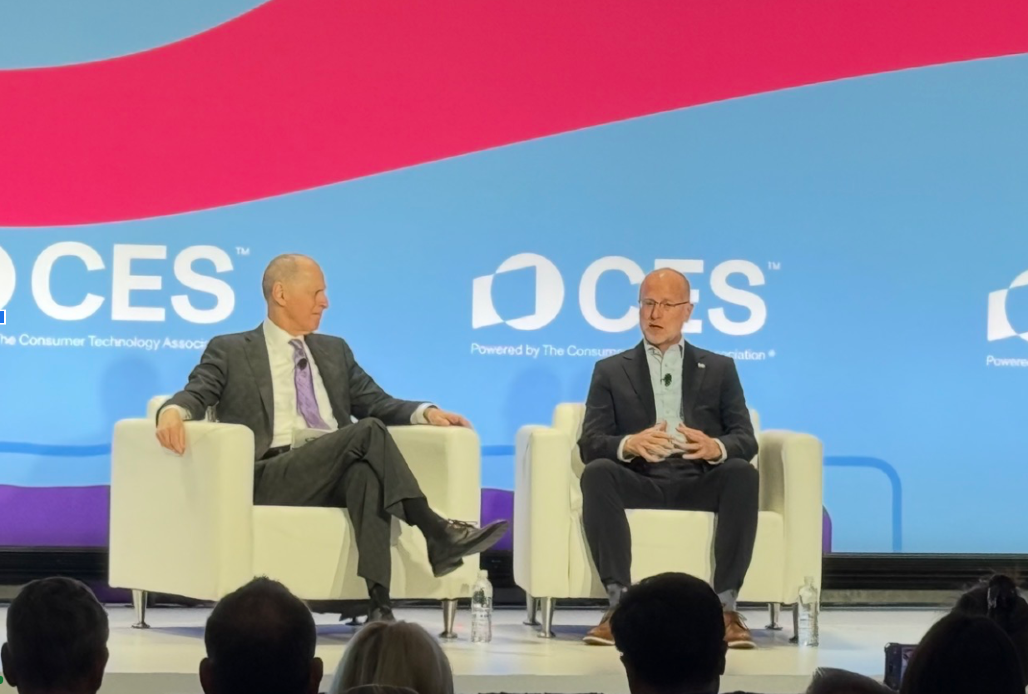
LAS VEGAS, Jan. 8, 2026 — Federal Communications Chairman Brendan Carr said Thursday that communications policy was shifting toward expanding spectrum supply, asserting federal preemption over artificial intelligence regulation, and reaffirming public interest obligations tied to broadcast licenses.
Speaking during a fireside chat with Gary Shapiro at the Consumer Electronics Show, Carr said the Federal Communication Commission’s agenda centered on spectrum policy, emerging satellite services, artificial intelligence governance, and the unique legal responsibilities attached to broadcast licenses.
Spectrum expansion
Carr said the commission was advancing spectrum through auctions, reallocations, and market-based mechanisms, with a focus on mid-band frequencies critical to 5G and fixed wireless services. He cited progress on the upper C-band auction the agency is working to conduct by July 2027.
He said the commission was also preparing to vote this month on rules affecting the 6 GHz band, including proposals to increase power levels for unlicensed use, a move he said would significantly expand Wi-Fi capacity for homes, enterprises, and public venues.
“This is one of the biggest opportunities we have to supercharge Wi-Fi,” Carr said.
Carr emphasized the FCC’s push to expand secondary spectrum markets, encouraging license holders to lease or sell underused spectrum rather than warehouse it. He pointed to a transaction completed within the past year that increased network speeds by roughly 80 percent without requiring a new allocation, arguing that spectrum reuse could deliver capacity faster than traditional reallocation proceedings.
Satellite-to-device connectivity
He also highlighted the commission’s work to enable direct-to-device satellite services, which allow smartphones to connect directly to low Earth orbit satellites when terrestrial networks are unavailable. Carr said the United States currently led global development in the technology but warned that future investment depended on regulatory certainty around spectrum sharing and interference protections.
“We’re effectively putting cell sites in space,” Carr said.
Artificial intelligence and federal preemption
Turning to artificial intelligence, Carr pointed to President Donald Trump’s recent executive order directing federal agencies to pursue a uniform national AI framework. He argued that a fragmented state-by-state approach would disadvantage startups and smaller firms, creating compliance burdens that deter innovation.
Carr said more than 1,200 AI-related bills were introduced in state legislatures last year, creating what he described as an unworkable regulatory environment.
“You can’t ask a startup to hire 50 lawyers just to deploy a product,” he said.
Carr said the FCC was directed to open a proceeding within 90 days examining AI transparency and disclosure requirements, which he compared to the light-touch regulatory framework applied during the early development of the internet.
Broadcast licenses and public interest obligation
Carr also addressed the public interest standard governing broadcast licenses, arguing that broadcasters occupy a distinct legal position because they operate using publicly owned spectrum. He said broadcast license holders do not speak solely for themselves but act as representatives of the communities they serve, a role that carries obligations not shared by podcasts, social media platforms, or other online speakers.
“Broadcasters have a very unique distribution of media,” Carr said. “You don’t conduct yourself the same way as if it were a podcast.”
Carr said those public interest obligations were central to ongoing debates over spectrum policy and whether broadcast spectrum could be returned to auction without associated responsibilities.
“You’re not just speaking for yourself,” he said. “You’re representative of the community.”
Correction: A previous version of this story misidentified a spectrum bands the agency is working on auctioning. It is the upper C-band.





Member discussion