Chip Pickering: Data Centers are America's Most Misunderstood Infrastructure Asset
The case for data centers rests on meaningful tax revenue, durable jobs, grid investment and the digital infrastructure that lets rural communities share in the AI economy.

Chip Pickering

We cannot champion a future driven by American innovation while simultaneously rejecting the very infrastructure required to power it. As communities across the country debate whether to welcome data centers into their communities, the facts highlight their critical role in powering economic growth and strengthening U.S. infrastructure.
Policymakers and the public alike need a clearer picture of what data centers actually deliver: Jobs, tax revenue, grid investment and the digital backbone of America's artificial intelligence future.
Walk into almost any state capitol or county commission meeting where a data center project is on the agenda, and you will encounter a familiar set of concerns. Too much water. Too much power. Too few jobs. Too little benefit for the surrounding community. These concerns are understandable. They deserve honest answers. But too often, the conversation stops at the objections and never reaches the evidence.
The evidence is compelling. Data centers generate substantial local tax revenue that funds public schools, roads and emergency services. They create direct employment across a wide range of skill levels, from construction trades to engineering and site management, many of which do not require a four-year degree. They invest directly in grid infrastructure, improving reliability for entire regions. And they anchor the broader digital economy that every other business in a community depends on to compete in the modern marketplace.
The opposition narrative has outpaced the facts for too long, and it is time to change the conversation.
The local politics of data centers are defining America's AI race
From zoning fights in rural counties to rate design battles at state utility commissions, the future of American AI leadership is increasingly being shaped not in Washington but in city halls and state capitols. Getting local policy right is not optional. It is essential.
Washington has begun to align on the urgency of AI infrastructure investment. The White House's National Policy Framework for Artificial Intelligence, the American AI Action Plan and the Ratepayer Protection Pledge all reflect a growing federal consensus that building the physical foundations of AI leadership is a national priority. Congress is debating permitting reform. Federal agencies are streamlining reviews. The policy direction from the top has rarely been clearer.
But federal intent runs into local reality every time a developer files a permit application or a utility commission opens a docket on rate design. A data center project that clears federal environmental review can still sit idle for years waiting on local approvals. A facility that has the technology, the capital and the workforce commitment can be derailed by a single zoning board vote - with consequences that extend far beyond a single community.
State legislators are drafting bills, some welcoming and some restrictive, based on assumptions about data centers that are not always grounded in evidence. Utility commissions are weighing proposals to create separate rate categories for large load customers, often driven by utility arguments that do not fully account for the grid investments data centers make or the economic activity they generate.
The companies building America's AI infrastructure are not asking for special treatment. They are asking for a level playing field, predictable permitting timelines, transparent processes and policy frameworks that reflect how data centers actually function in the communities that host them. That is a reasonable ask. It is also an urgent one. Every month of delay in a critical data center project is a month that America's competitors are gaining ground.
The digital divide will not close without data centers
Universal broadband access and universal AI access share the same prerequisite: infrastructure that reaches every corner of America. Data centers are not just a big-city, big-tech phenomenon. They are the connective tissue that makes next-generation services possible in rural and underserved communities.
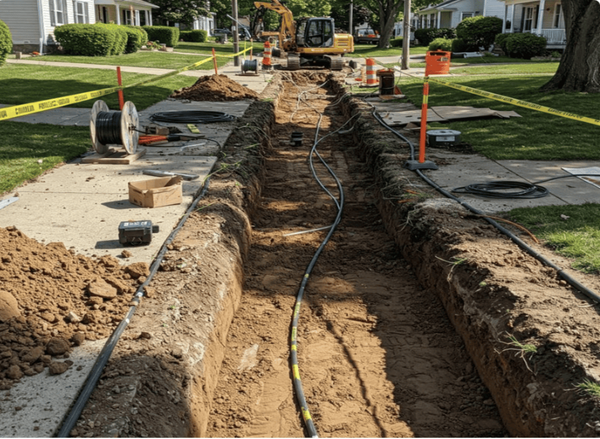
There is a tendency in the policy conversation to treat broadband deployment and data center development as separate tracks. They are not. The fiber networks that INCOMPAS members are building into unserved and underserved communities deliver their full value when they can connect to data centers, the hubs of the modern internet.
The AI-enabled services that rural hospitals, schools and small businesses increasingly depend on need processing power that lives in data centers. The cloud applications that a family farm uses to manage operations, that a rural clinic uses to deliver telehealth, that a small manufacturer uses to compete globally: all of it runs through data center infrastructure.
The federal government has invested billions of dollars in broadband deployment through the Broadband Equity, Access and Deployment program and related initiatives. That investment only delivers its full value if the broader infrastructure ecosystem is in place to support it. Blocking or delaying data center development, especially in communities that need economic investment and digital infrastructure is not a neutral act. It is a choice to widen the gap between those communities that are connected to the AI economy and those left behind.
The communities most skeptical of data center development are often the ones that have the most to gain. A rural county that welcomes a data center does not just get a single project. It gets a long-term anchor tenant for its local economy, a stable taxpayer that funds its schools and roads for decades, and a powerful signal to other investors that the community is open for business in the digital age.
The digital divide is no longer just about whether a household has a broadband connection. It is about whether communities have the full infrastructure stack, from fiber to data centers to reliable energy needed to participate meaningfully in the AI economy. Closing that divide requires getting the local politics of data centers right.
The facts are on the side of responsible data center development. The economic evidence is clear. The national security imperative is real. The opportunity for communities that choose to engage constructively is significant. What is needed now is the political will at every level of government to let the evidence lead.
Chip Pickering is CEO of INCOMPAS, the internet and competitive networks association. For nearly three decades, he has been at the forefront of every major telecommunications milestone, from his time as a Senate staffer on the Commerce Committee shaping the Telecommunications Act of 1996, to his role as a Member of Congress leading on tech issues and overseeing the transition to the commercial internet. This piece is exclusive to Broadband Breakfast.
Broadband Breakfast accepts commentary from informed observers of the broadband scene. Please send pieces to commentary@breakfast.media. The views expressed in Expert Opinion pieces do not necessarily reflect the views of Broadband Breakfast and Breakfast Media LLC.