
Colorado BEAD: Fiber Share Falls Dramatically, to 40% from 70%
NTIA Chief Counsel David Brodian confirmed receipt of a final BEAD proposal, from Louisiana.

ASPEN, Colo., August 19, 2025 – It was a good day for the satellite industry in Colorado.
On Tuesday the executive director of Colorado’s Broadband Office Brandy Reitter offered a sneak preview of results from Colorado’s Benefit of the Bargain Round.
Under the old Broadband Equity, Access, and Deployment program, roughly 70 percent of Colorado’s locations were set to be served by fiber, and 30 percent were to be served by fixed wireless and low-earth orbit satellites. Now, only 40 percent of Colorado’s locations are set to be served by fiber, with most the remaining 60 percent going to LEO.

Satellite providers were aggressive, bidding on all but six of Colorado’s approximately 130,000 eligible locations. Speaking to attendees of Technology Policy Institute’s Aspen Forum here, she noted that the BoB round saw a decrease in participation from fiber providers, though it saw an almost equally strong increase in participation from fixed wireless and LEO.
The changes are expected to save between $200-400 million, for the state or for the federal government. Whether that money will be used for non-deployment activities or will be sent back to the federal government remains to be seen.
Economics professors on panel praised Trump administration’s changes in rules
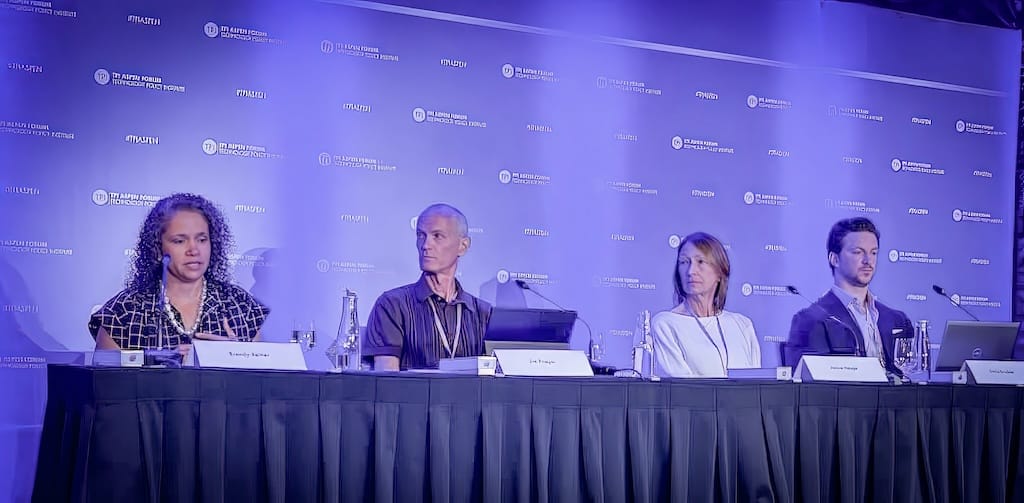
Reitter was part of a panel discussing the changes to BEAD implemented by Commerce Secretary Howard Lutnick in June. The panel included David Brodian, Chief Counsel for the National Telecommunications and Information Administration, who confirmed that NTIA had received a final BEAD application from a “state,” which he told Broadband Breakfast after the session is Louisiana.
The panel also included economists Janice Hauge from the University of North Texas, and James Prieger from Pepperdine University, both of whom praised the new changes to the program.
“I actually like the new rules,” Hauge said, going on to say that they promoted accountability, transparency, and market-based solutions. She did note her frustration with a lack of publicly available data surrounding the sharp decline in the number of BEAD-eligible locations.
Prieger expressed a similar sentiment.
“I also see it as a welcome change,” he said. “Not every government program has to try to achieve every social goal. And those that have tried to serve four masters: Climate change, diversity, and broadband expansion, you’re not gonna do them all well.”
Prieger praised BEAD’s technology neutral approach, and claimed that it would help “push broadband out to as many people as possible.”
Reitter conceded that the old BEAD program was “an exercise in some of the most bureaucratic processes I’ve ever seen in my career.”
But she also pushed back, noting that the new changes were a “top-down approach” that didn’t allow for collaboration between states and providers.
“Good public policy takes a little while,” she said. “Quick fixes, they’re quick, but it doesn’t always result in the outcomes you had intended.”
Panelists also debated the merits and drawbacks of disbursing money to all 56 states and territories simultaneously. While Prieger argued that a uniform disbursement would eliminate “needless uncertainty,” Reitter asserted that uniform deployment would result in a supply chain bottleneck.
For his part, Brodian told attendees that the revised NTIA guidance sought to lower costs, both now and in the future.
“Trying to use the right technology at the right location, not fund… very hard-to-serve locations with specific technology types which is going to raise the cost to the provider and then they’re going to have to recoup those costs later on,” he said.
“We really did not want to do that, and that’s why we were hoping to drive, with the ‘Benefit of the Bargain’ round, lower the costs and then hopefully reduce or eliminate a subsidy at a later point.”







Member discussion