Data Center Boom Strains Communities, Some Panelists Say
The issue may have already hardened into a defining political issue of 2026.

WASHINGTON, May 15, 2026 – Virginia’s Loudon County, the largest data center market in the world, has become the focal point of the backlash against AI-driven deployment, panelists demonstrated during a Broadband Breakfast Live Online event Wednesday.
The issue may have already hardened into a defining political issue of 2026.
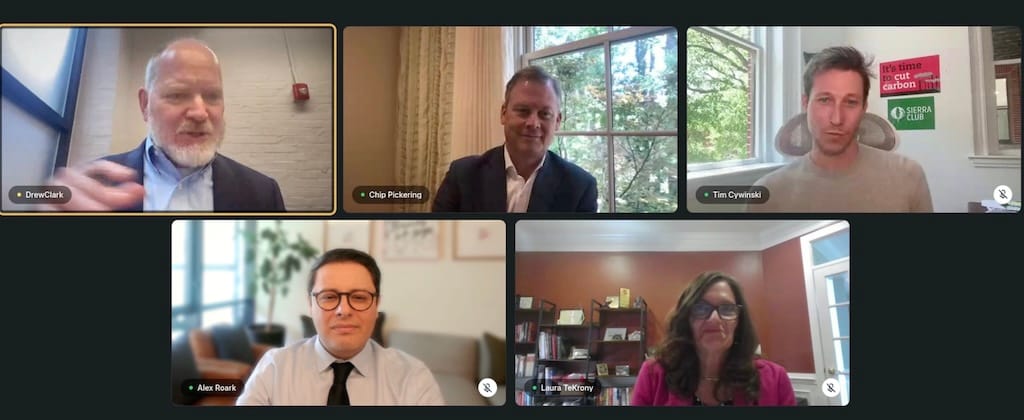
The leader of one environmental group said public approval in Virginia has collapsed from 62 percent unconcerned to a 23 percent approval rating. That was according to Tim Cywinski, communications director for the Sierra Club Virginia chapter, and who spoke on Wednesday.
 Tim Cywinski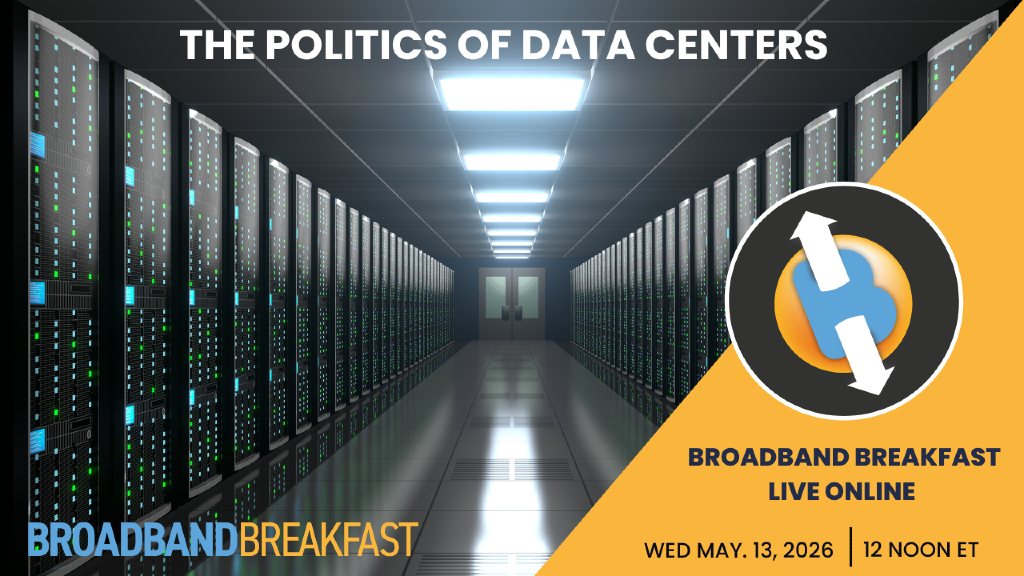
Special Offer! Become a Broadband Breakfast Club Member for only $390/year (that's $200 off) to watch all Broadband Breakfast videos. Discount continues annually.
"This isn't about technology. It's not about the politics per se of, like, left versus right. It's about who has power and who doesn't," Cywinski said, citing electric bills that have risen as much as 200 percent since 2020 and a $1.9 billion state tax break for the industry.
He said 29 of 31 Virginia data center developments under negotiations had to sign nondisclosure agreements before proceeding.
The case for the build-out
Chip Pickering, CEO of the internet and competitive network association INCOMPAS, took a different perspective, touting the benefits made available by the data center boom.
Hyperscalers including Amazon, Microsoft, Meta, Google and Oracle will invest $700 billion in data centers this year, with two-thirds flowing to rural America. He pointed to his home state of Mississippi, where roughly $60 billion in investment helped drive the second-fastest GDP growth in the nation last quarter.
"Where the internet economy may have concentrated wealth on the coast, the AI revolution is bringing new wealth, new opportunity, new education, new workforce, new jobs and tremendous infrastructure into middle America and into rural America," Pickering said.
He cited Madison County, Mississippi, where an Amazon Web Services facility pays $100 million annually in taxes, doubling the Canton School District's budget from $25 million to $50 million, he said.
Pickering argued the build-out will modernize an outdated grid through new transmission, small modular nuclear reactors and direct-to-data-center generation. He pointed to AWS investments in Entergy that he said are saving the utility and its consumers $2 billion through new capacity, and to ratepayer protection commitments his member companies made at the White House.
"Don't lose sight of what the data centers have built and given the areas like Loudoun County and Seattle and Silicon Valley and Chicago and Dallas," Pickering said, calling data centers "the new port cities" of the AI economy.
A supervisor’s perspective
But in Loudoun County, which hosts roughly 200 data centers with another 100 in the pipeline, critics are becoming louder.
Laura TeKrony, a member of the county’s Board of Supervisors, said that without guardrails, development is excessive said. Over the last 12 years, data center facilities have been approved "by right," she said.
That means no public hearings are held, and no board votes have taken place.
"Make sure they're not by right,” TeKrony urged. “Make sure they are coming into the board of supervisors or the commission, the county commission for review so that the public can have a voice and so that you can put standards on them."
TeKrony has not voted to approve a single data center since taking office in 2024. She is now focused on mitigation, requiring tree buffers, lighting controls and 500-foot setbacks from homes.
Cywinski said the industry is spending hundreds of millions of dollars to lobby Congress to strip states of the power to regulate data centers tied to AI, and to influence the 2026 midterms.
"The way we beat China and any country that's not supposed to be a democracy like ours is not just how we win in the economy, but how we treat our people," he said.
Alex Roark, CEO of the AI Policy Forum, said the value to communities must be defined by those communities, and a clear upfront process is the best way to achieve that. He noted that three executive orders from President Donald Trump positioned AI infrastructure as a national security asset, creating tension with local authority.
"We've essentially put local communities directly in conflict with a national directive," Roark said.
He urged local ordinances to set a baseline floor for any incoming project, layered with additional community benefit agreements.
That, he said, offered a more durable path than federal preemption. "If we're building a data center in our community, from my perspective, it should be integrated and aligned with the vision that community has for themselves," Roark said.
"Balance is important,” TeKrony concluded. “A balanced approach, and people's voices, do matter."