
Educational Broadband Groups Urge Senate Panel to Prioritize EdTech
The coalition’s letter advocates for technology use in schools to improve future job prospects and educational advancement.

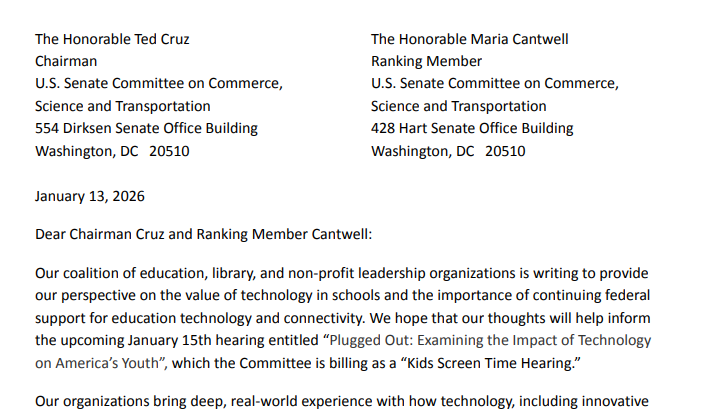
WASHINGTON, Jan. 14, 2026 – In advance of a scheduled Thursday’s hearing on the impact of technology on America's youth, a coalition of education, library, and broadband nonprofits sent a letter to the Senate Commerce Committee in support of “carefully curated” technology use.
The hearing is scheduled for Thursday, Jan 15 at 10 a.m., and will feature testimony from Jean Twenge, a psychology professor from San Diego State University, Jared Cooney , from LME Global, Emily Cherkin, the author of The Screentime Consultant and Jenny Radesky, associate professor of pediatrics and the University of Michigan Medical School.
The letter by the Schools, Health and Libraries Broadband Coalition, the Consortium for School Networking, and others, emphasized that broadband access is foundational to both teaching and learning. Reliable, high-speed internet enables schools to connect students with digital instructional resources, and maintain essential administrative functions and safety systems they said.
The groups said broadband access also plays a critical role outside the classroom: The letter highlights research from the Quello Center on Media & Information Policy noting that students who don’t have access to the internet or just have access through a cell phone often perform lower on a wide range of metrics including homework completion, GPAs, and are less likely to obtain a college or university degree.
The Thursday hearing, which is titled “Plugged Out: Examining the Impact of Technology on America’s Youth,” follows bipartisan legislation introduced by committee chairman Sen. Ted Cruz, R-Texas, and Sen. Brian Schatz, D-Hawaii, entitled The Kids off Social Media Act, or KOSMA.
It also follows a statement National Telecommunications and Information Administration Director Arielle Roth that the agency has turned a critical eye on education tech by beginning a review of technology use in schools, including federal broadband spending on educational technology.
If enacted, the law would set a minimum age of 13 for social media use and require companies to remove algorithmic feeds for users under 17, according to the bill.
The letter attempted to differentiate “largely unsupervised entertainment-driven technology at home” and “intentional, monitored” use in schools noting that digital tools need to be utilized to support future labor force and higher education preparedness.
“Because technology is now integral to the environments in which students live and learn, a school’s focus must be on intentional implementation rather than assumptions about ‘more’ or ‘less’ technology,” the letter states.
Coalition letter advocates against broad technology bans
The coalition’s letter advocates against broad bans against technology, and advocates for decisions about education devices, classroom technology, and screen-use practices to remain in the hands of local educators and their families who best understand their own students’ needs.
The groups cite research underscoring the positive impact of technology on student learning.
A 2021 Institute of Education Sciences report found that the vast majority of public schools surveyed said digital tools help students engage more actively in learning (93%), become more independent (92%), learn at their own pace (90%), think critically (85%), and collaborate with peers (83%).
“Effective learning depends on selecting the right tools to support specific instructional goals. Fragmented or inconsistent implementation, not technology itself, is what overwhelms teachers and families,” the letter states.
The coalition includes dozens of national education, library, and broadband organizations, including associations of schools superintendents, education service agencies, the American Federation of Teachers, the American Library Association, the National Educational Associations, and the Benton Institute.






Member discussion