Exclusive Q&A With Chairman Brendan Carr

President Trump has 'really sort of fundamentally transformed the direction of D.C., and I think it's fabulous to see,' said Carr.
Exclusive Q&A With Chairman Brendan Carr
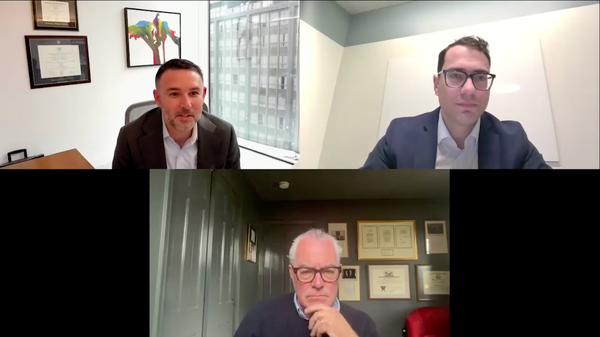
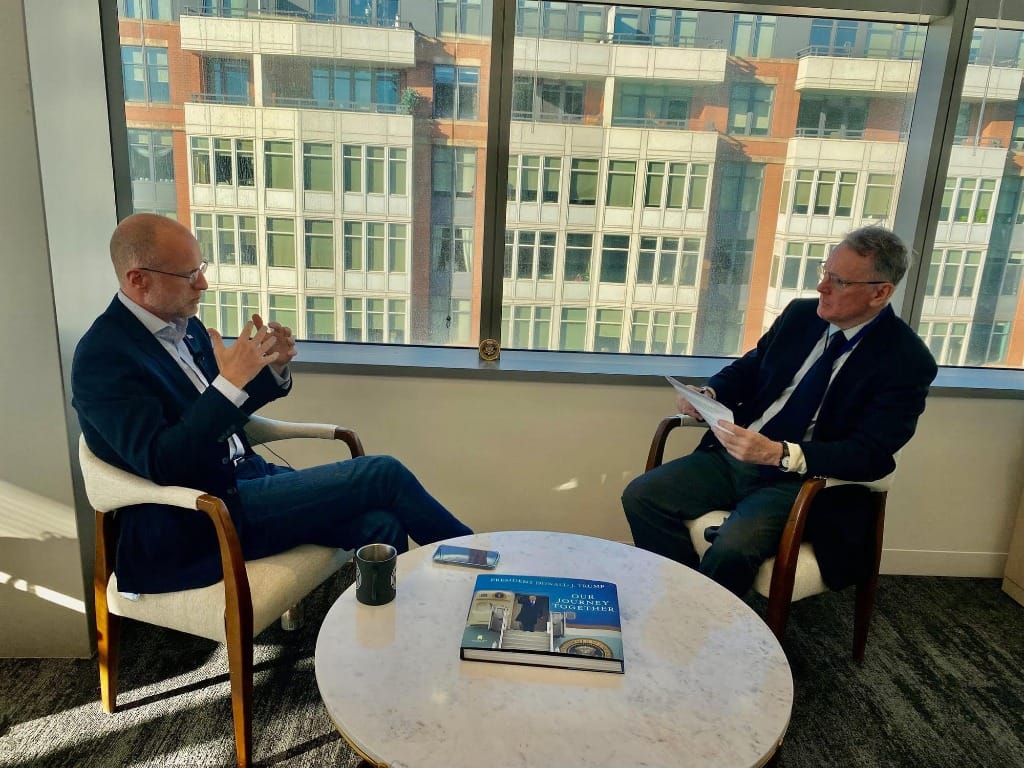
Federal Communications Commission Chairman Brendan Carr (left) and Ted Hearn

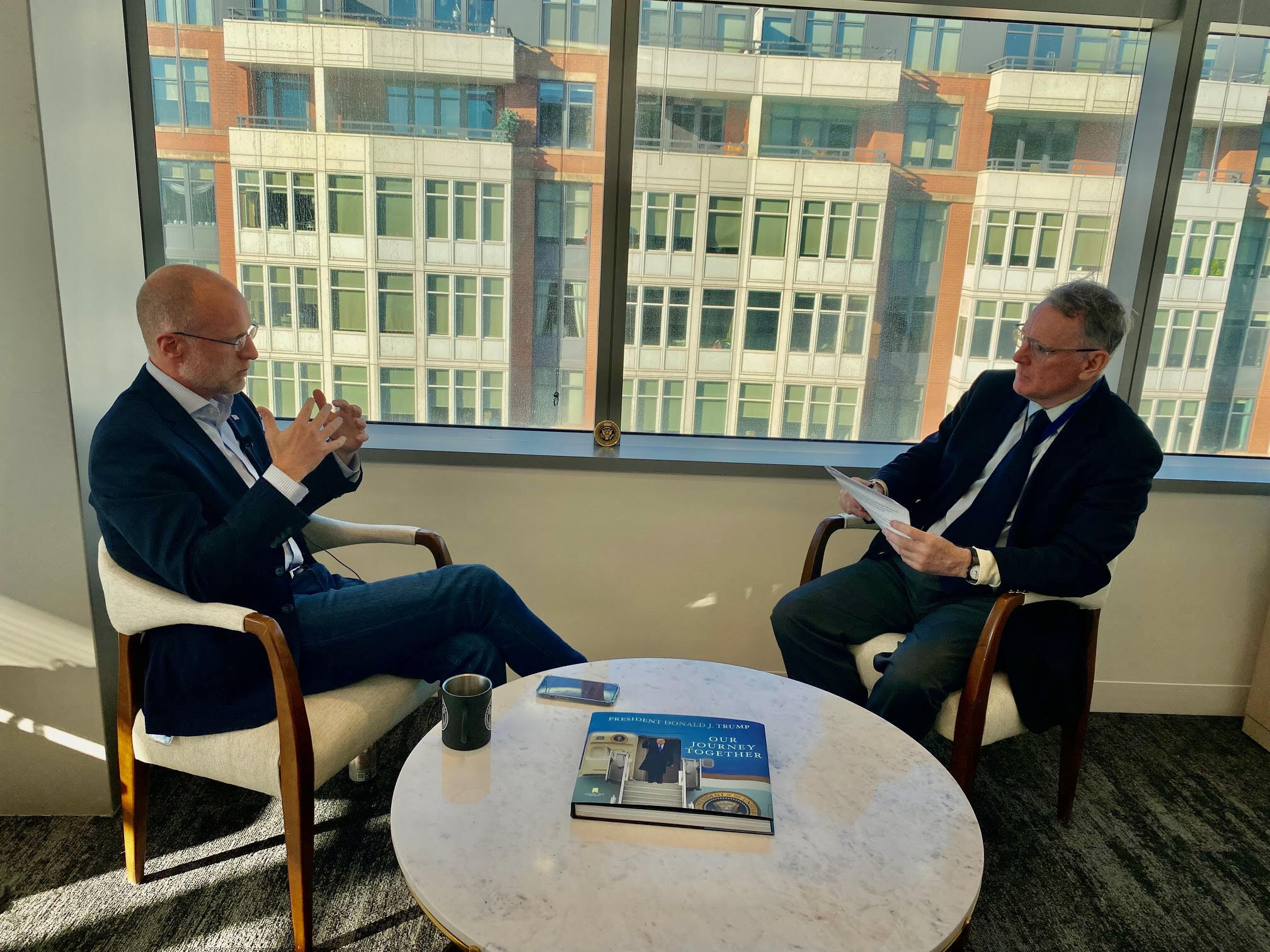
On Feb. 21, 2025, Federal Communications Commission Chairman Brendan Carr sat for an interview with Broadband Breakfast Managing Editor Ted Hearn. The interview occurred in Carr’s 10th floor office in the FCC’s headquarters building in Washington, D.C., near Union Station and Capitol Hill. The following is a transcript of their conversation.
Exclusive Q&A With Chairman Brendan Carr

On Feb. 21, 2025, Federal Communications Commission Chairman Brendan Carr sat for an interview with Broadband Breakfast Managing Editor Ted Hearn. The interview occurred in Carr’s 10th floor office in the FCC’s headquarters building in Washington, D.C., near Union Station and Capitol Hill. The following is a transcript of their conversation.
Available to Breakfast Club Members

Broadband Breakfast: Is there anything on your mind that you want to discuss?

Carr: We are roughly four weeks into this. We're having an absolute blast, really enjoying it. We've come out of the box really quickly with a lot of initiatives. President Trump, I think, has really set the tone. He came in and issued a lot of Executive Orders. Most people come in and they think they can turn the ship a government one degree here, two degrees there. That's the most that they shoot for. But he's really sort of fundamentally transformed the direction of D.C., and I think it's fabulous to see.

Since the election, I've been down to Palm Beach/Mar-a-Lago probably four or five times and the president's always in a great mood.

Right now, I think everybody across government is really executing in ways that the president intended based on the picks that he's made.

I think if you step back and just look at the country in general, it really feels like this wet blanket has been lifted and there's just so much optimism right now.

I really do feel like we're entering this golden age for the country.

And I think you're going to see it, whether it's free speech coming back, whether you're seeing it with sort of the economic future looking even brighter.

I think President Trump has come in and really set us on a really marvelous track, but it's been great to spend time with him.

Like I said, I got four or five times down there on visits with him and it's been really great.

Broadband Breakfast: The people who want you to revoke the TV license of Fox 29 in Philadelphia are some of the same people who say you’re a threat to the First Amendment. What's wrong with that picture?

Carr: Well, look, it's interesting. So, the last week that FCC Chairwoman [Jessica] Rosenworcel was in office, she dismissed four petitions. One had to do with Fox, and then one each on CBS, ABC and NBC.

What I did when I came in was restore the complaints to their prior status with respect to ABC, CBS and NBC.

With the Fox one in particular, that was one where the FCC had already sought public comment and had a record on it and only dismissed it after doing so. With respect to these other three, the FCC had never even bothered to seek public comment on.

So with the CBS one, we've now put that one out for public comment, and what I can guarantee everybody is that they're going to get a fair shake from this FCC.

It's sort of an odd posture to have some people pushing hard for the FCC to revoke Fox's license and then have serious issues with the FCC applying the exact same precedent that they pushed for in an even-handed manner.

And what I can tell you is that we'll give everybody a fair shake, and I think that's a departure from where a lot of President Biden's policies went. If your last name was Musk, then the government in my view was really weaponized against you, whether it was revoking this $800 million dollar award that they got, whether it was this cavalcade of investigations into Elon Musk's operations. On the other side of the coin, if your last name was Soros, you got unprecedented, streamlined shortcut treatment from the FCC. And so we were coming out of an era in which there was massive weaponization under the Biden administration. People that were politically allied got special treatment and shortcuts, and people that were perceived by the administration to not be aligned with them were given disfavored treatment.

And what I've said is we are returning to an even-handed treatment for everybody and the people that politically were benefiting from the weaponization of the government now feel like they're getting discriminated against when the reality is they're just getting even-handed treatment.

Broadband Breakfast: Put another way, the people who cheered Twitter and Facebook’s censorship of the New York Post’s Hunter Biden laptop story two weeks before the 2020 election are some of the same people who say you’re a threat to the First Amendment, because you want to know if NPR and PBS are selling ads in violation of federal law. Again, what's wrong with that picture?

Carr: Well, look, it's pretty ironic. I mean, at the end of the day, what we're doing with the PBS and the NPR investigation is … all broadcasters are differently situated because they've got a license to operate and they're supposed to operate in the public interest.

NPR and PBS are differently situated doubly so, because they not only have that obligation, but they need to operate as non-commercial stations. And there have been concerns that have been raised that what they call underwriting in sponsorship identification potentially crosses the line into advertisements and the FCC is in the process of launching investigations.

We are preparing additional investigatory materials. I don't think I've spoken with that yet, but we're preparing additional investigatory materials to look at the individual NPR and PBS stations to make sure that the materials they are running there are, in fact, underwriting and sponsorships and not crossing the line into commercialization.

But look, there is also a broader debate in Congress right now about whether taxpayers should continue to be forced to fund NPR and PBS.

And at this point, I've not seen a very compelling reason that that should continue.

In fact, a week or so ago, Sheryl Crow publicized that she was selling her Tesla and was going to take the proceeds to donate and subsidize NPR. And to me, I think that's not a terrible idea. Let's do ‘Cars for NPR.’ If celebrities care so much about that programming and they want to donate their cars to support it, that's great. But why should everyday taxpayers that don't necessarily listen to it be compelled to subsidize it?

So again, everyone's going to get sort of even-handed application and treatment. But it's sort of setting back toward where we started. I think it's been interesting the first 30 or so days here. One of the things that's important to me is to spend time in the building. One of the things that we started right away, and this is consistent with President Trump's direction, is return to work. We've been working heavily on that.

The FCC is a 10 story building, and every day I try to walk at least two floors of the FCC and that lets me cover the whole building at least once a week. And when I walk around, I bump into folks that work here and they offer ideas to me, and there's already been a couple instances where they've raised some small thing that would never ordinarily filter its way up, and we've been able to act on it.

For instance, I'll give you an example, we publicize our items that we're going to vote on at the meeting three weeks ahead of time.

Years ago, when this process was started, the decision was made that we should put those meeting items, those release items, in the actual docket associated with the proceeding but it just never happened.

And I was walking the floor and ran into [Office of General Counsel] lawyer [who said] “Hey, this was supposed to happen four or five years ago. It never did. Could you look into it?” We came back, looked into it, and now we have our meeting items in there and it's a process.

So walking the floor is an important thing and hearing directly from the line attorneys, the employees that do this, is an important thing to me, and it's already helping to improve our decisions.

Broadband Breakfast: Some are saying the Carr FCC is “weaponizing” government against major First Amendment actors like ABC, NBC, CBS, PBS, NPR, Comcast, and Disney. Why are they wrong?

Carr: Well, they're wrong for a lot of reasons, including, as I articulated, we're simply applying the FCC's case law and precedents. These were the exact same cases and precedents that the Biden FCC pushed hard, whether it was in the Fox context or in the context of the FCC's regulation of the use of AI in political speech. The FCC said very clearly – I was in the minority at the time – that the FCC's licensing authority allows it to look at issues, including misinformation.

And that was a decision that the Democrats on the FCC made to breathe new life into 1960s case law about the FCC's role was respect to licensed broadcast. And my position is that the FCC operates by case law [and] operates by precedent.

That was the decision that Democrats made, and we're just going to continue to apply the precedents that they put forward.

Broadband Breakfast: Can you discuss specific steps in mind to rein in the Big Tech censorship cartel under Section 230? Mark Zuckerberg seemed to say, “Guilty as charged, Chairman Carr.” Did you see the inquiry on this launched [Feb. 20] by FTC Chairman Andrew Ferguson? Is that perhaps a roadmap for the FCC?

Carr: Let me pick up the last piece of that prior question as well. You talked about this concern about weaponization. One thing that I've been very clear about with my vision with respect to media regulation is there's a lot of distrust right now in media, but that distrust is not uniformly distributed.

And what I mean by that is think about the media landscape in two pieces. On the one hand, you've got sort of the national programmers. That's ABC, CBS and NBC. There's a lot of lack of trust there, and that's just not my personal view. You look at Jeff Bezos – he did an Op-Ed where he said trust in national news media is absolutely at its lowest point in decades.

But there's the other side of that coin, which is the local broadcast stations. Those are the ones that actually have the public interest obligation. And in fact, studies show that they are really trusted by their local communities.

And so what I'm articulating here as a vision is to think about the media landscape in two pieces, the national programmers and the local broadcasters, and I am wanting an agenda to empower those local broadcasters to actually and truly serve their local communities.

A lot of time, there's this programming that is originating in Hollywood or New York that gets pushed down and out through these local broadcasters, but I want to empower them to do their job.

With respect to the Zuckerberg issue, Zuckerberg wrote a letter last year, which I call his mea culpa letter, where he effectively comes out and says, “Yeah, of course, the Biden administration was pressuring us to censor posts.”

That confirms something that a lot of us knew for a long time. The last three or four years in particular we saw this massive surge in censorship and too many in Silicon Valley played a role in carrying that out.

But the censorship cartel is broad and deep. It's a lot of features. One, you had companies just individually making decisions to censor the free speech of individual Americans. Two, you had the government pressuring companies to do this, and this is what Zuckerberg was talking about. Three, you have this cohort of advertising and marketing entities that work together to effectively demonetize platforms and speech that's disfavored. And so I'm going to attack this across all of the vectors.

I think Section 230 reform is something that is very much on the table at the FCC. I've been pushing hard at different features of the censorship cartel, which is whether it's NewsGuard, which I have more work to do on that front, but they are part of the tip of the spear of the censorship cartel.

And I think Chairman Ferguson at the FTC is doing a tremendous job. I applaud him for launching this proceeding, and I look forward to working together with him because we have to smash this censorship cartel into a billion pieces and ensure that it can never be put back together again.

And this is actually part of an economic agenda. When you censor words, you're censoring ideas, and when you censor ideas, you stifle innovation. And so we are going to unleash and unlock tremendous economic growth in this country, but promoting free speech is a part of that.

Broadband Breakfast: How far does a community notes approach now embraced by X and Meta/Facebook go toward addressing your concerns about politically biased content moderation?

Carr: I think it helps. There's something that the First Amendment got fundamentally right, which is if you centralize in one place, the decision-making authority about what can be said or what can't be said, you are going to end up with a lot of mistakes. That's because people are either fallible or they're biased. And so my thought on free speech is not that everyone has to be compelled to see or hear and listen to something that they don't want to. I think we need to distribute the decisionmaking authority down into the participants of the digital town square. Rather than having Facebook or Google or officials at X make the decision of what you're allowed to see, let's empower the participants in the town square.

If you don't want to see something, you can mute it, you can block it, you can unfollow. But just like if you have a systemwide decision being made at Google HQ or Facebook HQ, and they get it wrong, there's massive consequences.

Just look at the Hunter Biden laptop story, look at the COVID origin story.

There's all kinds of examples where censorship imposed very clear, real world harm.

I think community notes is on the right track. I'm glad that Facebook is starting to approach it, but I think we've got to put that power in the hands of individual participants. Don't let it be centralized in a corporation.

Broadband Breakfast: The big news [last] week [was] President Trump's Executive Orders that mentioned the FCC by name. What is your take on all this?

Carr: We’re going to follow the executive orders that were issued by the President. As I've long said, I want to make sure that I understand 100% President Trump's agenda and at the FCC we’re focused on a number of top priorities.

It's reining in Big Tech. It's going to be looking at media issues, including reinvigorating the public interest, and it's going to be a whole set of economic issues from more spectrum to permitting reform to the space economy where we have to go much faster at the FCC, and we are doing it and we will. And then four, it's going to be national security.

And I think those priorities feed into and line up with the exact types of priorities that President Trump is articulating.

But the FCC is actually somewhat differently situated than some other regulatory agencies.

For instance, the Communications Act was passed before Humphrey's Executor [v. U.S. (1935)] was passed by the Supreme Court, which is part of this debate about the unitary theory of the executive.

The Communications Act, for instance, does not include for-cause removal protection of FCC Commissioners because in 1934, Congress didn't think it could constitutionally restrict the president's authority to remove a commissioner.

When you look at sort of the indicia traditionally of independent agencies, one of the things you look at is, does the agency have for-cause removal protection? The FCC doesn't.

But at the end of the day, we're aligned with the policies set forth in President Trump's Executive Order.

Broadband Breakfast: Is DOGE going to audit the FCC or has it already? Isn’t a big piece of the FCC's budget staff salaries, meaning there's not a whole lot to audit?

Carr: Driving more efficiency out of the FCC is going to be one of the top priorities that I do. We are putting together our own DOGE group. I do anticipate the DOGE group itself, whether Big Balls is a part or not I don't know, will ultimately work with us at the FCC and we would welcome the expertise that they have.

The FCC does have a lot of staff who work on some of those issues, but the FCC also has a tremendous number of contracts, and right now we’re doing a soup-to-nuts review of the multimillion dollar contracts that the FCC has, and we're going to be taking a DOGE-style pencil to all of those contracts.

I'm confident there is a lot of fat at the FCC that will be able to trim.

Broadband Breakfast: Do you know how many FCC employees accepted the buyout and can you tell us the number or percentage?

Carr: My understanding is that there's information out there about the average percentage across agencies and the FCC's number is consistent with some of the averages that have been out there.

Broadband Breakfast: Justice Kavanaugh said Loper Bright was a course correction and do not overread it. He said if Congress provides the FCC with a broad grant of authority, courts will need to respect that. Do you agree? Do you have concerns that Loper Bright might frustrate your policy goals?

Carr: Fundamentally, what Loper Bright does is it returns decisionmaking authority to where the framers and the Constitution put it, which is in Congress.

Under Chevron, it was a pretty odd outcome, which is to say, in the context of any litigation against the government, the litigant – which is usually a private party or business – is on a level playing field with the other person as to what a law means or a statute means.

Chevron tilted the playing field very heavily in favor of the government, meaning even if you had the sort of the better reading of a statute, a court would rule against you, if the agency put forward a reasonable interpretation of the statute.

And so after Loper Bright, administrative agencies and individuals or businesses will be on a much more level playing field when it comes to disputes that go into courts.

There are times when there's things that I will want to do that I will have a harder time prevailing in court under Loper Bright than I would have under Chevron, but I'm totally comfortable with that because I think that's how the Constitution put it.

It also net-net, you look at the sweep of history of agencies, in the main they are engaging in regulation, or, I would argue, overregulation. And so Loper Bright is going to make it harder, relatively speaking, than it was under Chevron for agencies to successfully defend regulations.

But because in the main, the lion’s share of decisions over the course of history from agencies is too regulatory in my perspective, it's net-net a good outcome.

Are there cases where I think I'm right that I'm going to end up losing under Loper Bright that I might have won under Chevron? There's going to be some of those and that's just the way it goes.

Broadband Breakfast: It’s clear that the Sixth Circuit has vindicated your strong opposition to the heavy-handed Title II Net Neutrality regime embraced by the Biden administration. What are the next steps legally for the FCC and perhaps DOJ?

Carr: I think Net Neutrality has long been a solution in search of a problem. And particularly under the Biden administration, they imposed these heavy-handed, outdated regulations that made no sense in the context of the modern Internet ecosystem.

The biggest threat to Internet freedom over the last couple of years is not a Mom-and-Pop ISP in Iowa that needs the federal government to crack down on them with Title II regulations, it’s been the edge providers.

It's been Google, it's been historically Facebook. And so this entire effort was a distraction from where the real problem in the Internet ecosystem was. It was censorship.

In terms of next steps, there's been a petition for reconsideration filed by the people that liked the Biden-era rules and that'll be heard by the court and we'll see where we go from there at the FCC. But in the main, it was really a resounding loss for the backers of Title II.

Broadband Breakfast: Anything you can say about FCC's posture now vis-a-vi the digital discrimination case in the courts?

Carr: That case is working its way to the court system and we'll see what the court says on the merits there and then we'll make our decision how to proceed after that.

Broadband Breakfast: If the Supreme Court affirms the Fifth Circuit on the USF funding mechanism, what in your view should happen next?

Carr: Look, we're going to see what the court says, the exact scope of its reasoning and the steps we take will depend on that. When you step back more broadly, we got a lot of funding streams going right now to ensure universal service. We got the $42 billion BEAD program, which is being run by Commerce Secretary [Howard] Lutnick.

We've got, ultimately, I think the biggest long-term thing we need to do is rationalize all these programs. There was GAO report from a couple of years ago that said we have something like 115 separate broadband funding programs spread across dozens of different agencies. We’ve got to find a better way to sort of coordinate that.

Broadband Breakfast: If Congress needs to rewrite a USF statute, would you see that as an opportunity to make Big Tech contribute?

Carr: Look, again, when it comes to that particular case, we're just going have to wait and see what the court says.

Broadband Breakfast: Do you support a methodology that says something like if fiber costs more than $4,000 per location, states need to find a less-expensive technology. Do you think Starlink can handle all of BEAD's unserved locations?

Carr: As a starting point, I defer to Commerce Secretary Lutnick, who was recently confirmed in the position, to make the decisions on the future of BEAD. I'm happy to offer my thoughts to him on that. But sort of not looking forward, which I think is sort of purely in his view, and I don't want to step on his sort of jurisdiction there to make those decisions.

But if you look backward looking, what I've talked a lot during the Biden administration years was the Biden administration made a tremendous number of missteps along the way on BEAD – a $42 billion program, signature initiative from Biden to connect millions of Americans to high speed Internet, and after more than a thousand days, not only did they not get a single person connected, but they didn't even turn a single shovel’s worth of dirt.

And they got totally wrapped around the DEI axle and using the program to push for a lot of progressive policy goals. So, again, I defer to Lutnick and what he does, I'll back him on it. But I think at a bare minimum, you got to strip out a lot of that promotion of DEI and the woke policies that got embedded in.

I do think there needs to be a robust role, whether it’s BEAD or other programs, for Starlink. They can deliver high-speed connectivity for pennies on the dollar years ahead of time. And it's a shame that the Biden administration, in my view for political reasons, gave the Heisman to Starlink. The real loser there were the families that were stuck on the wrong side that digital divide longer than necessary.

Broadband Breakfast: Do you expect to call a vote soon on the proposal on automatic 60-day unlocking of all new mobile phones or something close to that?

Carr: We haven't made a decision on how to proceed that one yet.

Broadband Breakfast: Can the FCC raise or abolish the 39% TV station cap, or does it take Congress?

Carr: The FCC Republicans and Democrats alike have supported the position that the FCC has authority to raise the cap.

Broadband Breakfast: Is there a timeline for potentially relaxing local TV ownership rules?

Carr: No set timeline. Look, I do think that we're at an interesting time. Again, when you think about my approach to media regulation, which is to separate in people's minds the national programmers from the local stations, we need to make sure that the economics work for those local broadcast TV stations.

And I'm very open-minded to taking a look at local ownership restrictions in addition to the national cap issue that you mentioned.

Broadband Breakfast: Do you support classifying YouTube TV and the other virtual MVPDs as Title VI cable operators?

Carr: There's sort of an active debate and conversation with respect to vMVPDs. Most often directly what has come up is not full application of the cable statute to them, but what's come up most often is whether local affiliates should have the right to negotiate for retrans[mission consent] with respect to virtual MVPDs.

Up to now, that has been a right that has been sort of taken by the network. At this point, I haven't made a decision on that, but I'm open-minded to hearing from different people on how we should proceed. I don't think full application of the cable statute to virtual MVPDs is a point that's been pushed much, but the idea that we should take sort of the retrans[mission] negotiation right and ensure that local affiliates have that is an issue that's been pushed, but I haven't made a decision on it.

Broadband Breakfast: How do you view the conflict or war that's broken out between those who want licensed spectrum with those desirous of some kind of sharing regime. How difficult a problem is this for you?

Carr: Chairman [Ted] Cruz has really been leading on this issue, and he and his team have done a tremendous amount of work on their spectrum pipeline bill. The reality is this: Demand for mobile traffic is increasing like a hockey stick – growth over the next couple of years is expected to increase 250% [and] 500% percent over another set of years beyond that. And that hockey stick only gets steeper when you think about AI and AR and VR.

So, spectrum is a finite natural resource, and we have to have enough of it to make sure that all that mobile data traffic can get carried, because leadership and spectrum is key to our geopolitical leadership, it's key to national security, it's key to economic security. When you free up spectrum, that grows GDP, it creates jobs and it allows for competition like fixed wireless. The more spectrum you have, the more competition you have in the fixed wireless market, which necessarily drives down prices.

More spectrum is a great issue for easing the pain at consumers’ wallet. It's a deflationary step. And so I think Sen. Cruz has been doing some great work there.

Broadband Breakfast: Is DEI to you a proxy for racial and political-orientation quotas in the hiring and promotion practices of industries regulated by the FCC? To you, does DEI mean something like white conservative males need not apply? Where does DEI violate civil rights laws or the FCC's EEO rules?

Carr: There are certain activities that take place under the rubric of DEI. And I define those as invidious forms of DEI discrimination. And there are these forms of invidious DEI discrimination that, in my view, would pretty clearly violate the FCC's EEO rules.

We've taken a couple actions on DEI. One, on basically the first day that I became Chairman, I announced, following President Trump's leadership on this issue in an executive order, that we were ending the FCC's promotion of DEI. People would be shocked if they learned how much promoting DEI had been embedded into the work of the FCC. We were spending millions and millions of dollars, the FCC promoting DEI.

The FCC listed promotion of DEI as our second-highest strategic priority. We're supposed to be working to connect people, modernized media regulations, but we had DEI up there. So we've ended the FCC's promotion of DEI.

And I have taken a step beyond that. President Trump also asked, through an Executive Order, for agencies to end DEI in the sectors that they regulate.

So, I've started with Comcast. I wrote a letter to Brian Roberts, where I said I was concerned that some of the DEI activities that they're still carrying out, with the advertisement on the website, may run afoul of the FCC's EEO obligations.

We've launched a full investigation into Comcast, and we're getting more information from them about their DEI programs and DEI policies. And if they're doing that in a way that violates the EEO rules, then that's going to be a problem.

And what I've also said is that if there's anyone coming through the FCC right now that wants us to approve a transaction, we can only approve a deal at the FCC if we find that it serves the public interest.

And so what I've said is I would encourage anybody that's trying to get a transaction through the FCC right now to move with all deliberate speed to identify any invidious forms of DEI discrimination that their company has been promoting and end it immediately.

Broadband Breakfast: Could you give me an example of an invidious form of discrimination? Would it be a strict racial quota in hiring?

Carr: That could be an example. Our EEO rules are very clear about non-discrimination, so if someone is taking an immutable trait or characteristic and using that against somebody, that's something that we're going to look at through our EEO rules.

Broadband Breakfast: It seems like AT&T has a terrible copper theft problem in the Dallas-Fort Worth market, and it's not alone with this problem. Can the FCC do anything in this area?

Carr: Probably not copper theft itself but it is a trend line that is concerning to see, but I guess as copper prices increase, copper thieves increase their activity.

Broadband Breakfast: In the past three years, Alaska has had three serious subsea fiber tears. One going on right now can't be addressed until late summer because of darkness and thick ice. Are you concerned that fiber might be future-proof but not Alaska-proof?

Carr: Well, Alaska is tough territory. I've been up there a couple of times, including out to Unalaska, which is about a third of the way out the Aleutian Islands.

It's where Dutch Harbor is, where we used to film the Alaska king crab fishing show. And they're actually running fiber out there. They were going to run it along the northern side of the Aleutian Island chain, but because of ice, they put it on the southern side to try to mitigate some of the effects of fiber cuts.

But whatever technology you have, there's going to be some challenges. Fiber’s a great technology, it does have some limitations, but that's why my position is we need all of the above.

So let's get a ton of fiber out there, but let's also back America's LEO satellite systems, let's get the spectrum out there for 5G. We definitely need an all-of- the-above strategy.

Broadband Breakfast: What's your policy on allowing FCC commissioners to participate in open meetings remotely. Absent an emergency, shouldn't all commissioners be present and voting?

Carr: My general approach is I'm trying to get everybody back in the building. I think COVID was sort of an exceptional time, probably was an exceptional time for too long of a time. My plan is to be there in person and if someone has a conflict, we will work with them.

Broadband Breakfast: Why is it appropriate for Commissioners to read statements aloud in multiple languages? Shouldn't it be one but not both? Is there some limiting principle?

Carr: I'm not going to touch that one.

Member discussion

Popular Tags