
Experts Clash on Online Age Verification
Does age verification endanger free speech?

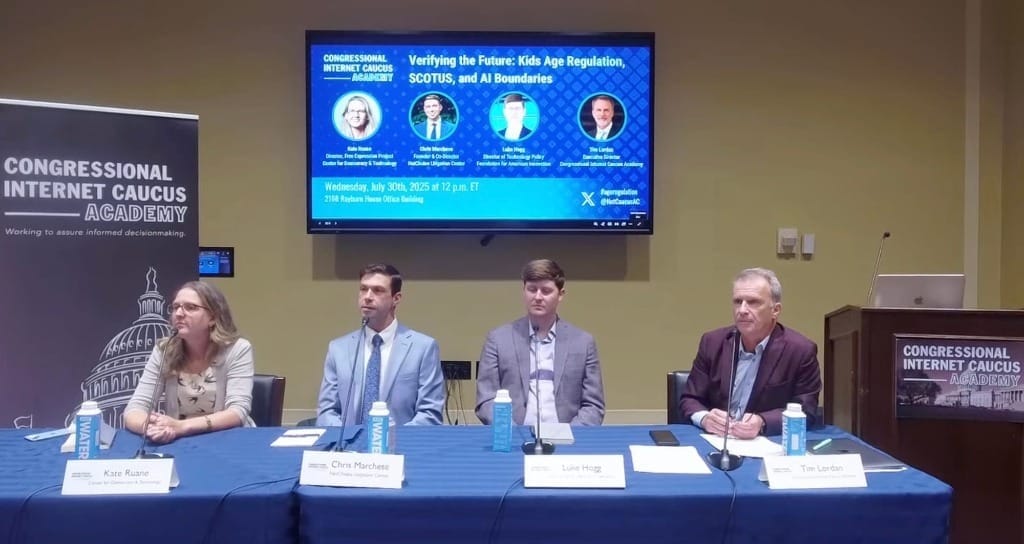
WASHINGTON, July 30, 2025 – A delicate balancing act is unfolding on Capitol Hill: safeguarding children from explicit content while defending free speech and privacy rights.
On Wednesday, the Congressional Internet Caucus Academy held a hearing to discuss age regulations and the role of artificial intelligence in the wake of the Supreme Court’s June decision in Free Speech Coalition v. Paxton. In that ruling, the Court upheld a Texas law requiring sexually explicit websites to verify the users’ age.
Some speakers warned that a broad interpretation of the ruling could endanger free speech. Kate Ruane, Director at Free Expression Project, Center for Democracy & Technology, cautioned that it could lead to censorship of constitutionally protected content.

“It includes sex education, any speech that will relate to sex speech,” Ruane stated. “The LGBTQ community, for example, I think, is at risk, and we need to be very, very, very, very, very careful about how we apply this going forward, and how we understand the scope of discussion.”
Chris Marchese, Founder & Co-Director of NetChoice Litigation Center, agreed that the ruling must be interpreted narrowly to avoid censorship.
“It has ramifications that go far beyond just trying to protect minors online,” Marchese said.
Others, like Luke Hogg, Director of Technology Policy, Foundation for American Innovation, defended the ruling, though he also emphasized the need for a narrow interpretation.
Hogg presented various age verification methods, including age gating, age estimation, and biometric-based verification–where AI analyzes a photo and then verifies the user's age.
He argued that biometric systems are both secure and effective, citing a maximum error rate of only 0.22 percent in practice. While he acknowledged that error rates are higher for people of color and LGBTQ individuals, he noted that the overall efficiency rate remains only 0.009 percent.
“I do think it is possible, I think the systems are efficacious, and I think that we can resolve the security problems,” Hogg stated.
However, Ruane and Marchese remained firm in their opposition.
Marchese pushed back on the use of biometric systems, stating that to him, it sounds more like surveillance. Instead, he called on Congress to pass a national privacy law that preempts conflicting state laws.



Member discussion