
FCC Prepares to Revisit Broadcast Ownership Rules
Chief of Staff Scott Delacourt cites recent court ruling that sets this review apart

Jericho Casper
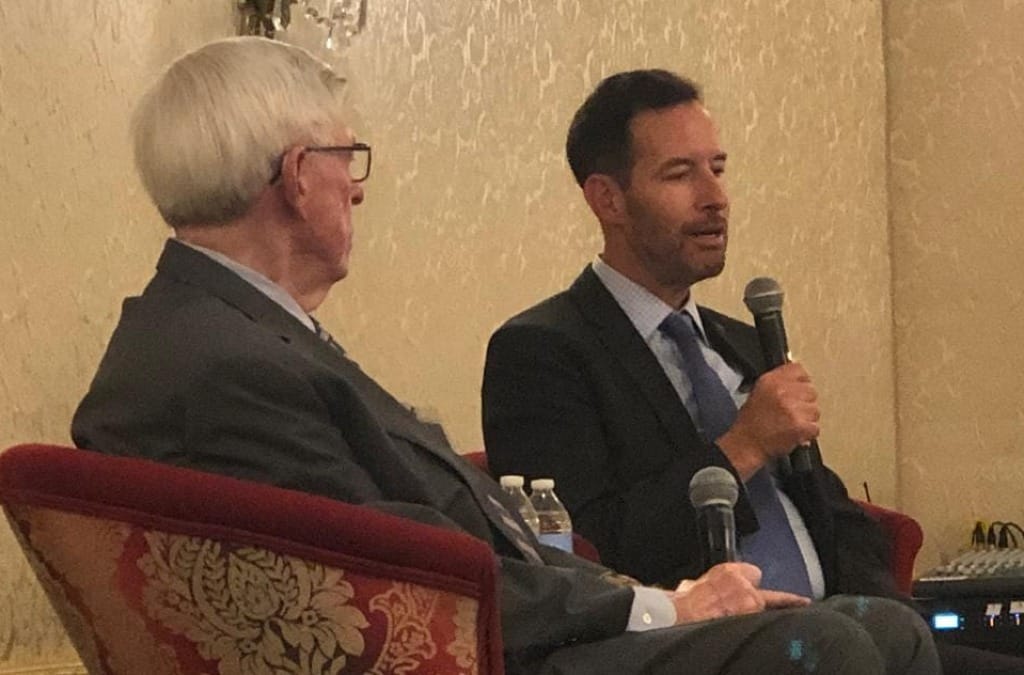
WASHINGTON, Sept. 25, 2025 – FCC Chief of Staff Scott Delacourt said Wednesday that the Federal Communications Commission’s upcoming broadcast-ownership review will be shaped by fresh legal guidance.
At its upcoming meeting on Sept. 30, the FCC will vote on a proposal to begin this year’s quadrennial review of broadcast ownership rules. The congressionally mandated proceeding considers whether local television and radio ownership limits remain “necessary in the public interest as the result of competition.”
“There are a couple things that are different this go around,” Delacourt told an audience of FCC veterans, agency officials and representatives from leading wireless and broadband trade groups at a Media Institute luncheon at the St. Regis Hotel.
He pointed to the Eighth Circuit’s July Zimmer Radio decision, which ended the FCC’s long-standing “top-four” rule, barring joint ownership of two of the four highest-rated local TV stations, and affirmed that Section 202(h) of the 1996 Telecom Act is a deregulatory mandate.
“If we determine that certain ownership rules are not necessary for competition, localism and diversity, we can get rid of those rules. We can modify them, but we can’t tighten them,” Delacourt said.
Last quadrennial review largely kept ownership rules in place
The last quadrennial review, started in 2018 and completed in December 2023 under Chairwoman Jessica Rosenworcel, largely kept existing ownership rules in place, but expanded restrictions on network affiliation swaps. Broadcasters sued, stalling the proceeding until July 2025, when the Eighth Circuit agreed in part finding the FCC had acted arbitrarily in tightening the rules.
Delacourt said the FCC’s forthcoming proposal will take up local television and radio ownership limits, which cap the number of stations one entity may control depending on market size; and the dual network rule, which prohibits any merger among the “Big Four” broadcast networks – ABC, CBS, Fox and NBC.
The national TV ownership cap, which bars a single company from reaching more than 39 percent of U.S. television households, will not be part of next week’s FCC vote. Congress explicitly carved it out of the quadrennial review process in the 2004 Consolidated Appropriations Act.
However, Delacourt noted that the FCC recently “refreshed the record” on the rule, asking whether the cap still makes sense in a marketplace reshaped by streaming and online video.
“Does the cap limit broadcasters as they're competing with new services and video offered by big tech? What's the impact of the cap on the relationship between affiliates and networks?” Delacourt rattled off questions from the notice.
Uncertainty whether the FCC will revisit the 39 percent cap
He acknowledged uncertainty over whether the FCC could revisit the 39 percent cap, noting that Congress explicitly directed the agency to adopt that figure in 2004.
“Overhanging all that is the question of the FCC’s authority to change the ownership cap,” he said. “That's kind of an open issue, and whatever we do is likely to be litigated.”
He pointed to shifts in the media marketplace as a fresh reason to revisit ownership limits.
“Over time we’re seeing new voices enter the space,” Delacourt said, citing the rise of streaming services, satellite operators and online video platforms. “Of course, they compete for the same advertising dollars as broadcast media does.”
Delacourt joined the FCC from Wiley Rein, where served as partner and chaired the firm’s wireless practice.
He previously served in leadership positions at the FCC, including deputy bureau chief and chief of staff of the Wireless Bureau, senior counsel in the Office of the General Counsel, and legal advisor to the Wireless Bureau chief.
In his current role, he manages Chairman Brendan Carr’s policy agenda, including deregulatory proceedings like the ‘Delete, Delete, Delete’ docket and the FCC’s ‘Build’ initiative. Carr maintains a separate chief of staff for his own office.



Member discussion